


There is still no law in Ukraine that clearly regulates real estate agent activity. Under such conditions, new players keep appearing on the market of services related to the sale and rental of real estate — not always honest. As a result, there are frequent cases when people, having paid money for finding housing, are left with nothing. This is exactly the situation a young displaced woman from Kherson found herself in.
Sofia is an orphan. Until she reached adulthood she had a guardian — her grandmother. She lived with her in Kherson. But due to constant Russian shelling and drone attacks the young woman left the frontline city. For a while she stayed in Odesa, but later moved to Lviv. A childhood friend lives here, also among the Kherson displaced. Sofia quickly found a job, getting a position as a waitress at one of the local cafes. All that remained was to find an apartment in Lviv — she planned to rent it together with that same friend.
Where to look for an apartment in an unfamiliar city? The girls turned to Google — the search engine immediately returned a website with a list of apartment offers for rent in Lviv. They started looking at those with photos. They were interested in a neat studio apartment located not on the outskirts, in an area with a convenient transport connection. They immediately dialed the phone number in the ad. In response they heard that the offer was current, the apartment is rented through a “real estate” agency and that they needed to come to the office where they would be given the owner’s contacts. The girls were warned right away: they themselves would not find the way to the “realtors”, they should approach one of the shops in the city center, near the opera house, and call the “realtors” — someone would come to meet them. That’s what happened. A polite young man introduced himself: “I’m from the realtors.” He led the girls into the building of one of the banks, where everyone got into an elevator and went up to the top floor. Then — an office, with about 10 people inside, a working atmosphere. The friends were met by a young woman who introduced herself as a “realtor”, but her name was not Maryana, who had spoken on the phone earlier. The girls showed a screenshot from the website — they needed that specific apartment. The response was: yes, of course, no problem!
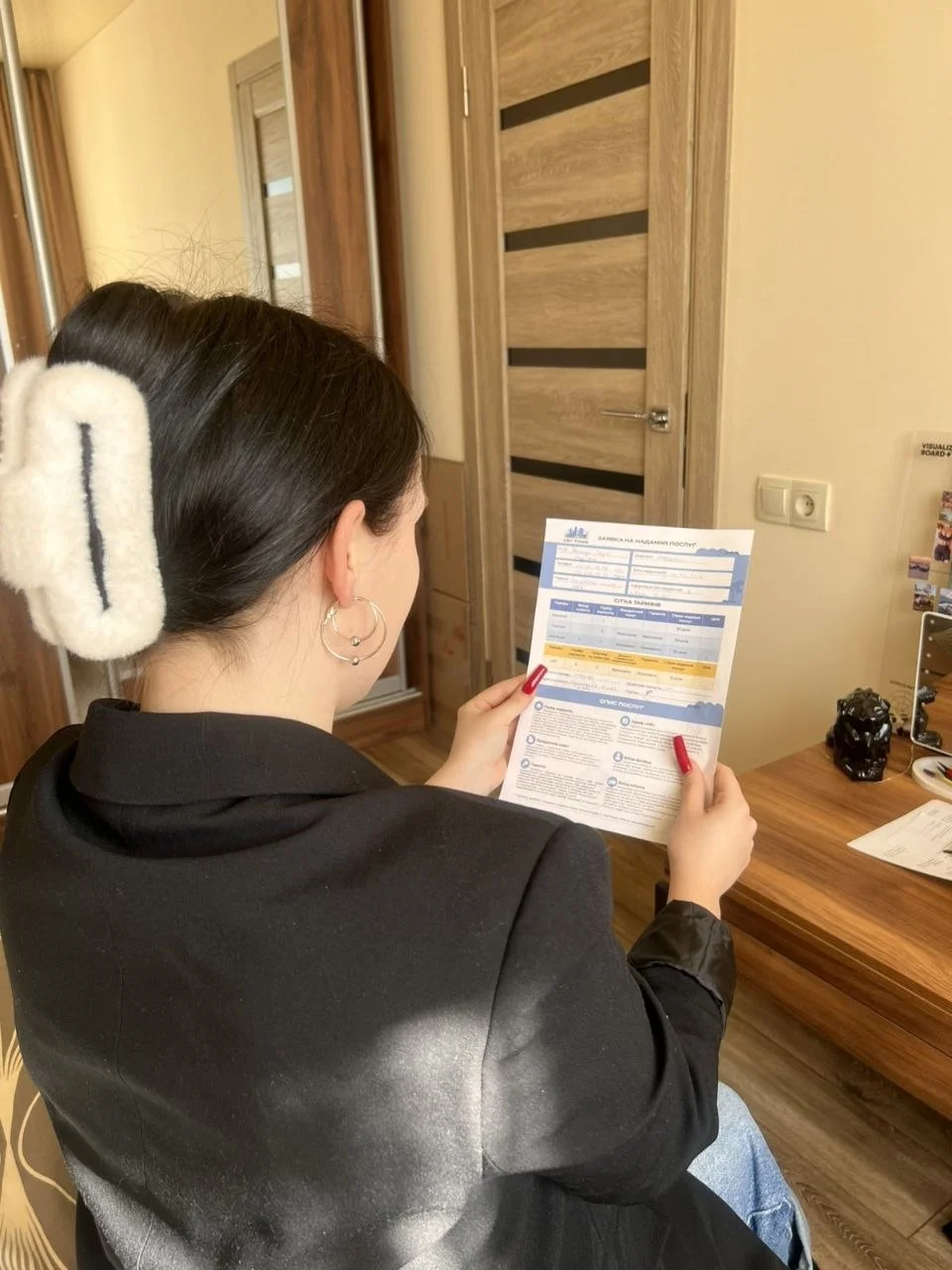
Next came the terms of cooperation with the agency. To obtain the address of the chosen apartment one of the girls had to sign a contract on the spot. There was a clause in it that the friends did not pay attention to.
“And they say: for our work we take 100% of the amount of the monthly cost of this apartment. And that’s 13 thousand hryvnias. We planned to move in that very evening, so we didn’t think twice. I was given the contract, to be honest, I didn’t really read it. We gave them the money we had brought with us. It was paid through an iBox using certain details by one of the office employees. Almost immediately a receipt was sent to my phone — the operation was successful. Well, I said, can we go see the apartment?” — recalls Sofia.
The expression on the face of the “realtor” sitting next to the girls suddenly changed — she looked surprised: “Oh, but this apartment has already been rented…”. The girls did not hide their irritation: how could it be rented if a few minutes earlier it was available?
“I said: how can that be? We agreed! We came to you with the money! They said: “Well then we’ll find you some other apartment”. I said: no, we wanted this one, then let’s immediately terminate the contract I just signed, you return the funds and we part ways. And they tell me: “No, we cannot do that, but we can ‘freeze’ our contract”, — Sofia told.
The girls left the office without money and without housing. Later they tried again to contact the “realtors”, hoping to resolve the situation. In response they heard: “No, and that’s final”. Later Sofia received a message on Viber:
“Dear client! Your application has been reviewed and a decision has been made to partially refund the amount of 2000 UAH. We offer you to arrange with the rental department during working hours a date for the refund of funds or you may suspend the provision of services, which gives you the opportunity to use our services free of charge for 6 months. Sincerely, company “KEY TOWN”.
The girls contacted the hotline of the NGO “City of Strength”, which implements the free legal aid project “Justice and Resilience: expanding legal aid and support for youth in war-affected Kherson”. The lawyer who took on the case immediately asked to send all related materials. It turned out that the contract Sofia signed contained no contact details of the real estate agency. The document only has the “KEY TOWN” logo and a stamp — “FOP Shchegelska Kateryna Olehivna”. At the same time the text, in small print, states that Belek O.I. acts on behalf of the sole proprietor on the basis of a power of attorney.
According to the receipt — the funds, that is, the 13,000 hryvnias the girls paid for the apartment, went to FOP Shchegelska Kateryna Olehivna. Accessing the Unified State Register of Legal Entities, the lawyer found information that this individual entrepreneur is registered in Khmelnytskyi region. Then he began to find out what this “KEY TOWN” is and how this name is connected to that sole proprietor.
“I have been working on this story since March 5, since I received the appeal. In the Unified State Register of legal entities I found an LLC ‘Key Town’ (in Ukrainian, not as in the Lviv office contract), which claims to be engaged in real estate activity. Judging by the information on the internet, it is a network that operates in Kyiv, Odesa, Dnipro, Lviv. And there would be no questions if it were an open activity. But doubts about transparency arose when I could not reach the phone number listed in the LLC’s registration data. A man answered the phone who said he had no idea what a real estate agency had to do with it, and that this was his personal phone number,” — said Anton Shevchenko, senior lawyer-analyst of the NGO “City of Strength” free legal aid project.

The lawyer also sent a letter to the email address listed as the contact inbox of LLC “Key Town”, asking what relation they have to FOP Shchegelska Kateryna Olehivna. Two weeks have passed and there is still no answer.”
In addition, Anton Shevchenko sent an attorney’s request to the email of FOP Shchegelska Kateryna Olehivna. He managed to contact the entrepreneur by phone. In response he heard: “The issue will be reviewed by our legal department, it will take up to a month”.
The girls cannot wait a month. Sofia is temporarily staying with acquaintances and has no funds for rent. Her only relative is her grandmother, who remains in Kherson and cannot help financially. Having received no answers to the requests, the lawyer prepared a lawsuit. In it Sofia asks to declare invalid the contract for the provision of services for selection, organization of viewings of housing options for rent dated 05.03.2026, concluded between her and FOP Shchegelska Kateryna Olehivna, and also — to recover from that sole proprietor 13,000 UAH, which were paid for a service not provided. The Volochysk District Court of Khmelnytskyi Oblast accepted the claim for consideration. On 23.03.2026 proceedings in the case were opened, as evidenced by the relevant court ruling.
While the material is under consideration by the court, MOST conducted its own check. We called the two numbers that Sofia and her friend had previously used to contact the “realtors”. At first no one answered. Later a woman who introduced herself as a realtor called back and asked what we were interested in. We informed her that we were preparing a piece and would like a comment regarding the situation with an 18-year-old girl in Lviv who contacted the “KEY TOWN” office, paid money, but did not receive housing. We also asked whether a company representative could speak with us. In response we heard:
“We don’t have a central office. I’ll call you back in a few minutes”.
Sooner or later the journalist received two calls from different numbers — the callers dropped the call. In open sources we found an eponymous site “KEY TOWN”, however it contains information only about activity in Kyiv. There is very little information there. Just a “database of apartments in the city”, a Kyiv address and two phone numbers. We couldn’t reach them. Assuming the journalist’s number might have been blocked, we called from another one — the result was the same. The information on the site contradicts the response of the “KEY TOWN” representative in Lviv. That is, there is no central office, but there is a website listing Kyiv contacts. At the same time, listings advertising real estate services under “KEY TOWN” appear on various services in a number of regional centers, including Lviv. There are also plenty of reviews about this service publicly available, most of them negative. For example:
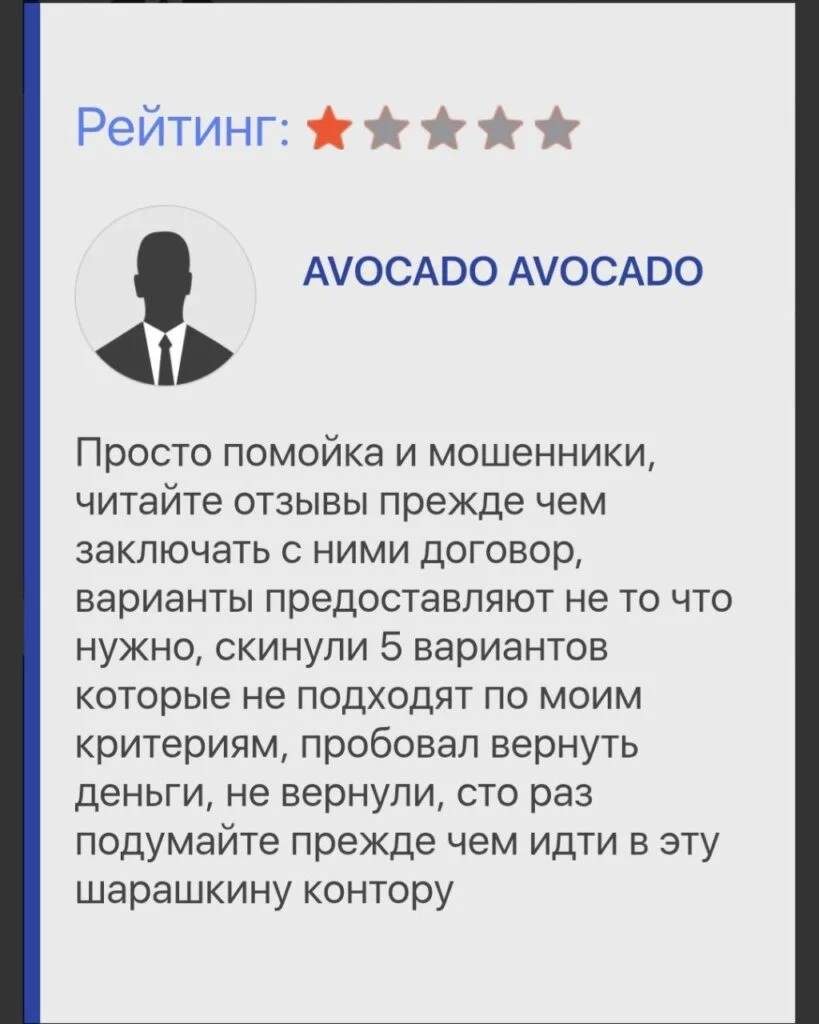
“Just a dump and scammers, read the reviews before signing a contract with them, they provide options that are not what you need, they sent 5 options that did not match my criteria. I tried to get my money back, they didn’t return it. Think a hundred times before going to this shady place” (nick AVOCADO AVOKADO).
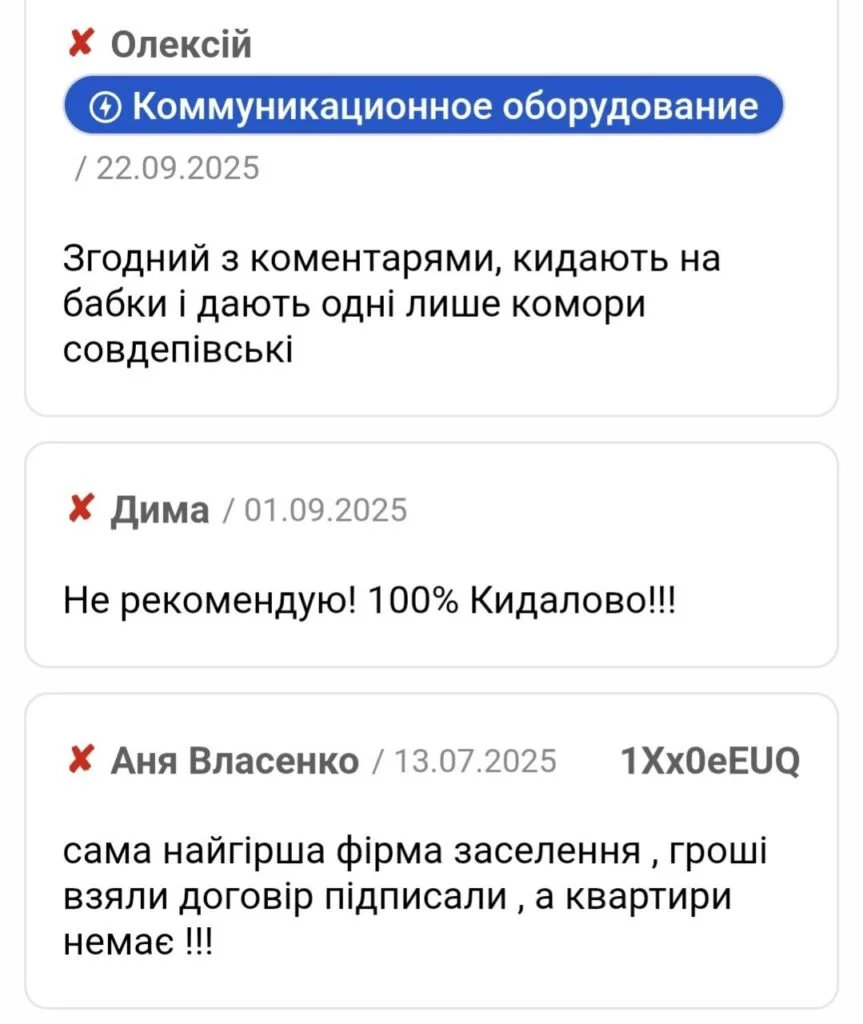
“The worst settling firm. They took the money, we signed the contract, and there’s no apartment!!!” (Anya Vlasenko).
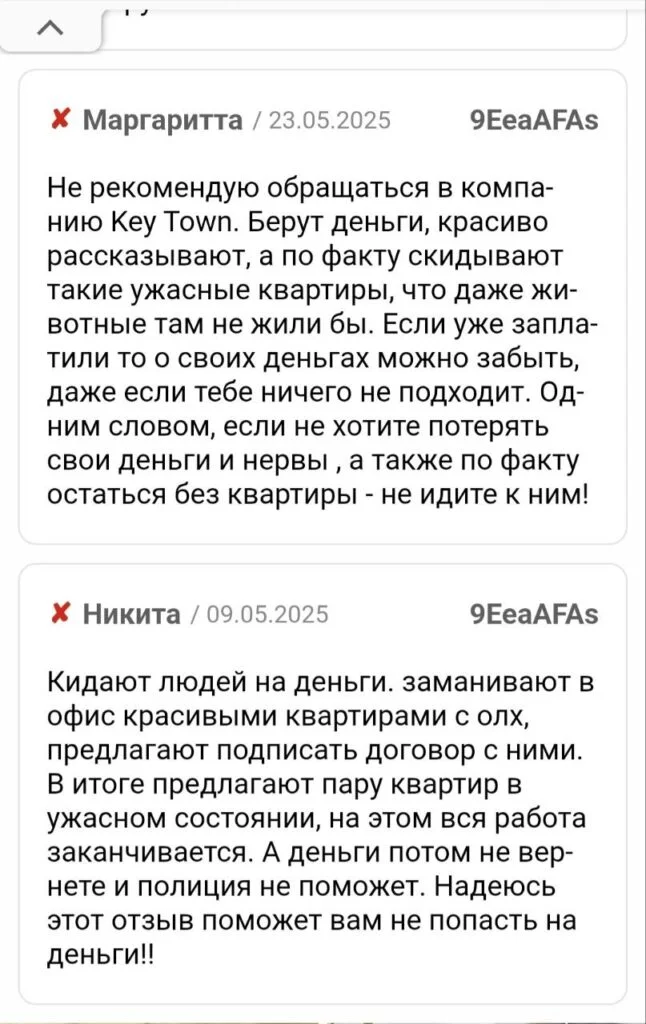
“I do not recommend contacting Key Town. They take money, tell a pretty story, and in fact they send such terrible apartments that even animals wouldn’t live there. If you’ve already paid, you can forget about your money, even if nothing suits you. In short, if you don’t want to lose your money and nerves, and in fact end up without an apartment – don’t go to them!” (Margarita).
“I do not recommend! 100% scam!!!” (Dima).
We also tried to contact FOP Shchegelska Kateryna Olehivna to get a comment on the situation, in particular to find out what relation the individual entrepreneur has to LLC “Key Town” and on what basis the sole proprietor issued a power of attorney allowing an office employee in the city center of Lviv to accept funds from people. But the FOP’s phone was not answered, and so far there has been no reply to the email the journalist sent to that FOP’s inbox.
Meanwhile Sofia and her friend received SMS messages from representatives of the Lviv office who identify themselves as “KEY TOWN”. The girls were offered 6 addresses of apartments “potential for rent”. But none of them matched the criteria the clients had voiced when they applied. Such a formal response from the “KEY TOWN” chat coincided with a statement from the attorney of the mentioned FOP, where she assures that the contract was lawfully concluded and that it is being properly executed — by sending an SMS with “options of 6 apartments”.
A court hearing of the case is ahead. While it is ongoing, the girls who paid 13,000 hryvnias for housing remain without an apartment and their money has not yet been returned. For comparison: this amount exceeds the minimum wage in Ukraine, which currently stands at 8,647 hryvnias.
To avoid ending up in a similar situation, lawyers advise carefully reading the contract, checking exactly with whom it is concluded, and not handing over money without clearly specified terms.
“In such situations the key issue is not the advertisement or the realtor’s verbal promises, but the terms of the concluded contract, which must reflect the real content of the parties’ agreement. If the contract does not contain specific terms (address, price, parameters of the housing), and is formulated as ‘general services for selection’, it actually governs other legal relations. In that case it is much more difficult to prove that the parties agreed on a specific apartment, and the paid funds are considered payment for a selection service — even if this does not meet the client’s expectations”, – says lawyer Anton Shevchenko.
Experts point out that when reading a contract, special attention should be paid to the content of the realtor’s obligations: whether the search process itself is paid for or whether it is about the result — a selected dwelling that suits the client. According to them, if realtors refuse to specify their services, the client, by signing the contract, actually agrees to terms different from what they expect.
There is still no law in Ukraine that would regulate real estate agent activity. Some participants in the real estate market take advantage of this, positioning themselves as specialists in the field.