

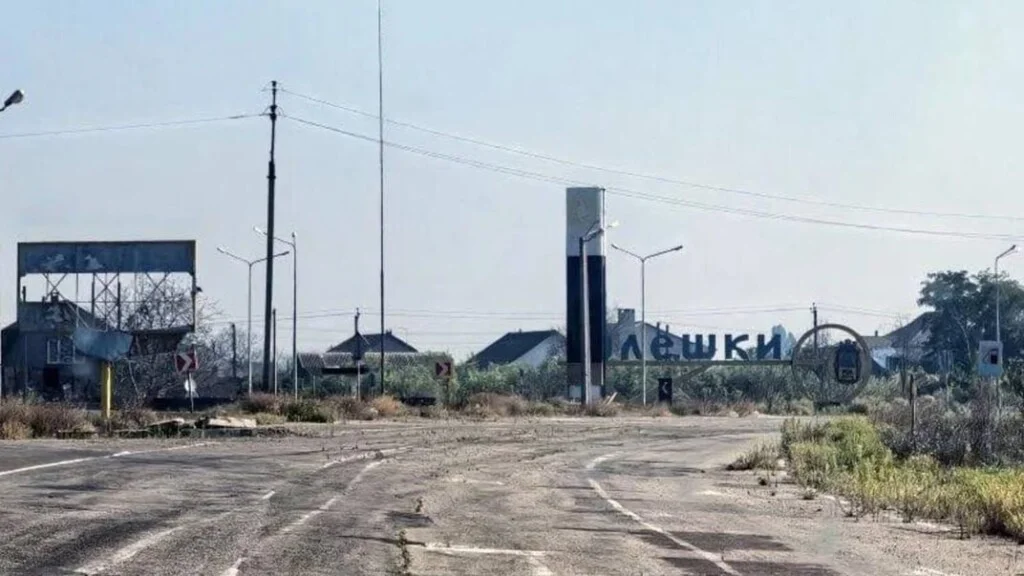
In the occupied Oleshky in the Kherson region, Russian forces have created conditions incompatible with normal life — the city is effectively under a humanitarian blockade. Civilians are left without food, water, and medical care, and attempts to leave often end in tragedy. This was reported by the Commissioner of the Verkhovna Rada for Human Rights Dmytro Lubinets and is evidenced by documented eyewitness accounts.
The team of the Charitable Foundation «Skhid SOS» conducted 10 interviews with witnesses of Russian war crimes in the city of Oleshky. Respondents’ names have been changed for security reasons; all of them have left the TOT.
- Injuries and killings of civilians
Civilians attempting to buy food become targets of Russian attacks using drones. Victoria reported the death of her mother while trying to buy provisions:
“My mother, unfortunately, died; she was treacherously killed near the shop. She tried to buy food, but there was a drone drop, not just one drone. At that time, as I was told, there were three of them. Two people died: my mother and another man, and two more were very seriously injured. This happened on March 5, at about 8 a.m. (2026 – ed.). Everything was shredded, torn apart. The body was taken to the morgue, and today is already March 11 — that is, the mother’s body has been lying in the so‑called morgue for 6 days. It’s just an ordinary building that doesn’t have any refrigerator at all, nothing. And even if it did, the city has no electricity. There are also bodies of people who died from shrapnel wounds and from a mine explosion. Father tried to ask for the body to be released for burial. But they said that an investigation is ongoing and the body will not be released.”
Russian forces carry out chaotic strikes using drones against civilian vehicles. Kateryna told of her mother’s severe injury from a Russian drone strike. After the wounds healed, the woman (her mother – ed.) left for another locality, but she is still under occupation.
“Until November 2025 my mother lived in Oleshky and was not planning to go anywhere, like most elderly people. On September 11, 2025, I received a message via a Telegram channel and through acquaintances, then phone calls, that most likely your mother was hit by a drone, her friend was killed, and she and the driver were seriously wounded, in poor condition, she is in the hospital in Oleshky. My mother began to feel better around the fourth or fifth day, when she regained consciousness, we were even able to speak with her. Yes, the left side — arm, leg, the flank — everything was shredded by shrapnel; fragments still remain in her hand. Now no one will operate on anything, she was in the hospital for a very long time, about two months.”
Iryna spoke about the Russians’ hunting of city residents using drones:
“There are people who do not want to leave because they take care of animals. It’s their last solace there, they feel it is their need. But you know, this very often happens at the cost of life. Because last year a drone simply dropped an explosive on a woman who cared for cats; she died.”
Volunteer Kseniya Arkhipova (name not changed), who left the occupied city in 2022, described the difficult situation in Oleshky. She is currently engaged in evacuating the population from the TOT. In the Telegram channel Kseniya created, people leave messages about relatives who died as a result of Russian shelling or the dire humanitarian situation. This is an incomplete list of residents the volunteer named:
“24.06.2024, death from an enemy bomb that hit a city lane, Mursky 20, Lidiya Veniaminivna died. From the strike on a shop – Larysa Malakhova, 27.02.2025. Good evening, my mother died on March 5, 2026 near the ‘Evelina’ shop, Filipova Larysa, born 07.09.[19]62, died March 5. Andriy Pastukhov blew up on a mine on 1.12.2025. During the shelling of ‘Almaz’, it was a bakery, Volodymyr Stepansky died, 2024. Died from illness, cold and lack of medical assistance in January 2026 Romanenko Mykola, 77 years old. Vdovych blew up on a mine when leaving Oleshky, died in the Skadovsk hospital on January 30, 2026. […] I have several hundred such messages; people whose relatives or friends died write these. That’s the situation in Oleshky.”
- Obstruction of evacuation from the city
Local residents are trying to leave Oleshky. However, the occupation administration deliberately creates obstacles to evacuation. Russian forces mine roads and destroy civilian cars trying to leave the city. Iryna describes the near impossibility of leaving the city:
“Last time, when volunteers wanted to evacuate people in winter, someone very much asked for an old woman and a man, someone else, the driver hit a mine because there was snow, and mines are scattered at the city exit across the city, for reasons unknown. He hit a mine, exploded, his legs were blown off, the old woman’s legs were blown off, and that driver then died the next day in intensive care. The grandmother remained alive, I don’t know what her fate is, but drones there kill people. One woman was killed by a drone, and for a month they couldn’t retrieve her body from the road. Because drones fly there, no one dared to go there. People who want to leave walk on foot to Hopriv, and Hopriv is very far. Last time the people who dared to do it — two elderly grandmothers and one man — walked 7 hours to those Hopriv to somehow save their lives.”
Kseniya Arkhipova told the foundation’s documenters about the difficulties of evacuation from the city as of March 2026:
“There are about two thousand people in Oleshky today, perhaps a bit more. There are children, there are people without documents who cannot leave, whose Ukrainian passports were lost during the flooding (as a result of the destruction of the Kakhovka HPP – ed.). They are not given Russian passports because they need to go through an identity restoration procedure. People cannot complete this procedure because it requires neighbors — three people. But the neighbors died or the neighbors left, so people cannot confirm their identity.
- Use of starvation and lack of access to medical care as a means of warfare
The city is critically short of food. Only occasionally are supplies delivered to shops in Oleshky. However, residents must queue at dawn to purchase them, Iryna says:
“And now the situation is very terrible. […] Oleshky is in complete blockade, the Russians do not deliver food, shops are not operating. One hospital is functioning, and I don’t know whether there is a pharmacy there or not.”
Another problem, according to Iryna, is high food prices. They are unaffordable for local residents. The most vulnerable groups are older people and families who have lost a stable income.
“And products in the occupation are three times more expensive. So the price, for example, for meat, if it was about 300 hryvnias in Ukraine, in the occupation is 600–700, or even 800. So they set food prices very high, and they were bringing specifically Russian products.”
Since 2022 there has been an acute shortage of medicines in the city, and those that are available are often of poor quality. The medical system is effectively non-functional due to the absence of doctors, depriving the population of the ability to receive proper medical care. Vladimir, who needed medication to recover after a heart attack, spoke about this:
“The cardiologist left in 2022. And after that I stopped going to the hospital because there was no one left to turn to. The medicines ran out within a month or a month and a half, and I stopped taking them. Some Russian medicines were sold on the market. But the market is different — it’s unclear whether they are genuine or of good quality. Moreover, I don’t know what I should take. And in general there were no medicines for serious illnesses, and it was difficult.”
- Damage to civilian infrastructure
As a result of Russian shelling that lacks military necessity, Oleshky’s civilian infrastructure has been almost completely destroyed. According to Iryna, at least one city resident died in winter due to lack of heating:
“One man froze to death this winter in his apartment, because imagine: there is no heating, it’s freezing outside, no heating, no gas, no electricity, no water, there is nothing, and I don’t know how people live there. Now we try to spread information so that this issue is considered, so that a green humanitarian corridor is provided to evacuate people, or at least to deliver food.”
In 2023 the city suffered from flooding as a result of the destruction of the Kakhovka HPP by Russian forces, which is discussed in a separate material by the CF «Skhid SOS». Above all, one of the most acute problems was the lack of access to clean drinking water. The city experienced a shortage of humanitarian aid. At the same time, the Russian side obstructed evacuation from the flooded city.
This is how Kseniya Arkhipova describes the humanitarian situation in Oleshky as a result of the enemy shelling:
“After the flood there is no electricity, no water, no gas in Oleshky. People have already sawn all the firewood, all the trees around, they heat themselves like that, building some kind of makeshift stoves.”
- Persecution and illegal detention of civilians
The city has also recorded cases of persecution of civilians, their enforced disappearances and abductions by Russian security forces. People disappear without a trace, and relatives are left with no information about their fate or whereabouts. The occupation administration provides no explanations or official information, which only amplifies the atmosphere of fear and uncertainty among the population. Hanna reported the disappearance of her husband:
“From the moment my husband disappeared, I went everywhere – filed reports, and my mother‑in‑law, while she was still in the city, appealed to the occupiers’ appointed gauleiter Zhuravka Heorhiy Volodymyrovych. He then looked at her statement, saw the name and told her that he had seen his name in the daily reports, and there it was marked that he had been arrested by counterintelligence for evacuating people from the city. After some time they told her not to look for him, that he would return soon, don’t worry, he would be released soon, everything would be clarified and he would be released. Well, and almost three years have passed since that moment.”
Documented testimonies as evidence of violations of international law by the Russian army in the TOT
Documented testimonies indicate systemic violations of the occupying state’s international legal obligations to protect the civilian population. At the same time, pursuant to Article 55 of the Fourth Geneva Convention, the occupying power is obliged to ensure the population of a temporarily occupied territory is supplied with food and medical supplies in the event of insufficient local resources.
Pursuant to Article 17 of the Fourth Geneva Convention, parties to an armed conflict are obliged to conclude arrangements for the evacuation from besieged or encircled areas of the wounded and sick, elderly persons, children and expectant mothers. In addition, Article 49 of the same Convention provides that the occupying power must not leave civilian persons in areas that are exposed to particular danger as a result of military operations.