


Almost four years a part of Kherson region has been under Russian occupation, and residents of left-bank Kherson live under constant and growing informational influence and pressure from the Russians and their local proxies, from whom the occupation authorities were formed. This pressure is applied directly — through terror, and also softly — through networks of pro-Russian print and online media, messengers and social networks. To this should be added intense pressure on owners of satellite dishes and a virtually total control over the internet and its significant restriction.
Taken together, this is gradually turning the Ukrainian region into a mirror world. And the further it goes — the more noticeable.
Overall situation
It is extremely difficult to fully study the media landscape of the temporarily occupied part of Kherson region, since access to a significant portion of the information channels used by the Russian side to spread its own narratives is limited. Primarily this concerns television and radio broadcasting. In the right-bank part of the region, notably in Kherson, the signal of the occupying Russian television is not detected, and FM radio stations can only be received episodically — under favorable weather conditions or in certain locations.
Therefore, the analysis of the media situation in the temporarily occupied territories of Kherson region is based exclusively on those sources to which there is actual access, in particular on open online resources and the administrative documents of the occupation administrations.
As before, the main part of the work of Russian propagandists is concentrated on the print press and television. The occupiers continued the publication of a number of seized Ukrainian local district newspapers, which became mouthpieces of propaganda. The most widely circulated, aside from the regional “Naddnipryanska Pravda”, are “Kazovska Zorya”, “Chornomorets”, “Holoprystanskyi Visnyk” and “Oleshkivskyi Visnyk”. From everything it is clear that the occupiers concentrated their main efforts on these resources, although they simultaneously continue to develop the digital direction, in particular Telegram channels.
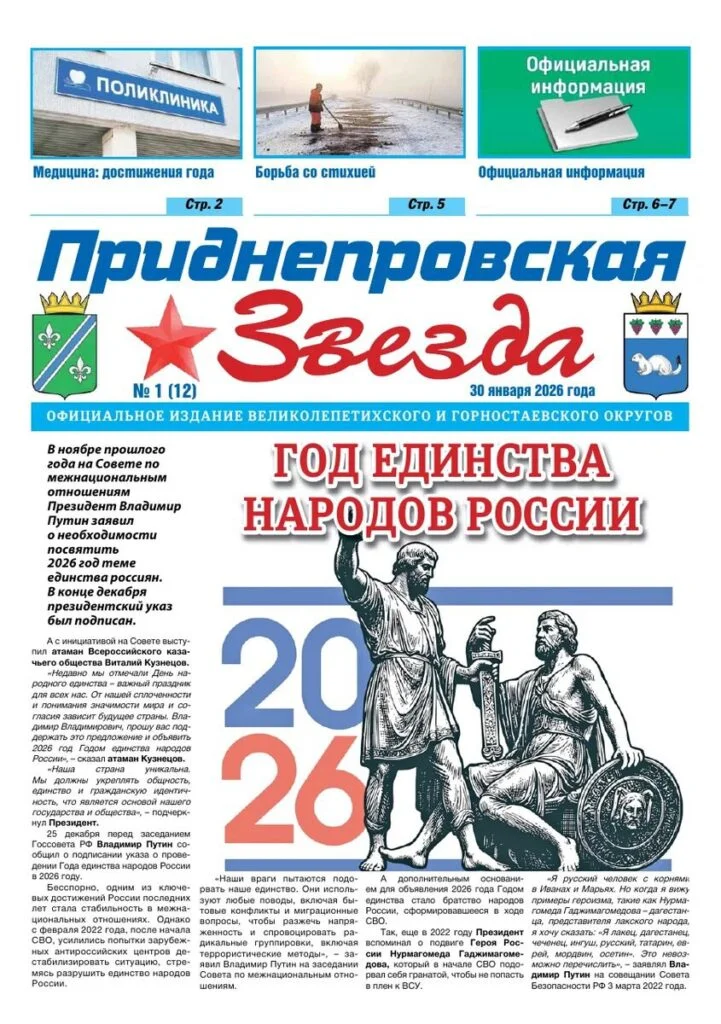
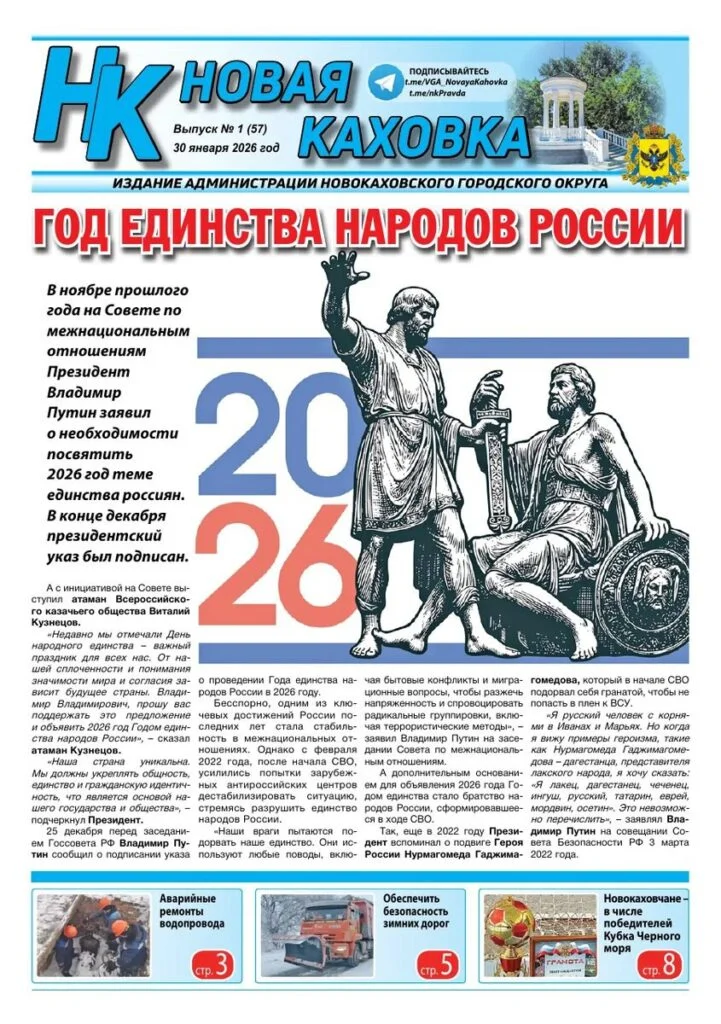
Newspapers are identical — covers like from the same mold. Photo: screenshot from the PDF versions of the newspapers
To this should be added the intensified fight against satellite dishes capable of receiving the signal of Ukrainian TV channels. It continued throughout 2025 and, obviously, will continue in 2026. The occupiers and their local proxies have repeatedly stated the importance of combating “gorynychs” — what the Russians call satellite dishes because of their characteristic three receiving heads.
The dismantled antennas are replaced by Russian ones that broadcast exclusively the “Russkiy Mir” package. Currently “Russkiy Mir” broadcasts in the temporarily occupied territories up to 20 Russian federal channels, 9 regional — the so-called “LNR” and “DNR”, as well as those of Crimea, Kherson and Zaporizhzhia, and up to 12 entertainment channels. Among them — “1st Respublikanskyi”, “OPLOT”, “Union” (the so‑called “DNR”), “Perviy Krymskiy”, “Crimea 24”, “STV” (Sevastopol), “Luhansk-24” (the so‑called “LNR”), “Dom Kino”, “Pobeda”, “ZaTV” (Melitopol), “Tavriya” (Kherson), “Semeinoye Kino”, “Krepkoe Kino”, “Mirovoy Serial”, “Nashe Rodnoe Kino”, “Muzhskoy Serial”, “Romanticheskiy Serial”, “Planeta Deti”, “Nashe Detstvo”, “Sovetskoe Rodnoe”, “Kino Plus”.
At the same time, residents of the TOT have to pay for the entertainment package. Currently the Russians have stopped publishing the relevant figures, so we do not have statistics on dismantled equipment. Free installation of “Russkiy Mir” kits was planned to be completed by November 2025.
The Russians are no less actively promoting their own messenger MAX, which they plan to replace Telegram with. This Russian messenger, developed by VK at the initiative of the Kremlin and released in 2025, is being pushed to be installed by all Russians and residents of the TOT. The app, according to the Russian leadership’s design, is used for communication, government services, payments and verification, and since September 2025 it is mandatory to install on devices in the Russian Federation and on the occupied territories of Ukraine. The app does not have end-to-end encryption and transmits data to the security services.
However, it is difficult to assess its popularity, since the messenger is closed to users outside the RF, which makes a full study of the channels impossible.
Budgets for propaganda are increasing
In 2026 the Russians plan to increase funding for propagandist organizations created during 2022–2025. For 2026, in the budget of left-bank Kherson region the occupiers allocated over 590 million rubles (approximately $7.76 million) for the maintenance and activities of the information and propaganda structures under their control. This is the sum included in the occupation budget of Kherson region, which the occupation regional Duma supported in December 2025.
These figures are indicated in the budget of the occupied region, however they may still change — as happened in 2024 and 2025, when the amounts were increased based on the results of half-year budget execution. Earlier we wrote that in 2025 in the temporarily occupied part of Kherson region 426 million rubles (approximately $5.4 million at the 2025 exchange rate) were allocated for propaganda.

At the same time, spending on the main budget holders either remained at last year’s level or increased. As last year, the TV and radio company “Tavriya” will receive 90.9 million rubles. It is still far from the record 2024, when 330 million rubles were planned to be spent on occupation television, however these funds are sufficient for the functioning of one of the key mouthpieces of Russian propaganda in the region.
The budget of the “Information Center of Kherson Region”, which centrally publishes occupation newspapers for the entire TOT of Kherson region, was significantly increased — from 105 million to 290 million rubles.
In addition, funds for propagandist activities in the TOT of Kherson region were distributed as follows:
• 49.7 million rubles — ANO “Kherson Telecom”;
• 21 million rubles — “Center for Social Communications”;
• 18 million rubles — “Center for Social Advertising”.
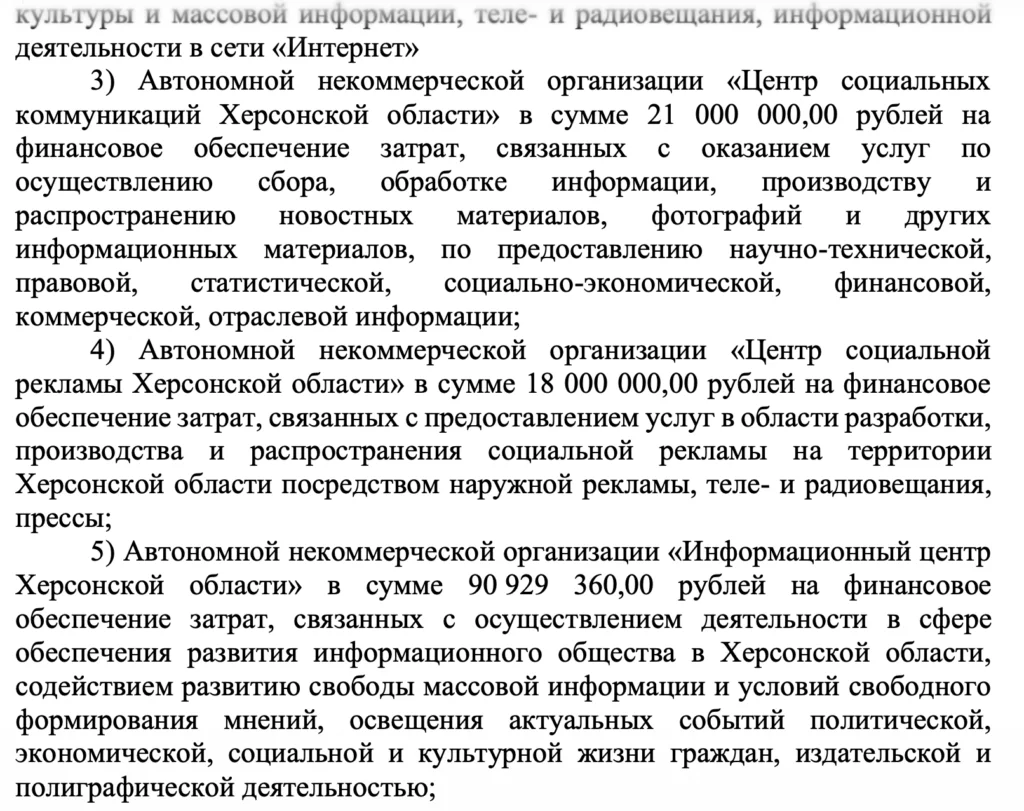
Of these three structures, last year only the Center for Social Advertising of Kherson region was financed from the “propaganda budget” — 35 million rubles were spent on it. What exactly “Kherson Telecom” and the “Center for Social Communications” do within the propaganda structure on the TOT is currently difficult to say.
In addition, the Russians planned 64.3 million rubles for the “Youth Center ‘Patriot’”, and another 60 million for the pro-Russian organization “Young Guard of United Russia”. A year ago, these two structures were allocated 51 and 60 million rubles respectively.
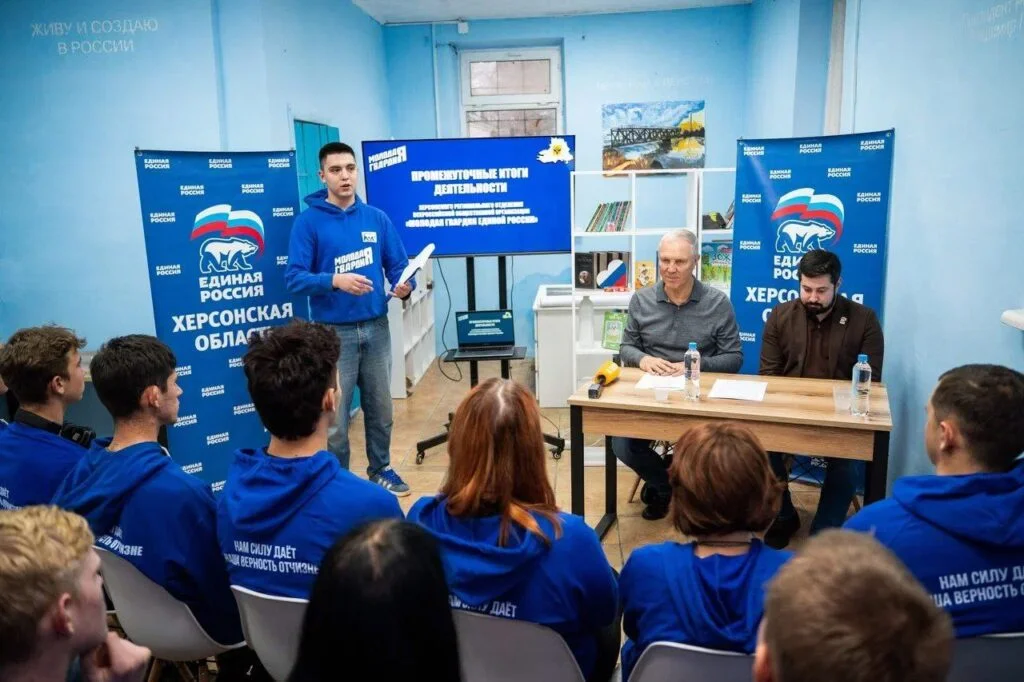
Unfortunately, it is currently impossible to see the programs under which the Russians plan to spend these funds — the occupation authorities hide this information. In 2026 Russia is systematically increasing funding for propaganda in the TOT of Kherson region, making it one of its budgetary priorities. This indicates an intention to strengthen informational control and influence over the region’s population.
What has changed?
It is difficult for an outside observer to notice significant changes in the enemy’s propaganda in the TOT of Kherson region. The usual routine remains: distribution of newspapers, broadcasting of TV and radio signals, running thousands of Telegram channels. At the same time, Kherson journalists who daily monitor life under occupation note certain trends.
“Telegram channels and occupation online media in 2025 became more oppositional to the local occupation authorities. There are many truly oppositional channels that publish critical materials. Such materials have increased, and the audience of these media has grown,” says journalist of the Center for Journalistic Investigations Oleg Baturin.
According to his observations, ordinary people have begun to comment on such channels more actively. The documents they publish are genuine and often expose the machinations of local collaborators.
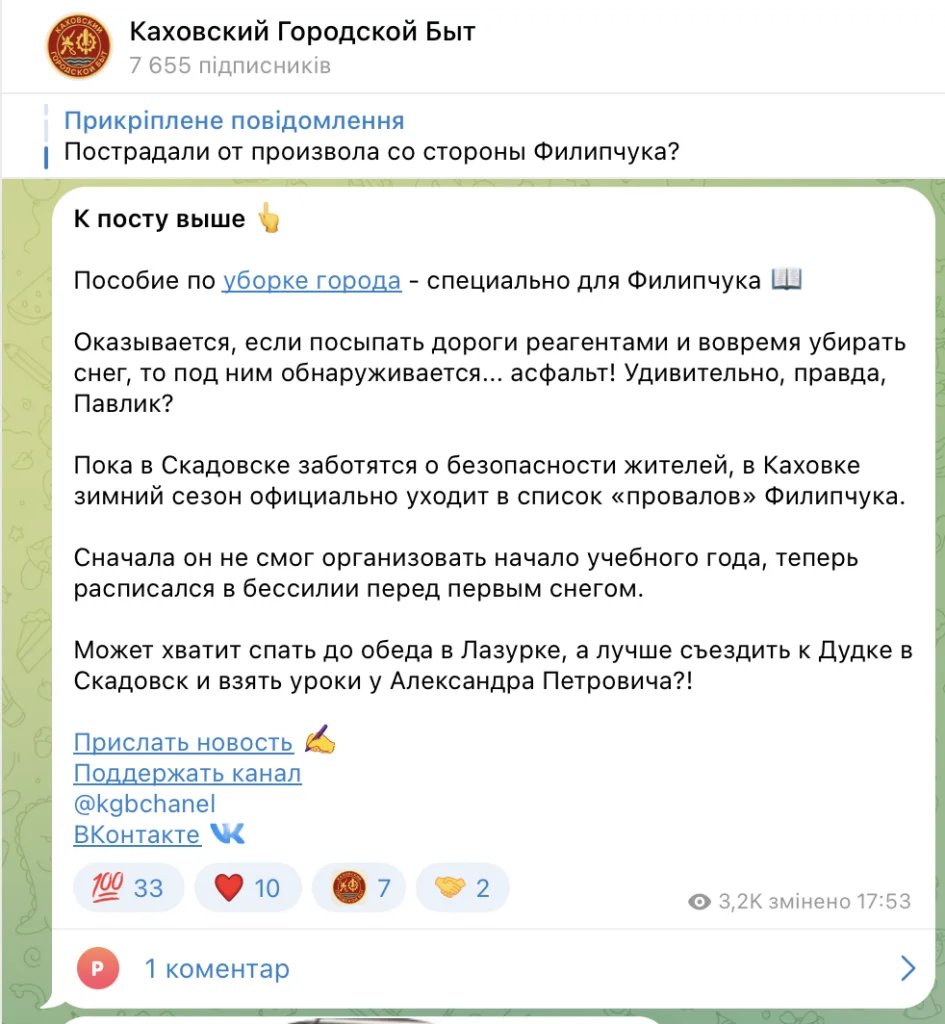
This trend is also noted by MOST journalists, who have repeatedly used these materials in their own investigations.
“I suspect that people find this more interesting to read than the boring officialdom in the Soviet style characteristic of the official occupation administrations,” Baturin believes.
According to MOST journalist Margarita Dotsenko, there has been significantly more video content and podcasts in the occupation media.
“I think this is related to the opening of the new ‘Tavriya’ studio. They make videos on a wide range of topics — reports, interviews, separate programs. Essentially, they understand what is popular now and implement it, but all this content is saturated with propaganda. If it is a podcast — then the conversation is about how everything is bad in the West, and in Russia everything is wonderful, because they have a great president. And so in almost everything,” she says.
At the same time, journalists note negative trends as well.
“In my opinion, the ‘Tavriya’ TV channel has deteriorated over time, becoming more primitive. Maybe they improved something technically after launching the new studio, but from the standpoint of journalistic work — a complete failure. This is probably related to a staffing crisis. Media workers from the RF do not stay there for long, and there are almost no local personnel. Moreover, media collaborators from Kherson region are trying to leave for Russia, and some have already left,” says Vyacheslav Husakov, who monitors the situation in the TOT of Kherson region.
There have been no substantial changes in the printed media of the TOT, although there have been personnel reshuffles. In September 2025 the Russians unexpectedly replaced Yevhen Belyi in the position of editor-in-chief of the occupation newspapers. Since 2024, newspapers that previously had their own editorial offices have been united under one “roof”. The publisher of the occupation newspapers is the illegally created “Information Center of Kherson Region”, headed by Kherson resident Oleksandr Alieiev.
The editor of these publications was Belyi, who in 2022 began cooperating with the Russians. Where he disappeared to in 2025 is unknown, however it is known that he was replaced by former Kherson journalist Tetyana Nazarenko.
The quality of the newspapers, which are 90% composed of propaganda and image-building materials, has not changed significantly.
“The only thing that was added in 2025 is more original materials in the ‘grandfathers fought’ style: about Stalin, the ‘Great Patriotic War’ and similar topics. But even such materials are still few,” says Oleg Baturin.
***
Russia is systematically building a closed and controlled information space in temporarily occupied Kherson region, combining financial injections, technical restrictions and propagandist content. Despite growing budgets and the expansion of influence tools, the occupation media machine faces staffing problems and a loss of trust, manifested in the growth of critical and semi-oppositional channels. This indicates that even under strict control the occupiers’ information monopoly remains fragile and requires constant strengthening.
Serhiy Nikitenko, regional representative Institute of Mass Information in Kherson region