

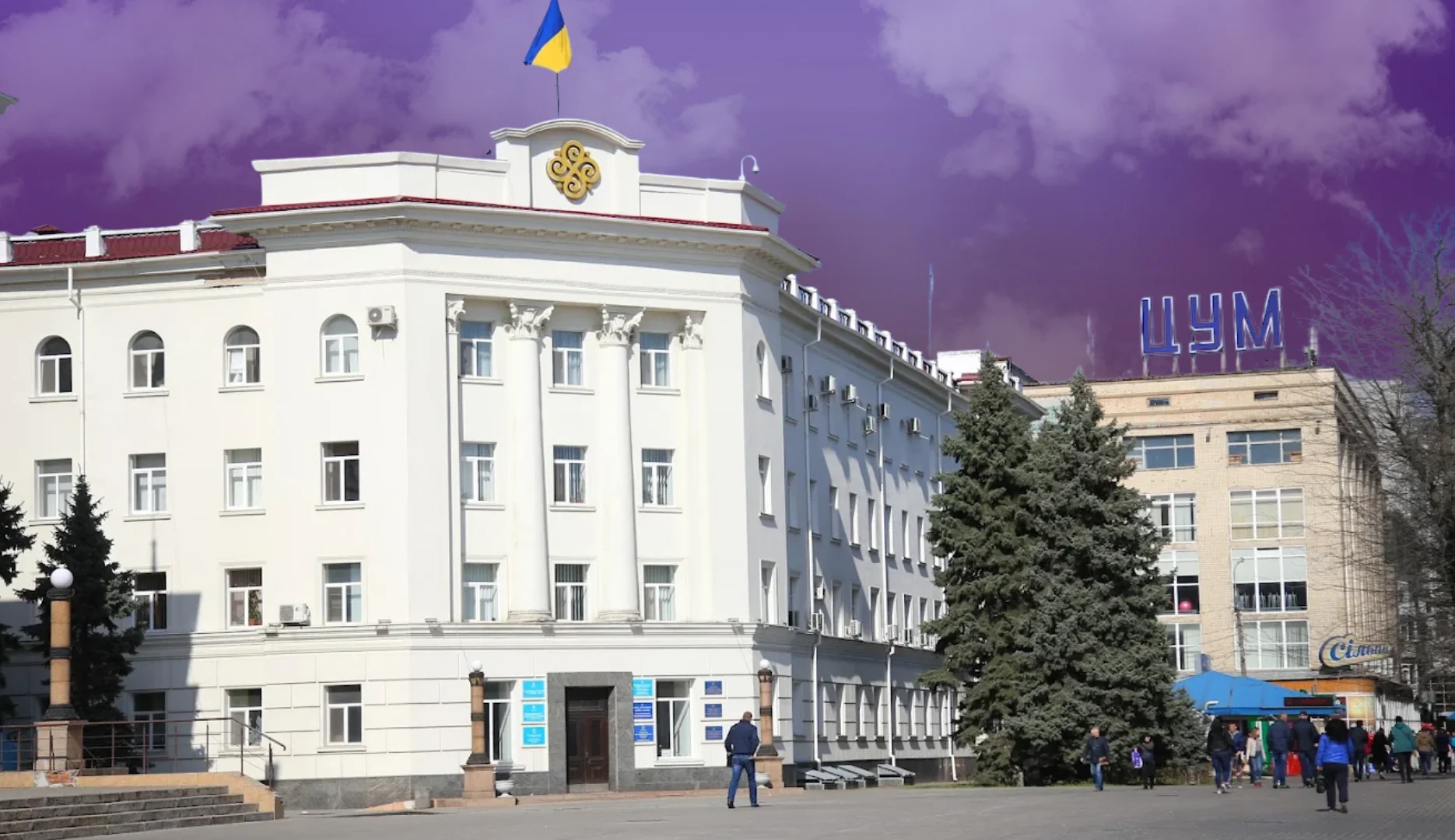
District councils in the city are bodies of local self-government created by a decision of the city council in large cities to manage individual districts. They represent the interests of the district’s territorial community, have their own executive bodies, but their powers are limited and delegated by the city council.
In Kherson, three district councils — Korabelna (formerly Komsomolska), Central (earlier – Suvorovska) and Dniprovska — were created almost 60 years ago. All these years deputies were elected there, a large apparatus operated, and the district councils performed various work. There was almost no politics there, and deputies from the so-called “Svoboda” calmly voted with the so-called “Opposition Bloc,” which was sometimes impossible in city councils due to ideological contradictions.
Last year was supposed to be the final year of the existence of district councils in the city of Kherson. Our city remains one of three — together with Zaporizhzhia and Kryvyi Rih — where they were not abolished after the 2020 local elections.
The Constitution of Ukraine and the law on local self-government do not prohibit the creation of such councils in cities with district divisions. Formally, their liquidation requires a decision of the city council to change the management system; however, in Kherson this is currently impossible due to the lack of its full functioning. At the same time, after the partially unsynchronized reform of 2020 their role has effectively eroded. Main powers and financial resources are concentrated at the level of the city council and its executive bodies, while district councils in the city often do not have clearly defined functions and sufficient funding.
Due to the full-scale invasion, the next local elections did not take place, so the district councils in the city continue to exercise their powers. In a way this is saving Kherson and the city’s residents.
“At present, district councils are perhaps the only self-government bodies that actually work in Kherson. The city administration now operates at the city level and does not involve the Kherson City Council in its work. District council deputies meet, pass decisions at sessions. Somewhere they are symbolic, somewhere they need attention. Here we must give credit to our deputies — they did not stop communicating after the occupation, they engage in work in a mixed format and they work,” notes the head of the Central district council in the city of Kherson, Andriy Zadnipryany.
According to him, today two factors make the liquidation of district councils impossible.
First, the head of the city military administration cannot unilaterally make changes to the structure and create new structural divisions. Only a session can do this, and it is believed that the city council does not have a quorum to hold one. Second, state powers regarding the maintenance of the State Voter Register are delegated to district councils. The city does not have such a department — they were created only in the district councils.
However, the reduction of the powers of district councils continues. In particular, services for children, powers regarding veteran policy, some powers were transferred to the Pension Fund, and social protection administrations were also reduced to the city level.
Even in this “reduced” mode of operation, district councils have many powers. Most of the work is in social protection administrations and departments of district life support.
“In the Central district council’s social protection department there are 18 people left out of 50 who worked before the full-scale invasion. They deal with IDP registration, acceptance of documents for assistance under city and regional government programs for the deceased, wounded, etc. Our specialists draw up care acts for people. We provide people with aid — some kits, heaters and other items. The life support department works with block captains, maintains a register of losses, records damage, issues materials if ‘Kherson Parks’ are behind or cannot go to the ‘red zone’. Work with condominium associations is carried out to prepare for winter, the heating season, and emergency situations,” says Andriy Zadnipryany.
During the full-scale invasion, district councils became a place where people go to solve their problems, says Stanislav Lysiuk, head of the Korabelnyi district council, which suffers most from enemy shelling.
According to him, over the past year the district council received more than 4,500 appeals from district residents, half of which concern damaged property. District council employees help people file applications for receiving assistance, provide materials for repairs after strikes — OSB boards, plexiglass to board up windows, films, tarpaulins, etc.
“We are not a structure that simply exists and does nothing. All this time during the war, district councils have been a place where people come with their problems and know that we will solve or at least try to solve their issues. It is very difficult to send our people into the ‘red zones’ for inspections and visits. Every time my people go there, as a leader I am very scared. But there are many appeals and we work on each of them,” says the head of the Korabelna district council.
At the same time, district councils do not have their own budgets. Salaries are financed by the city council. Aid transferred to residents is purchased either with city funds or with funds from charitable organizations, volunteers and NGOs.
Last year there was also a reorganization that resulted in a 40–50% reduction in staff numbers. Performing tasks, especially for social protection administrations, life support departments, and territorial social service centers has become more difficult.
“Currently, 37 people work in our territorial social service center. They serve 333 people: visit them at home, buy groceries, medicines, pick up items for the social laundry. When the Russians destroyed the Kakhovka Hydroelectric Power Plant, our people were engaged in evacuations from flooded areas. During the evacuation from the Island our head of civil protection worked there every day from 8 a.m. to 5 p.m., checking every vehicle with people. Women from social protection worked at reception points. Of course, there are not enough people. There is not a single department of ours that would be 100% staffed. And there is a tendency that even those who remain in the city try to find employment with more favorable conditions. So we try to save, add bonuses to employees, somehow encourage them,” notes Stanislav Lysiuk.
In the Territorial Social Service Center of the Central district council, according to Andriy Zadnipryany, almost 4,000 people are registered, including 200 people with limited mobility who are visited by social workers. Before the war, 90 people worked in the Center, now — 30.
Despite the fact that many powers have already been transferred from the district councils, some new responsibilities have also been placed on them, in particular those related to maintaining the shelter register and mobilization work. Notification points for the population have been created at district councils, records of those liable for military service are kept, and district council employees distribute summonses.
Recently, Kyiv also intensified work on the State Voter Register, which had been on pause since the beginning of the full-scale invasion.
According to Andriy Zadnipryany, most of this is paperwork. A premises has been prepared, and the district councils are waiting for equipment — the equipment that was in the departments before February 2022 was stolen by the Russians. This means that, most likely, Ukraine is indeed moving toward a peaceful track and plans to hold elections, including local ones.
The last term of the district councils in the city of Kherson fell on an extremely difficult period for the city. And this in a way helped Kherson, because their activities have always consisted of work that is simple in terms of management and at the same time practically difficult — reaching out to people, constantly interacting with residents, communicating, solving ordinary everyday problems. Now there are significantly more of them in Kherson than even before the war. District council employees cover the “gaps” that the city authorities cannot cover: they take on the work of municipal enterprises, go to the “red zones,” distribute materials for repairs and do a lot of other complex work that is not always visible from offices.
Both heads of the district councils we spoke with are confident that these structures should be liquidated after the end of the war.
“One must proceed from a state-building position: the population that has remained in Kherson does not need as many as three district councils. Various options can be considered — from creating district administrations without electing deputies to transitioning to management through departments. There are many examples of other cities that have done this and work successfully. And for now we have not once failed the city council, we fulfill all the tasks set before us. And in a way this really saved Kherson,” says Andriy Zadnipryany.