

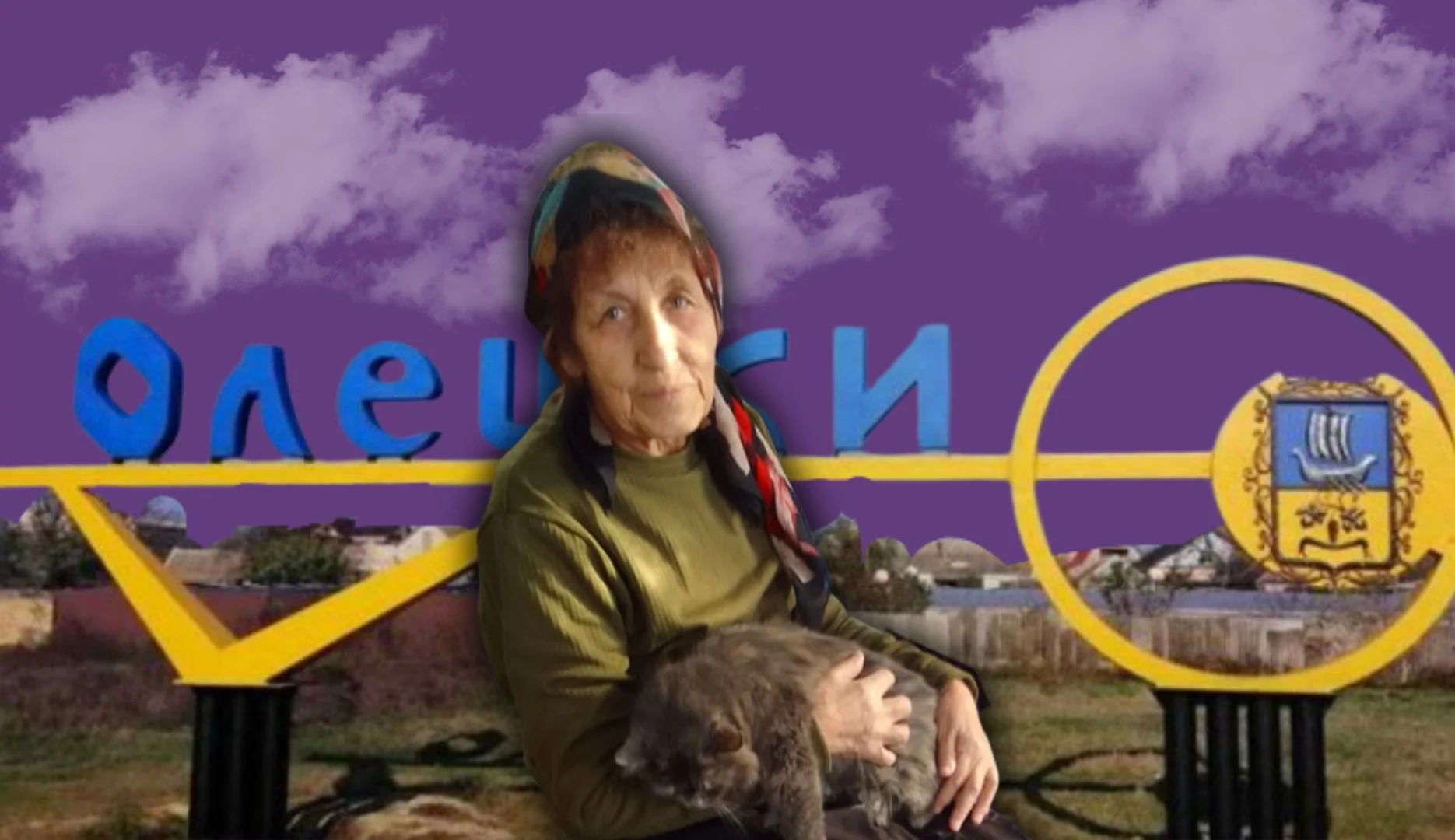
A photo of an elderly woman, leaning on a cane, standing by animal cages at the border, quickly spread on social media. Users could not believe it: how is it possible, at 73, after a serious wound, to leave the occupation and even take three cats and two dogs with her? MOST found out how Nadiya Dubova from Oleshky is living now, who, despite difficult circumstances, made her way to freedom.
All her life Nadiya Dubova lived in Oleshky. She worked as a plasterer-mason. Her children grew up. Her own apartment in a multi-story building. And, it would seem, one thing awaited her ahead – a peaceful old age in a picturesque town on the bank of the Dnieper. The daughter’s house was located right by the river. Nadiya liked to visit there very often… However, her life, like the lives of millions of Ukrainians, was abruptly changed by the infamous date – February 24, 2022.
From the first days of the full-scale invasion the Kherson region fell under occupation. In less than nine months the Armed Forces of Ukraine liberated the right bank of the region, including Kherson. Fleeing the regional center, which proved too much for them, Russian troops blew up the Antonivskyi Bridge that connected the right and left banks of the Kherson region. Oleshky did not just remain under occupation. The town turned into a frontline. As a result of shelling there has long been no electricity or gas supply. And after the occupiers blew up the Kakhovka HPP dam there is no drinking water either. With each passing day the town turns into a ghost. A significant part of the residents left, and even collaborators fled to the calmer part of the left bank and to Crimea. Only Russian soldiers and the elderly who resigned themselves to life in a frontline territory, or those who had nowhere to go, remain in the town.
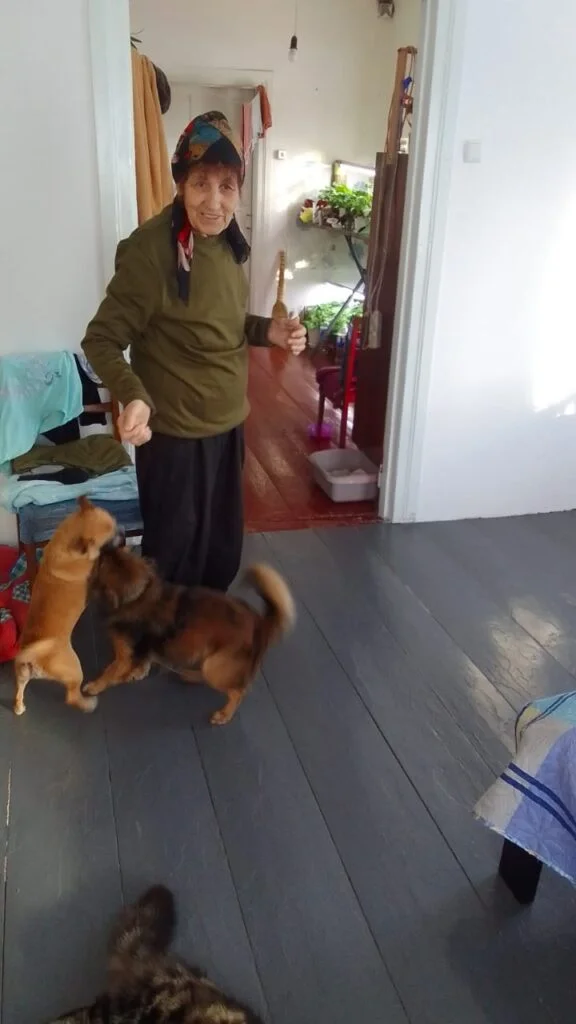
Seventy-three-year-old Nadiya Dubova stayed in Oleshky until the last, despite her daughter and son-in-law leaving in the first months of the occupation. The woman says she was held back by the pets she could not abandon. At home she had four dogs and three cats. She saved her four-legged ones during the flood in June 2023, when the occupiers blew up the Kakhovka HPP. The pensioner alone pulled them into the attic when the high water was already approaching the daughter’s house, where she was living at the time.
“The house is located at the very end of the street, near the river. This part of Oleshky was flooded right away. I sat in the attic with the dogs for three days. Until the current stopped. Meanwhile our relatives found people with a boat. They lowered us from the roof on a broken piece of roofing slate,” recalls Nadiya Dubova.
After evacuation from the flooded area the woman returned to her apartment in another part of the town (Olimpiysky district). And the daughter’s house in the coastal strip stood in water for almost a month. Shelling finished it off – there was practically nothing left of the home. Under constant attacks of artillery and drones Nadiya, it would seem, had already gotten used to living in her five-story building. But on August 23 something irreversible happened. During another shelling the woman suffered severe wounds. She says local doctors literally pulled her back from the brink.
“I had just stepped out onto the loggia, wanted to close the window. Because there were constant shellings, and the cats were sitting on the windowsill, I wanted to protect them from shrapnel. And then a drone dropped something and the fragments flew straight at me. My stomach was slashed and it struck under my shoulder, it hit a lung. I feared it would reach my heart. It became so painful. There was internal bleeding, as it turned out. I ran to the stairwell and started shouting,” the woman recalls.
Neighbors called an ambulance. At that time it still operated in Oleshky and a crew arrived. Nadiya was hospitalized and had an emergency operation. They removed her spleen and one kidney. The woman spent almost three months in hospital. As the seriously wounded woman’s daughter Olena Djerzh told MOST, after what happened one thing was clear — the mother had to be taken out of the front-line town and the occupation by any means. She found volunteers who agreed to evacuate the elderly woman after her wound, with five animals (by that time two of Nadiya’s dogs had already died as a result of the shelling). The evacuation group also noted that they would take her out free of charge.
With her she took only a couple of albums with family photos and two small bags with robes and slippers. The main treasure she carried were her “tails”: the cats Busya, Masha, Kiki and the dogs Bonya and Fedor.
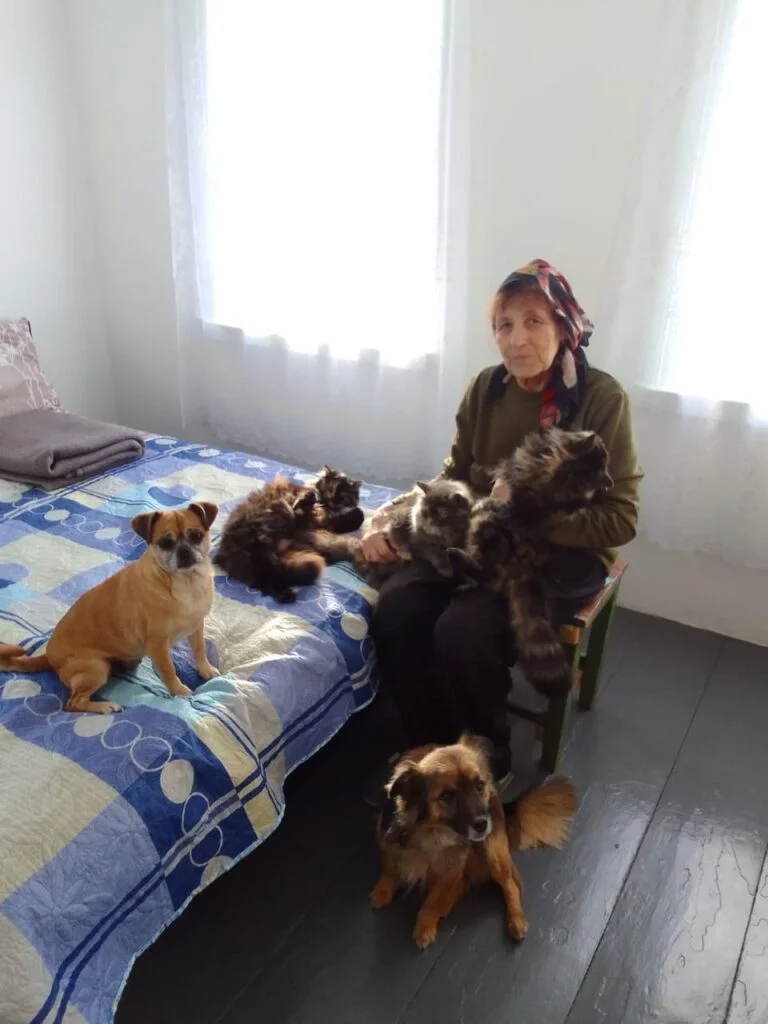
There were 8 people in the evacuation minibus. At the last moment the driver was replaced, and the new one did not know that he had to carry many animals. But the man accepted such “passengers”. The cats traveled in a carrier, one small dog was on someone’s lap, and the larger dog lay on the floor.
“Thanks to the patient people who sat next to me. Of course, the dogs worried them — they barked and moved around. But they had to be taken out. I said — I won’t go without the dogs and cats. I saved them so they wouldn’t drown and protected them from shelling. Well, how could I leave them now?”, says Mrs. Nadiya.
Occupied territory of Ukraine, Russia, Belarus. And finally – the longed-for freedom. The evacuees traveled to the Ukrainian border for three days. For Nadiya Dubova the road was a trial, because the woman left with a stoma (an artificial opening on the abdomen, surgically created, which directs digestive waste into a special pouch, – MOST). All that time Nadiya ate almost nothing, fearing health complications that could be fatal.
“I myself don’t know how I endured that journey. The hardest part was to walk one and a half kilometers to the Ukrainian border. Volunteers carried my bags. But I walked myself, they gave me a little cart, they placed the carriers with the cats on it, I held it with my hands and, pushing it, I walked. And at the checkpoint in Kovel a car was already waiting for us, volunteers organized that too. And they drove me to my daughter’s house. I had not seen her for more than three years. I imagined this meeting over and over, what it would be like. But I had no strength left for long hugs,” — Nadiya recounts.
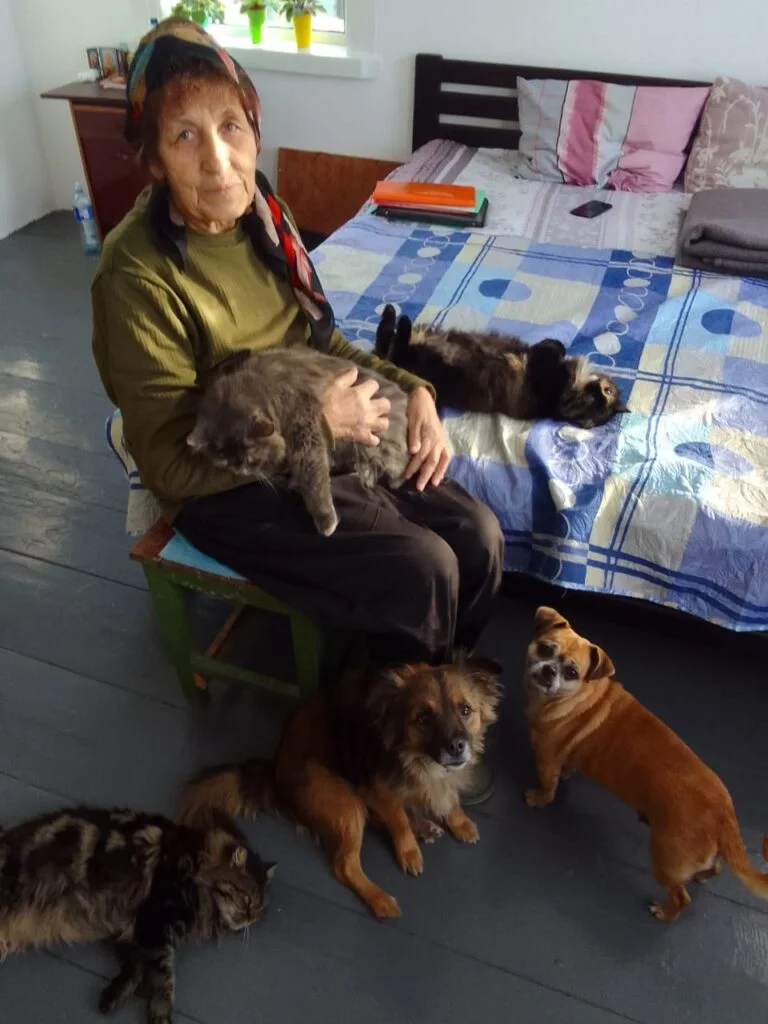
The cat — in her arms and another one nearby. The dogs — at her feet. All the animals the woman brought live with their owner in the Kyiv region. Nadiya moved to her daughter Olena, who bought a small cottage. She says she has already registered as an internally displaced person and applied to restore her pension. Ahead of Nadiya Dubova is a long course of treatment. And also — a difficult path of overcoming bureaucratic obstacles. She needs to obtain disability status. And to fight for the right to a housing certificate for the home that remained in the occupation. Lawyers from one of the NGOs have taken on advising the family on these matters.
For being able to leave the occupation, Nadiya Dubova is infinitely grateful to the team of volunteers. Among them is Kseniia Arkhipova, who herself got out from the left bank and helps fellow townspeople overcome this difficult but so desired journey to freedom.