

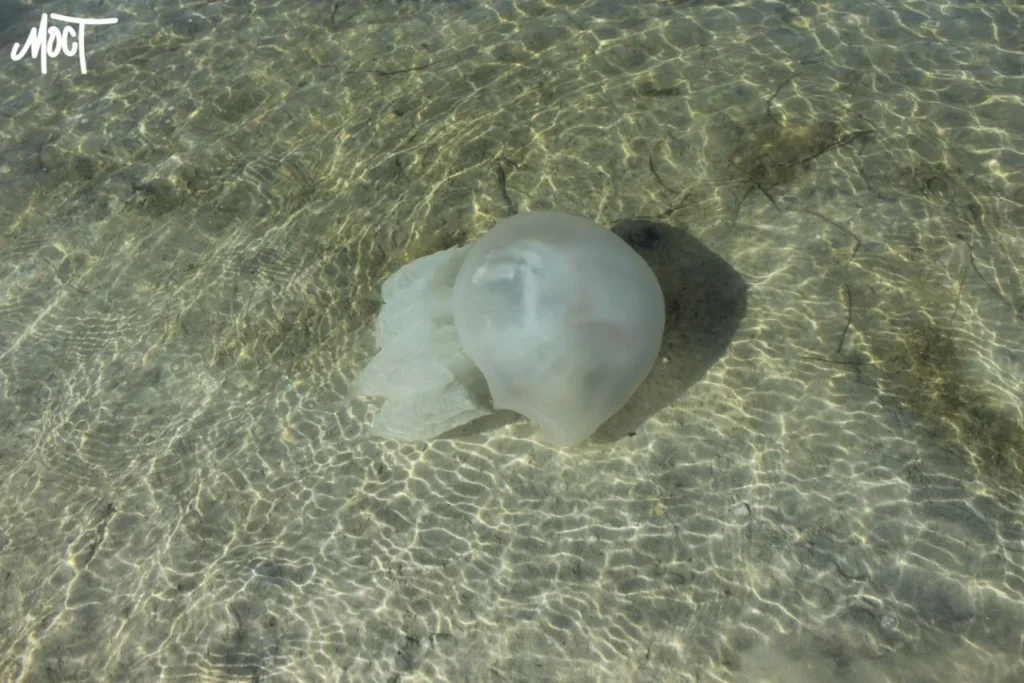
The occupying authorities announced plans to establish industrial harvesting of jellyfish in the Sea of Azov and to use them for collagen production.
This is reported by pro-Russian Telegram channels.
Thus, the relevant project was included in the updated development strategy for Pryazovia. According to the occupiers’ plan, up to one million tons of jellyfish are planned to be harvested each year. From such a volume, in their estimates, about 260 thousand tons of collagen can be obtained, which is used in cosmetology and medicine.
It is noted that collagen from jellyfish supposedly has high biocompatibility with human tissues and can be used in regenerative medicine.
According to the occupiers, the number of jellyfish in the Sea of Azov has significantly increased due to a rise in the water’s salinity.
Earlier the Russians stated that the increase in the number of jellyfish in the Sea of Azov has negatively affected fishing activity, particularly in the coastal areas of the Kherson region.
In May 2024 the occupying authorities acknowledged that the Sea of Azov is unsuitable for swimming due to an increase in the amount of plankton and jellyfish in it.
About the threat of the Azov Sea’s extinction the Ukrainian authorities reported as early as May 2022. One of the reasons for this is the bombing of “Azovstal” by the Russians.
In February 2025 the occupiers noted that they had supposedly developed a project to protect the beaches of the Sea of Azov from jellyfish.