

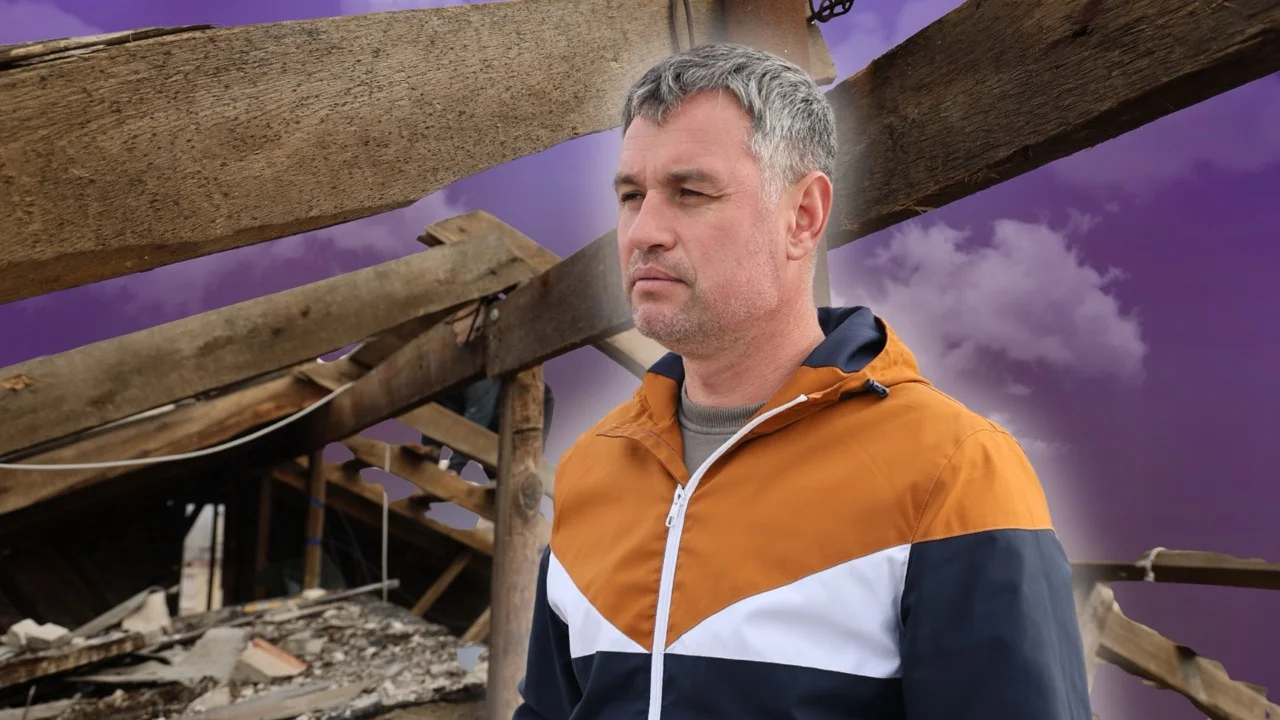
Every working day for Andriy begins on the evening of the previous day. It is necessary to order coverage by electronic warfare systems, because often this is a matter of life and death. It is necessary to plan the transportation of people so that there are enough vehicles, which are few. In the morning there is simply no time for this, because the city wounded by war is already waiting for help. And there is often very little time to provide it.
Andriy Zaluzhny is the head of the repair department of the city communal enterprise (CE) “Parks of Kherson”. We will spend one working day with him and tell how the enterprise works, on which the cleanliness and order of the city depend, and which performs the majority of repair work on buildings damaged as a result of Russian shelling.
Morning
We meet Andriy at his enterprise. Morning. At this time Kherson residents set off for work (life in a frontline city has not frozen despite Russian claims) and try to get things done related to leaving home. The section of Kulyka Street we drive along is almost empty. Most of the development here is private houses with sprinkled-in shops and other establishments that have not been operating for years due to the war. A significant number of windows of buildings facing the roadway are closed with OSB boards. There are also unfinished buildings that the events of the past almost four years have prevented from becoming homes.
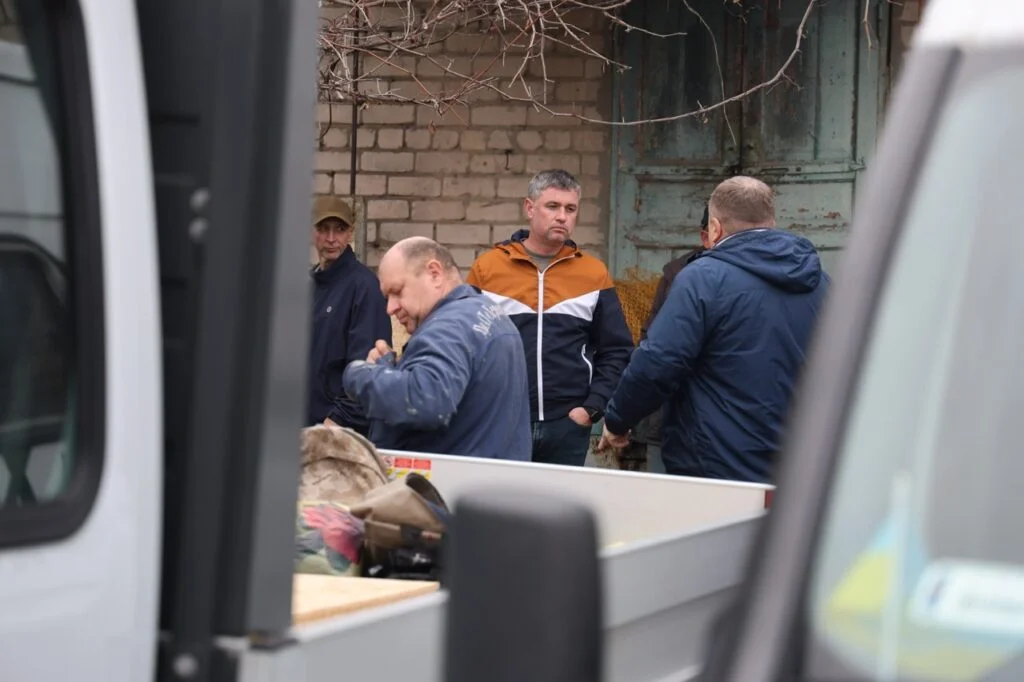
The working day at the CE “Parks of Kherson” begins at seven in the morning with the allocation of tasks among the crews.
Currently the enterprise’s staff is 343 people. By current Kherson standards this is a fairly large enterprise. However, in terms of the volume of work that has to be done every day, there are few people, and each of them has their working day scheduled literally to the minute.
“We have, – says Andriy Zaluzhny about the start of the working day, – half as many vehicles as there are crews working on sites. Therefore it is necessary to organize the transportation of people so that one vehicle takes crews to two locations without spending much time on it.”
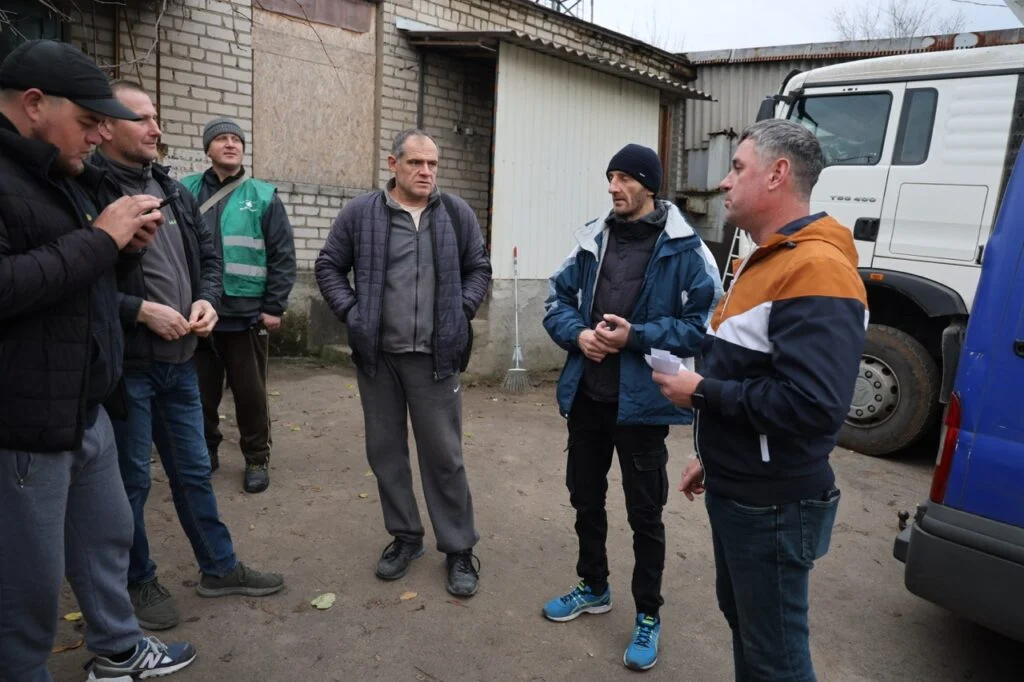
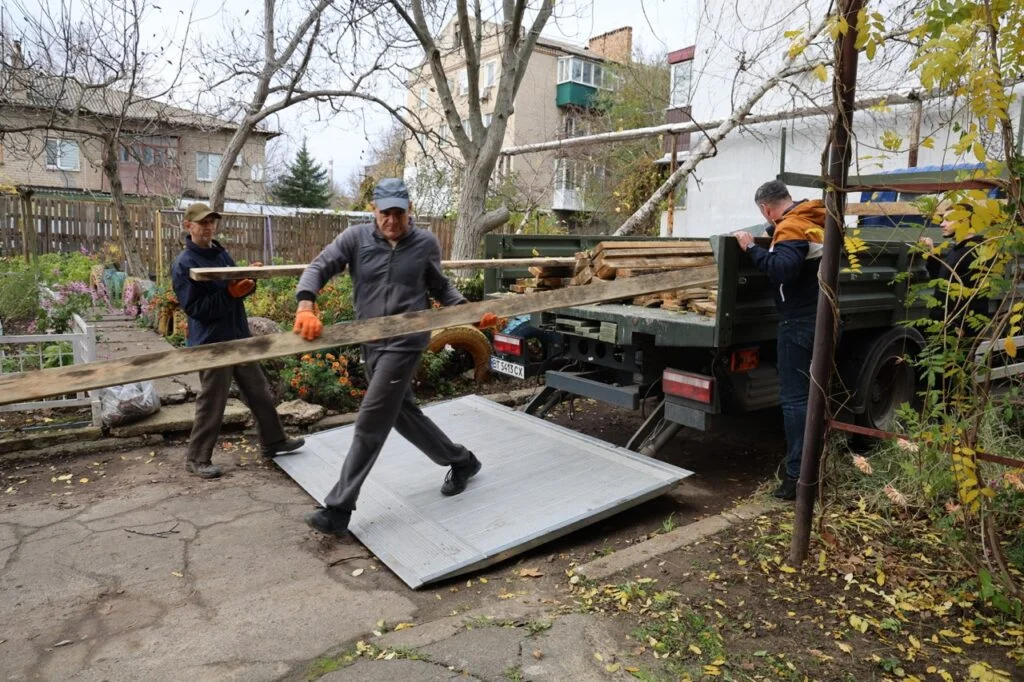
“Parks of Kherson” is the main enterprise that performs emergency repair work on city buildings damaged as a result of Russian shelling and drone attacks. Mostly this is closing the thermal envelope (windows, doors) with OSB boards or other materials. Recently roof repairs have been added.
“This is, – says Andriy Zaluzhny, – a new direction of our work. In one and a half months we repaired roofs on 25 sites. We repair both soft roofing and slate. Sometimes we have to do a full roof replacement, covering 500-600 square meters. We repair everything according to technologies: we make a new lathing, lay tarpaulin or bitumen tape under the main roofing (soft waterproof materials, – MOST) depending on the type of roof.”
He tells this already in the car, when we are driving to the first site – one of the volunteer warehouses for materials for roof repairs. In particular, for rafter boards.
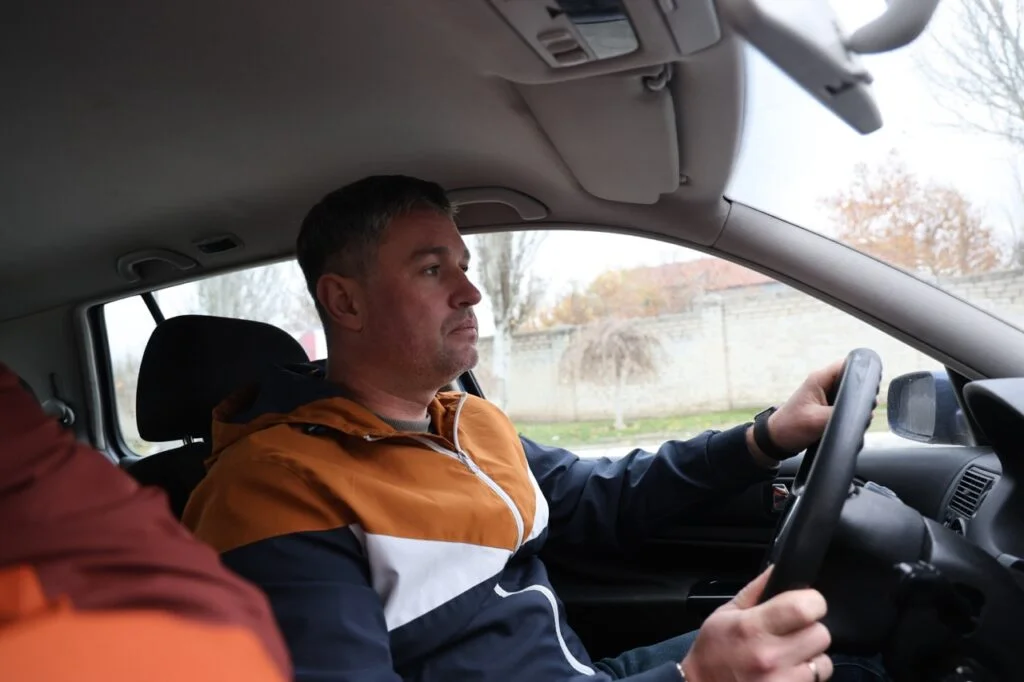
“Right now, – says Andriy, – we are fruitfully cooperating with volunteers. They help us a lot, because the city budget for this year does not provide funds for the purchase of rafter boards. From next year such funding will be available.”
Also, the head of the repair department of “Parks of Kherson” says that volunteer organizations provide the enterprise with vehicles to use, because situations often arise where the enterprise’s own fleet is not enough to quickly transport people and materials to all locations.
Day
On the section of Kulyka Street between its intersections with Chornomorska Street and Zalaegerszeg Street, it is quite crowded during the day despite the danger. Dnipro market is operating, shops are open, public transport runs.
Driving this section with Andriy Zaluzhny, we also see “Parks of Kherson” workers who are cleaning the street.
“If, – says Andriy, – we don’t clean, the city will quickly drown in garbage. There will be chaos. So we clean even in such dangerous places as Zalaegerszeg Street. We order coverage and work. And people see that the municipal workers are on site, that everything works even in such conditions, that the city is not neglected and not abandoned. We work where the level of danger is high. Of course, there we provide cover for the workers.”
We stop by a building where most of the windows are without glass and closed with OSB boards. The head of the repair department of “Parks of Kherson” tells that a Russian shell hit the building precisely while the consequences of a previous impact were being cleared: “The claimant died, and our employee was seriously wounded.”
We talk about the specifics of closing the thermal envelope of damaged buildings. Andriy says that soon the “Parks of Kherson” team will be joined by employees of a new specialty – industrial climbers.
“Right now, – says Andriy, – two people are undergoing training. Funds have been allocated for the purchase of equipment, materials, climbing gear. Industrial climbers will work where it is impossible to cope otherwise. In particular, they will take part in closing windows with OSB boards on floors above the sixth, where it is already impossible to do this using a lift.”
Although we are not climbers, we climb onto the roof through a narrow hatch. Three Russian shells struck here: into one of the apartments, into a corner and into an air duct. The last shell struck through the roof and damaged it so much that a full replacement is needed.
“On this site, – says Andriy, – we are restoring the roof. We will cover it with tarpaulin and winterize it.”
On this roof we spent less than an hour with Andriy, but we fully felt all the discomfort experienced by people who spend a full working day there. The roof being repaired is itself very dangerous. In addition, cold and wind are felt more strongly up there. And worst of all – the artillery and drone danger: there are almost no shelters in case of a UAV attack or shelling. But the repairs still have to be done. In terms of complexity and nervous strain, such repairs are perhaps somewhat similar to military combat missions.
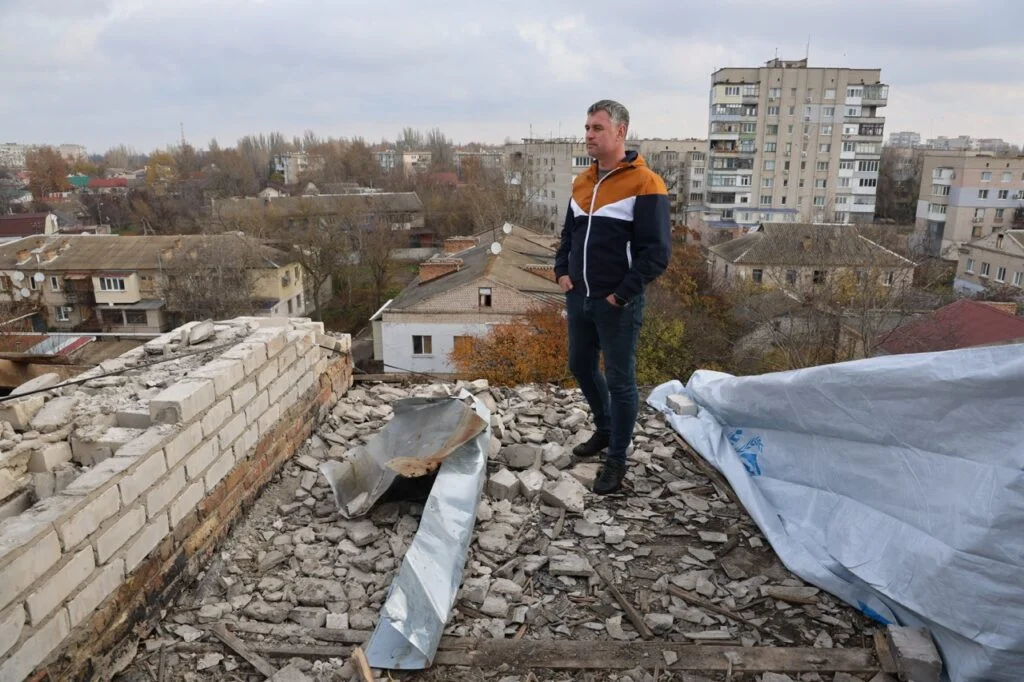
The roof offers a view of the district, and further to the right you can see the distant left bank of the Dnipro. Today a little fog has settled on the ground, so there is hope that the Russians will not send a drone our way.
During the site tour we talk about the situation in Kherson. Andriy Zaluzhny, as a person directly involved in eliminating the consequences of Russian shelling, says that things are getting worse and worse.
“If, – he says, – you look at our reports, you can see that this year we usually used about a thousand OSB sheets per month. We closed 2000-2500 windows. But in November 2025 we used 1700 sheets and closed 5097 windows. Unfortunately, both for Kherson and for the Kherson community the trends are very discouraging: shelling and drone activity are increasingly intense, and there are more and more damaged objects.”
We visit one of Kherson’s schools located in the red zone. The main building of the institution, the former male gymnasium, was completely destroyed by fire. We passed the building and went down. I would once have remembered that this is the road to the regional archive reading room, but now I look with horror at broken roofs and walls of private houses, and the mutilated college.
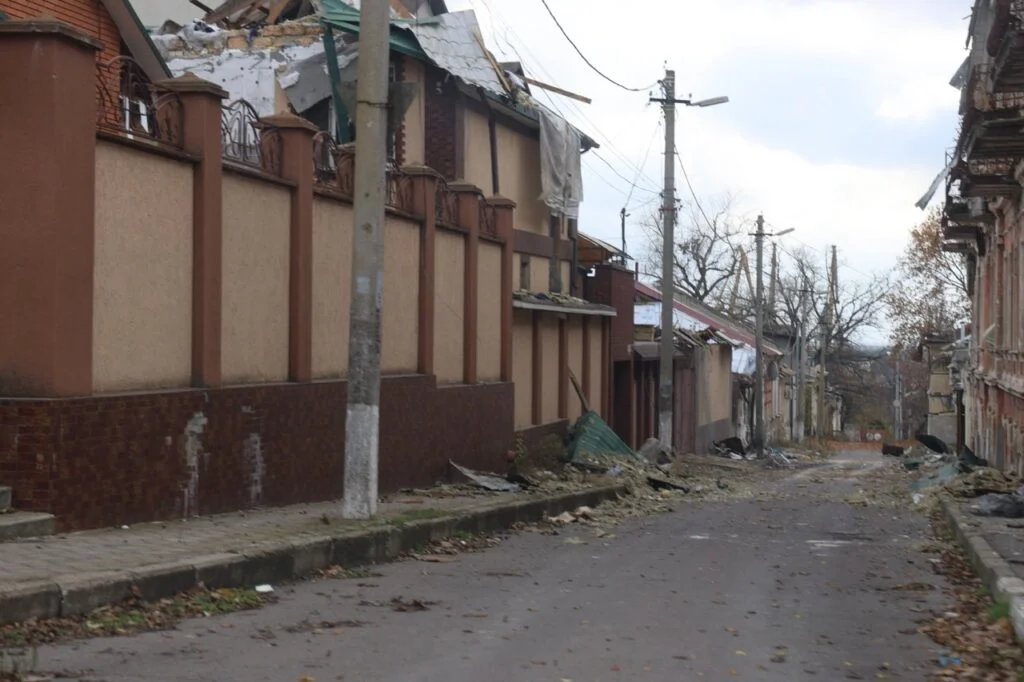
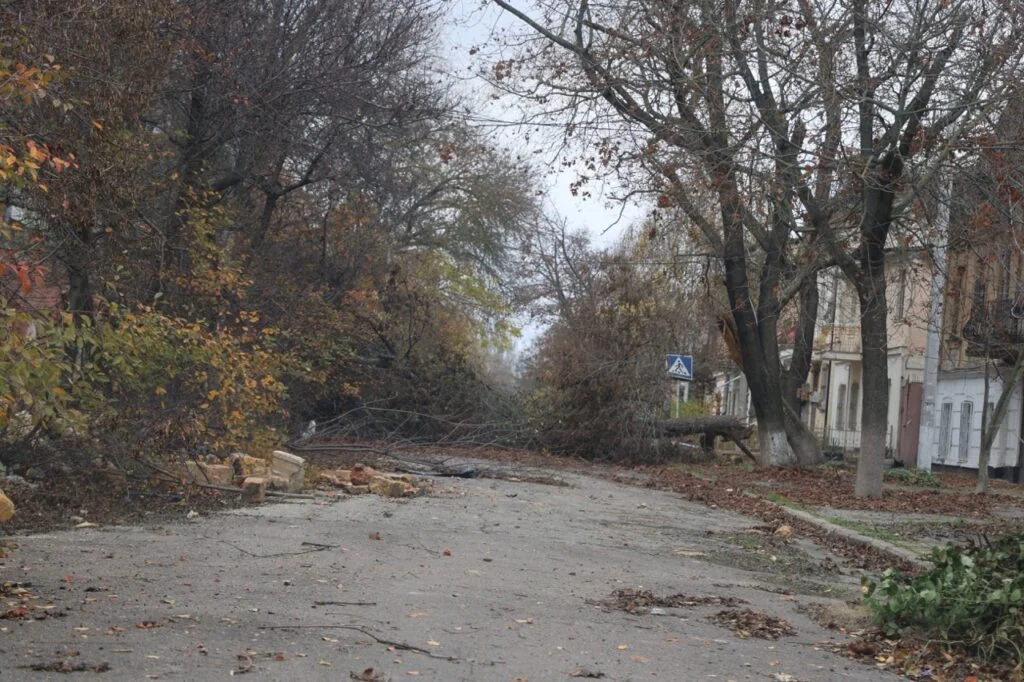
It is impossible to drive along Hoshkevych Street because a tree knocked down by an explosion blocks the way. We return to the school’s “new building.”
The building was heavily damaged by a recent shelling. “Parks of Kherson” workers are closing windows that are left not only without glass but without frames as well, and closing openings left after door blocks blown out by the blast. We brought tarpaulin to cover the next holes in the roof. Later this roof will be repaired by Andriy’s subordinates.
We drive away from the school in silence. I think about how this district has changed literally in half a year while I was not here.
Ahead is another school. The Russians level it almost every week. A crew is working here, fixing the result of the latest hit. Men are sealing windows that have long had no glass, and a nearby explosion has undone their previous work. The school seems not to be in the “red zone,” but beyond it the military area already begins.
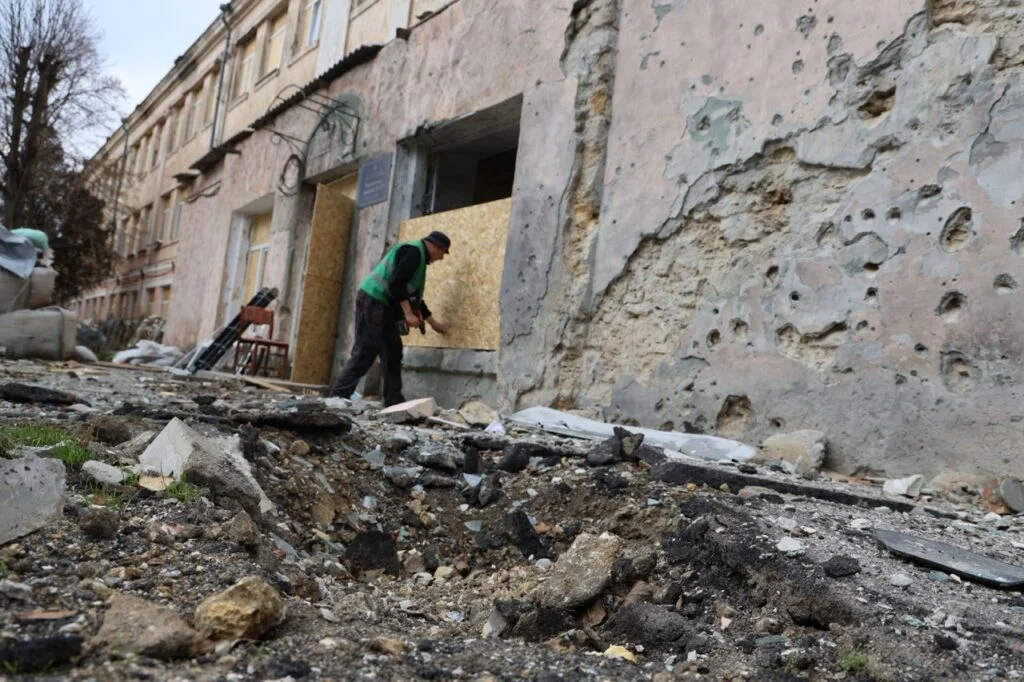
From the school’s yard you can see the mutilated building of the city printing house. The holes in that building, it seems, no one is covering anymore.
“Let’s go, I’ll show you where we will work, but we won’t start now because there is no cover,” proposes Andriy and we speed down Universytetska and turn down.
There are fewer and fewer people on the street, and more and more holes in the road and in the walls of houses.
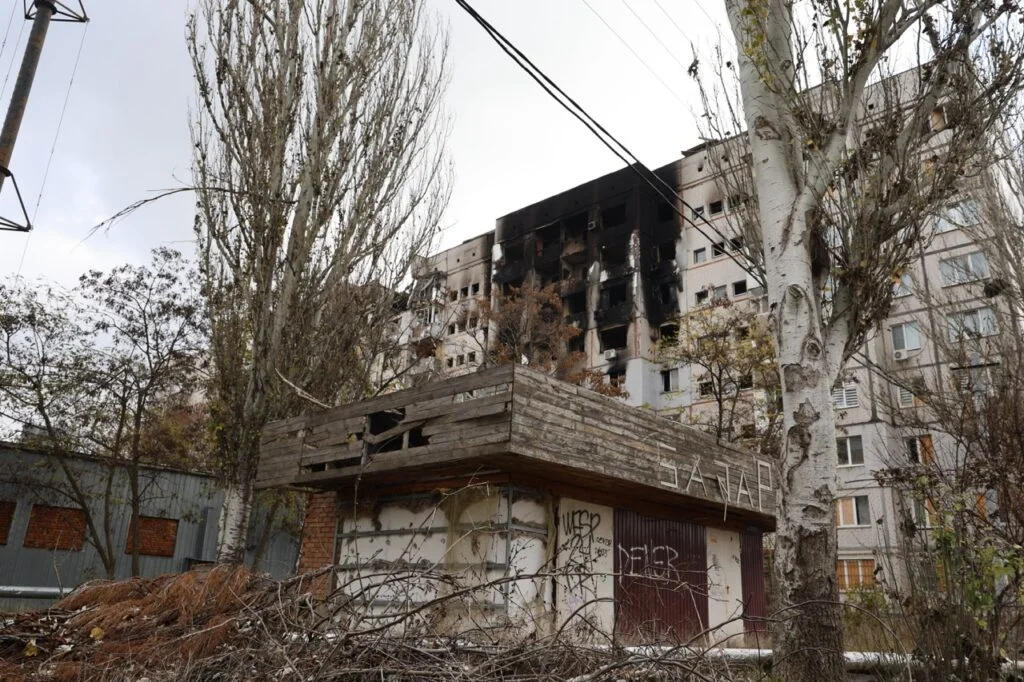
We turn to a half-burned nine-story building. On the sidewalk a man in the branded jacket of one of the providers sits on a folding chair soldering an optical cable.
Evening
Shortly before the end of the working day we arrive at one of the houses on Naftovykiv Street. Andriy Zaluzhny talks with the workers. The situation is complicated: during artillery shelling a shell hit the house in such a way that it damaged the roof, causing rainwater to get inside. But due to the position of one of the residents there is no possibility to get onto the roof.
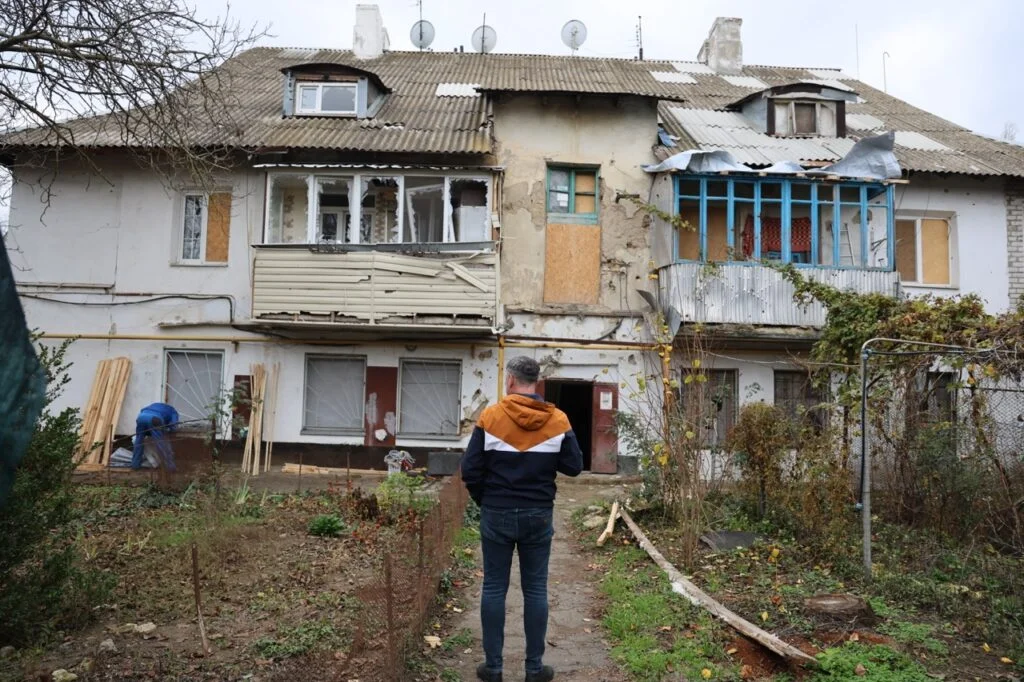
“Parks of Kherson” workers discuss how to repair the house: first they will eliminate the consequences of the shell hit that prevent getting onto the roof, then they will repair the roof.
On Shumensky there are two more roofs to inspect. They were damaged by the Russians back in 2023, the municipal workers patched them up, but it’s time to redo them because water started pouring on residents’ heads.
“Andryusha, come up-come up, I’ll show you everything,” says the grandfather who takes care of his apartment building, which the municipal housing service long ago gave up on.
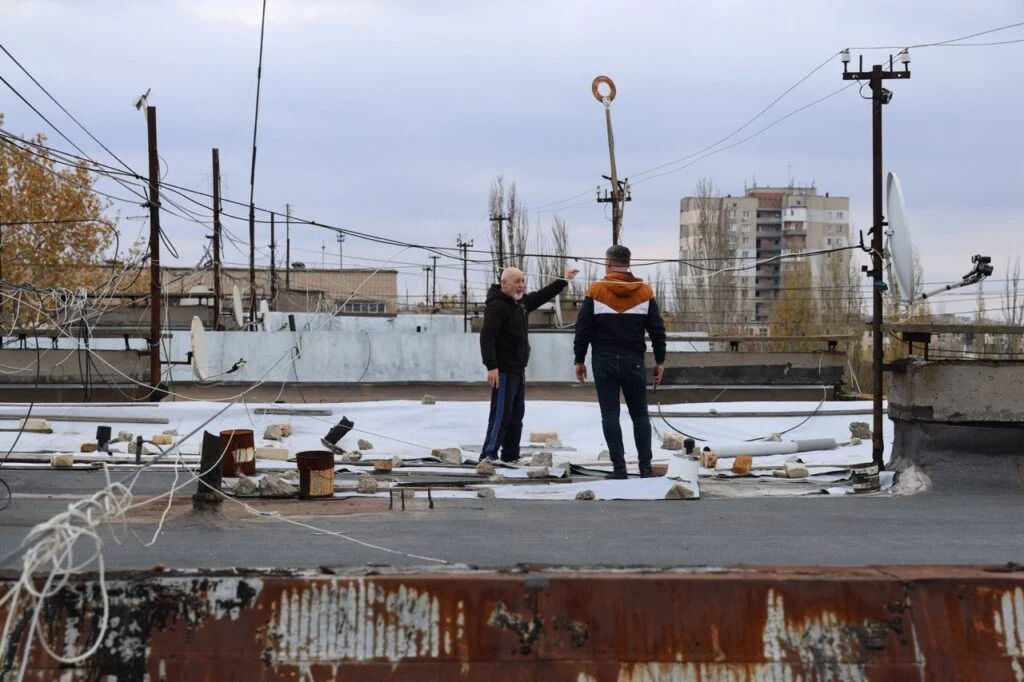
We climb onto the roof with him, where Andriy inspects a hit from 2023, patiently listens to the problems and types some instructions to someone in a messenger.
In another part of the district we climb onto the roof of a nine-story building. It offers an absolutely crazy view of Shumensky. You can even see the almost erased-from-the-map settlement of Dniprovske, which stands on a clay cliff. Or maybe I want to see it.
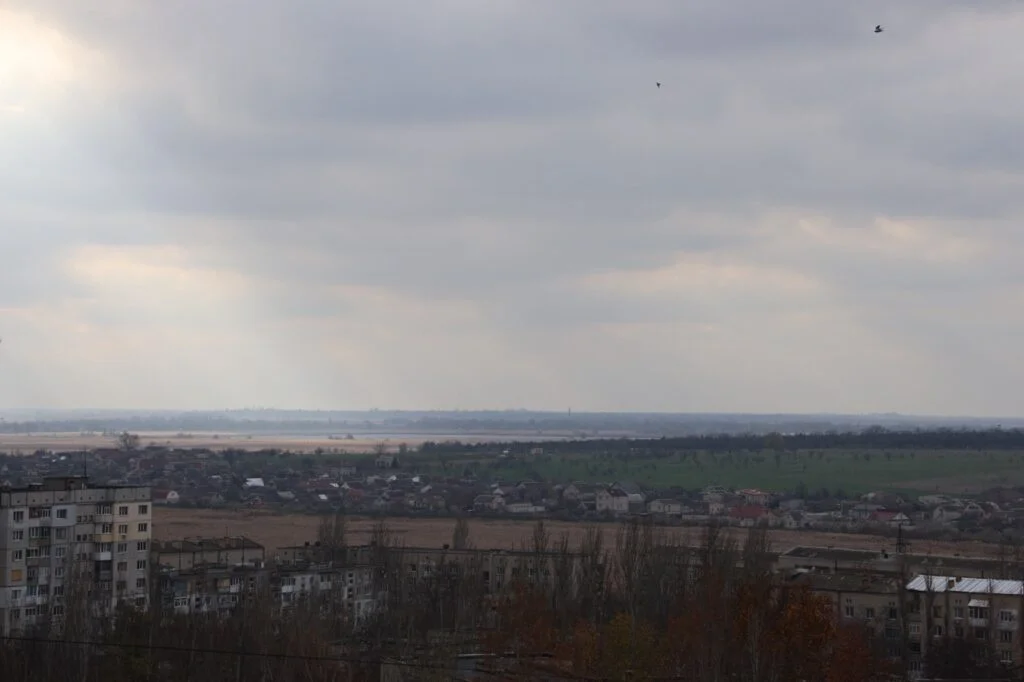
While I look around the surroundings of Kherson through the lens, Andriy assesses the amount of materials and people needed.
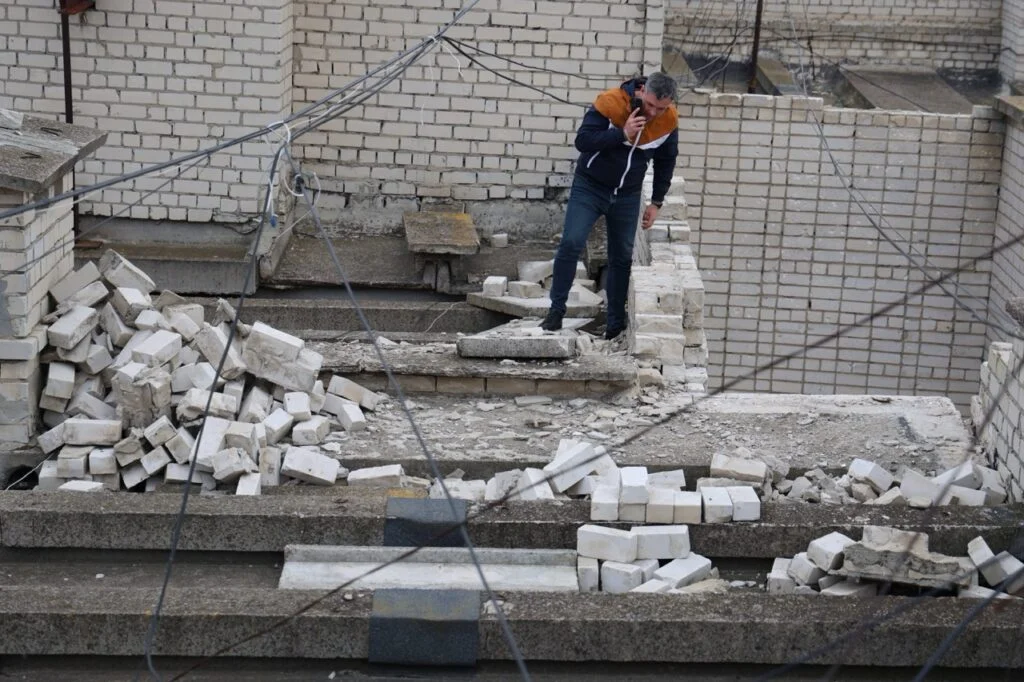
“Our workers’ working day, – says Andriy Zaluzhny, – starts at 7 a.m. and lasts until 4 p.m. Mine lasts until 7 p.m. because I need to make a report on the work done: on the number of windows and doors closed, etc. It is also necessary to account for materials: how many were issued from the warehouse, how many were used, how many remain for the next day. Such reporting is done on the basis of acts of completed works provided to me by the site masters.”
Andriy says that working at his enterprise is difficult because the conditions are often extreme; if needed (if shelling is very intense and damages are significant), people work without days off.
“I would like, – he says, – wages to be better, because people work in difficult conditions: shelling, drones. I would like better provision of materials and tools.”
The working day ends. We drive with Andriy Zaluzhny through the city past buildings damaged by shelling that would certainly look much worse and much scarier now if not for the workers of “Parks of Kherson”.