
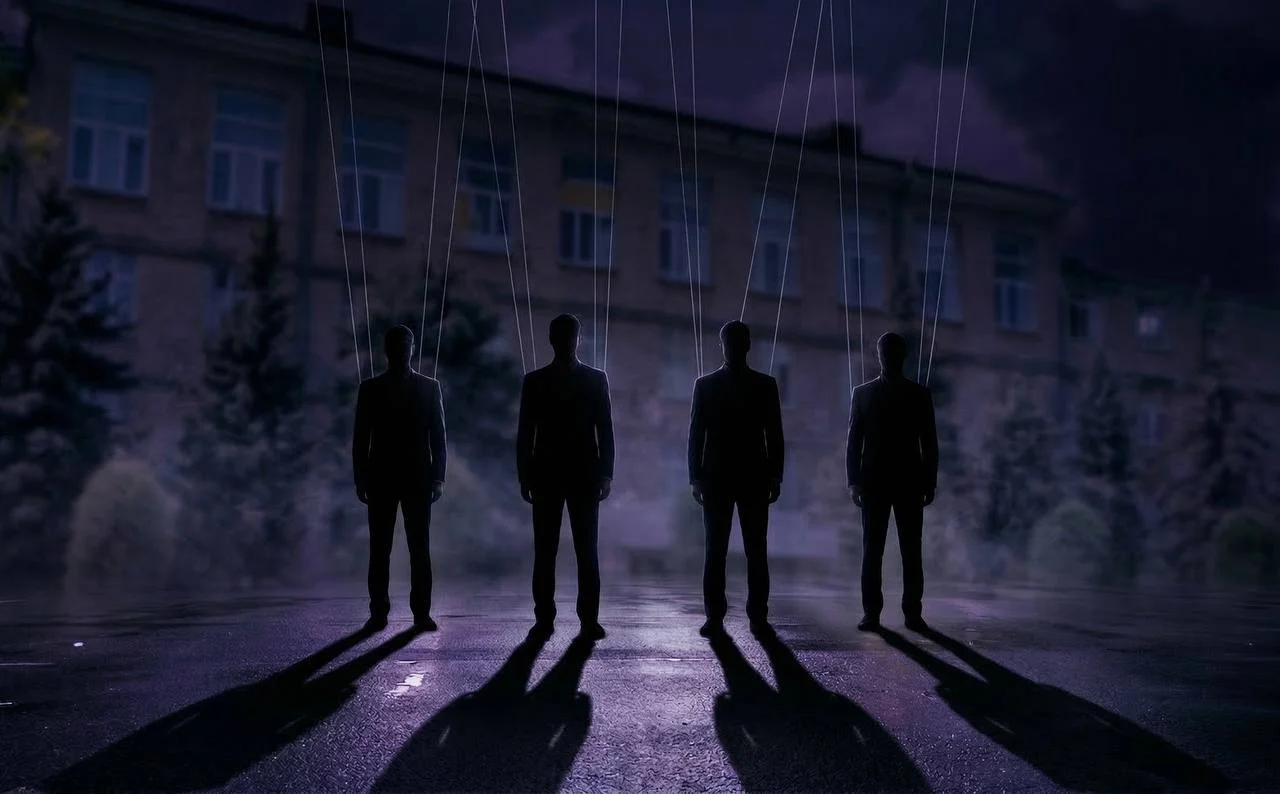
Four years ago – on March 16, 2022 – one of the key events of the full-scale invasion took place: the Russians publicly presented their henchmen, who shortly after became the faces of occupied Kherson region.
In September 2022 MOST had already reported on local collaborators, Russian, Crimean and “DPR” varangians whom Kremlin and FSB handlers sent to the region to build the “Russian world.”
Since then much has changed: some continue to work, some were promoted or returned home and dissolved into obscurity, some gambled big and received real prison terms, and some characters won tickets to a Kobzon concert. At the same time, we learned about some figures only with the passage of time.
MOST is starting a series of publications in which we propose to refresh readers’ memory and, relying on new facts and materials, look at the faces of the leaders of the Russian occupation of Kherson region – from March 2022 to today.
“Military-civilian administration” of Kherson Oblast (1 (15) April 2022 – 24 January 2023)
On March 16, 2022 we observed how, in the fever and uncertainty about the future of occupied Kherson region, Russian Chekists hastily fashioned something resembling a new local authority. The frightened eyes of Volodymyr Saldo, which he hid from cameras, were still fresh in memory, and the cautious nonsense spoken that day at the first and only session of the “Committee for Salvation for Peace and Order” by the local pro-Russian provocateur Kyrylo Stremousov was notable.
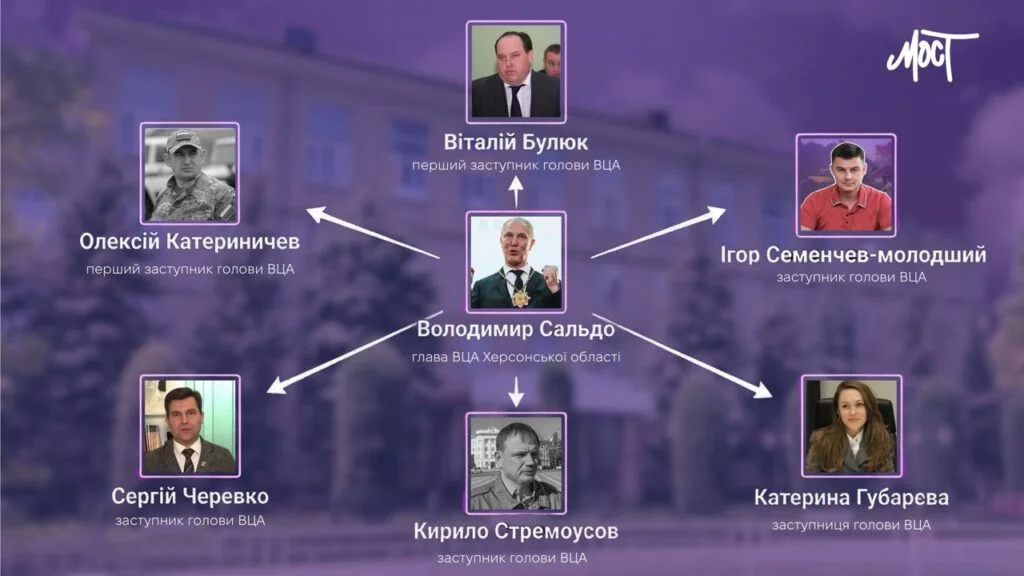
Former Kherson mayor Volodymyr Saldo and former head of the Antonivka settlement council Ihor Semenchev explained their participation in the meeting of the “committee of salvation” by saying they were forced. Soon almost all participants of that gathering became collaborators and entered the leadership of the newly created “military-civilian administration of Kherson oblast” – the quasi-government of occupied Kherson region.
One important point: they were made collaborators by Russian military, who legally formalized the occupation authority and by their orders created the MCA in the region. It is now known that this process was led by the “military commandant” of Kherson oblast, Colonel Volodymyr Bedryk. And those who called themselves the new authorities were FSB officers with call signs Sabir and Alpha.
There is an assumption that it was these two who gathered participants in the small hall of the regional council. There is also an assumption that the acting mayor of Kherson Ihor Kolykhaiev was present at that meeting. According to our source from Volodymyr Saldo’s circle, Kolykhaiev sat at the table but was not captured on camera.
In news published by Russian media, it was reported that the “Committee” included the acting mayor and his deputy. Kolykhaiev himself did not publicly comment on this before his abduction.
Whether this is true or not we cannot assert, since none of the participants of those events are currently available for questioning.
The occupation MCA began work on either April 1 or 15, at least this follows from the dating of two identical decrees signed by its “head” – 65-year-old Kherson native Volodymyr Saldo.
Volodymyr Saldo
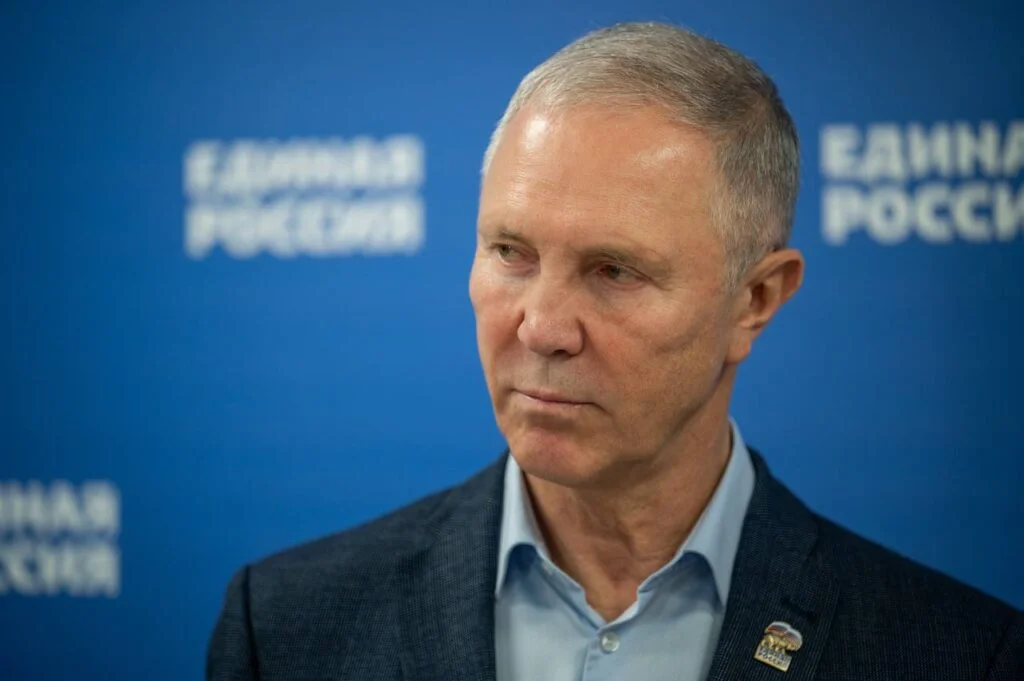
Saldo is a well-known figure in Kherson. A builder by trade. In the early 2000s he was deputy head of the regional administration on Yurii Kravchenko’s team. It was that general who insisted that he run for mayor of Kherson in the 2002 local elections. Since then Saldo was elected mayor twice more.
Mayor Saldo did not hide his Russian sympathies, organizing official city day celebrations with Potemkin and Catherine II funded by the budget. Jokes circulated that the Russian consul general in Odesa, Oleksandr Hrachov, had practically taken up residence in the mayor’s office.
In 2012, amid growing friction with the new head of the regional administration Mykola Kostiak, Saldo was nominated as a candidate for parliament in constituency 182 from the Party of Regions. He won that election against the Batkivshchyna candidate Oleksii Ursulenko thanks to administrative resources, with a margin of less than a thousand votes.
During the Maidan events on February 20, 2014, MP Volodymyr Saldo appeared on propagandist Solovyov’s talk show in Moscow. Later Saldo stated that at that time he found it amusing to hear that he was engaged in anti-Ukrainian propaganda.
Besides voting for the dictatorial “January 16 laws,” Kherson MP Saldo became known nationwide after an incident near the Verkhovna Rada when an unknown person, slapping him on the forehead with a palm, called him a “chmoshnik”. Under that nickname Saldo entered domestic history.
Since then he unsuccessfully tried to be re-elected to parliament or become mayor of Kherson.
In summer 2016 an audio recording appeared in which a person with a voice similar to Volodymyr Saldo’s confessed to cooperation with the FSB. Simultaneously, photos appeared of Saldo together with fugitive ex-MP Oleksii Zhuravko and Russian actor Mikhail Porechenkov. These files were supposedly extracted from Saldo’s phone while he was held in a Dominican prison. The SBU began an inquiry then, but no results were announced.
However, the “Russian trace” did not prevent Saldo from leading the electoral list of the eponymous party Bloc of Volodymyr Saldo in the 2020 local elections, gaining the support of over eight thousand Kherson residents and becoming a deputy of the Kherson City Council, securing mandates for eight fellow party members. Under his brand another 25 nominees were elected to various regional councils.
That Saldo by that time already had contacts with FSB handlers is beyond doubt. At the same time it remains unclear why on March 16 he publicly tried to deny cooperation with the occupiers when Kherson was already under their control.
We assume that at that moment he still did not have a final defined role in the hierarchy of the future occupation administration. It appears that different influence groups promoted their own candidates for leadership positions in the region, so there was no clarity about who would head it.
The “first team” of Saldo in the MCA consisted mostly of Kherson natives. It is difficult to determine what united them, but the motives that pushed them to openly cooperate with Russian occupiers were different. For some it was an attempt to avoid criminal liability for past misdeeds, for others – an opportunity to immerse themselves in the vortex of a new political struggle, and for someone – a chance to gain influence and resources in the conditions of the so-called “new geopolitical reality.”
Vitalii Bulyuk
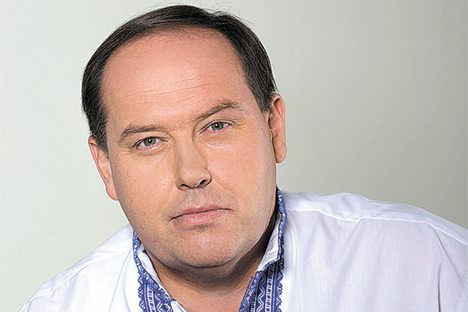
Among the latter is 53-year-old Vitalii Bulyuk – a customs general, businessman, and serving deputy of the Kherson Regional Council, who in the newly formed MCA received the post of first deputy for economy and finance.
Vitalii Bulyuk rose professionally from an inspector at the Skadovsk customs post to head of the Kherson customs, which he led in 2007–2014. In that position he attained the “general” rank of State Advisor of the Customs Service III class, and in August 2013 he received from then-president Viktor Yanukovych the Order of Merit III degree.
As head of Kherson customs under the patronage of his godfather – the head of the State Customs Service Ihor Kaletnik – Bulyuk had wide opportunities to capitalize on his position. Incidentally, Kaletnik himself briefly headed Kherson customs in 1999–2000.
With Kaletnik’s support Bulyuk began a political career: in 2006 he was elected a deputy of the Kherson Regional Council from Natalia Vitrenko’s bloc “People’s Opposition.” In 2010 he was re-elected to the regional council, this time from the Communist Party of Ukraine.
During Yanukovych’s presidency Bulyuk tried to become head of Kherson Regional State Administration, but the long-standing friendship between the then regional head Mykola Kostiak and the president outweighed the customs official’s ambitions.
After the Revolution of Dignity, the then head of Kherson RSA Yurii Odarchenko raised the issue of dismissing Bulyuk from the post of customs chief. As a result the official fell under the lustration law. Bulyuk appealed his lustration in court and in November 2020 won the case, formally reinstated as head of the Chornomorsk customs, which was at that time being liquidated. An additional bonus was over UAH 800,000 in compensation for unlawful dismissal.
In 2015 and 2020 Bulyuk was again elected a deputy of the Kherson Regional Council – this time from the Our Land party, which he headed in the region. His appearance in this political force is linked to then-deputy head of the Presidential Administration Vitalii Kovalchuk, who earlier was connected to the Kherson oil refinery.
Having reached an agreement with the pro-government head of the regional council Andrii Putilov, in December 2015 Bulyuk became deputy head of the Kherson Regional Council. In this position he focused on strengthening his influence, including by advancing his people to leadership positions in key regional communal property objects – such as Kherson International Airport.
Despite demonstrative patriotism, Bulyuk repeatedly made anti-Ukrainian remarks. For instance, at the end of 2016 within the walls of the regional council he publicly insulted the memory of fallen Ukrainian servicemen. But that did not prevent him from wearing a vyshyvanka and speaking Ukrainian when needed.
Rumors about possible cooperation of Bulyuk with Russian special services circulated for a long time, but there was no reaction. Some regional council deputies tried to draw law enforcement attention to his possible Russian ties, but unsuccessfully. Thus, on February 8, 2019 at a session of the Kherson Regional Council deputy Vasyl Rudyk publicly accused him of cooperating with Russia, as well as with representatives of the terrorist groups “LPR”, “DPR” and occupied Crimea. Deputies proposed to form a temporary deputy commission to verify these facts, but the initiative failed to gain majority support.
The spinelessness of RSA head Andrii Hordieiev and Bulyuk’s connections with security forces played no small role. In 2025 information appeared that he influenced the then head of the SBU Department in AR Crimea Oleh Kulinich and allegedly “shaped opinions” about his subordinates.
Later, in March 2023, former RSA head Andrii Hordieiev placed responsibility on Bulyuk for the “dismantling of the territorial defense system” that he supposedly developed while governor. “Bulyuk knew everything – about every unit, about alert systems,” Hordieiev claimed.
However, if any territorial defense system existed, it was mostly in Hordieiev’s imagination and in reports to the Presidential Administration. So most likely Bulyuk did not have to make special efforts to “dismantle” anything.
After the start of the full-scale Russian invasion, Bulyuk initially denied involvement in creating the so-called “Kherson People’s Republic.” However, by April 2022 he was presented as the first deputy head of the occupation military-civilian administration of Kherson oblast.
Bulyuk’s collaboration is not based on ideological views but primarily on the desire to preserve and multiply his business assets in the occupied region, relying on support from handlers in the Russian special services.
Despite being part of the occupation structures, Bulyuk formally still remains a deputy of the Kherson Regional Council. Since Our Land failed to withdraw his mandate, in December 2022 the regional council only managed to strip Bulyuk of the right to participate in its sessions, like other deputy-collaborators.
Ihor Semenchev–junior
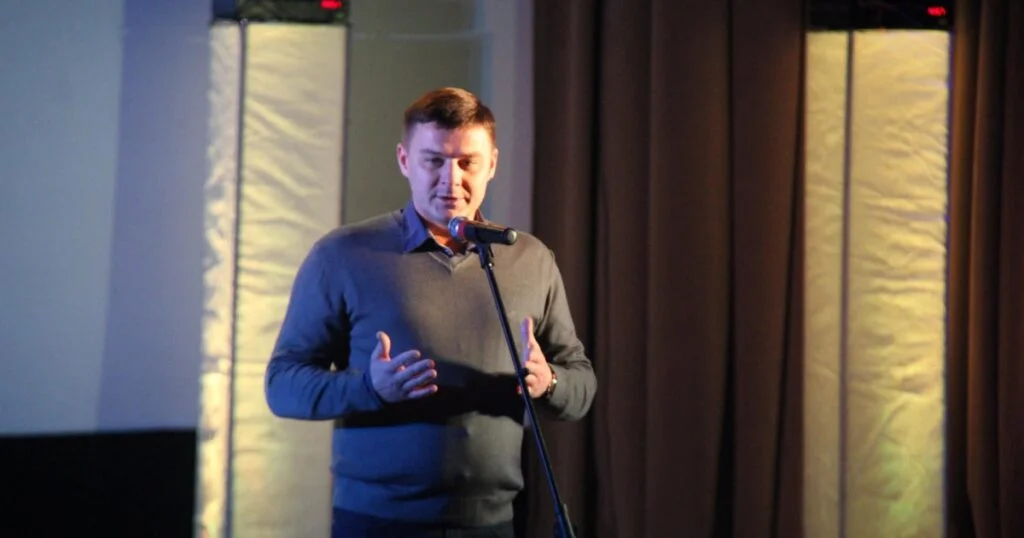
The motives for cooperation with the occupiers were different for 40-year-old Ihor Semenchev–junior, who in the MCA became deputy for the fuel and energy complex, industry and trade.
Semenchev-junior’s career began at the joint-stock company “Sigma,” which belonged to his father.
In the early elections of 2008 the young Semenchev was first elected head of the settlement Antonivka in Kherson’s suburbs. His work in that position was accompanied by corruption scandals that culminated in 2012 with the arrest by law enforcement of his driver during the transfer of a bribe of $80,000. Semenchev himself then disappeared and was detained in February 2013 in Moldova. In December that year the Antonivka settlement council session terminated his powers early.
After the Revolution of Dignity Semenchev returned to Ukraine, was reinstated as settlement head and in 2015 was re-elected. During that term new scandals arose around a number of Antonivka settlement council contracts – from snow removal to electric network repairs – which were awarded to his common-law wife and entrepreneur Tetiana Dokuchaieva.
In the 2020 local elections Semenchev was elected a deputy of Kherson City Council from the Bloc of Volodymyr Saldo and served as deputy head of the faction.
After the full-scale Russian invasion in 2022 Semenchev-junior quickly sided with the occupiers and on March 16 took part in the meeting of the “Committee for Salvation for Peace and Order,” although that same day he claimed he got there under duress.
Semenchev-junior’s motives for becoming a collaborator were not sophisticated. First – the long and warm friendship of his family with Volodymyr Saldo, and second – at that time Ukrainian law enforcement was actively “closing in” on him on orders from Kherson mayor Ihor Kolykhaiev and he faced a real prison term.
According to former head of Kherson City Military Administration Halyna Luhova, Semenchev-junior was supposed to become the head of the occupation administration of Kherson, but in the end that post was given to former SBU officer Oleksandr Kobets.
In the regional occupation administration Semenchev-junior formally reported to Saldo but in fact belonged to the circle of persons connected with Russian special services. His name was mentioned in connection with the seizure of enterprises, attempts to establish control over large retail chains and other schemes of redistributing property in the occupied territory.
In September of the same year Ihor Semenchev-junior moved to work in the occupation government of Kherson oblast.
In the occupation authorities Semenchev-junior stood out for his wolfish grip and industriousness.
Serhii Cherevko
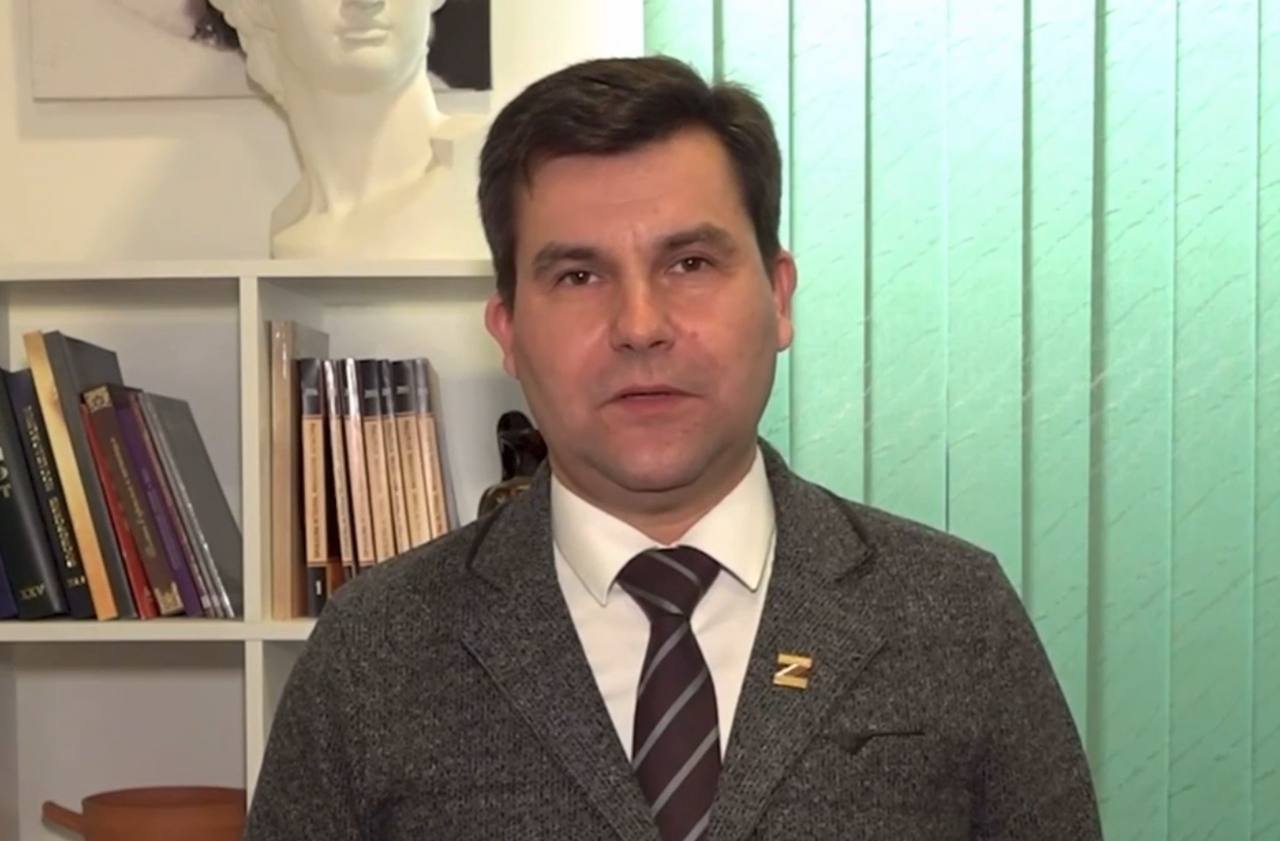
Another figure close to Saldo in the occupation MCA was 46-year-old Serhii Cherevko, who became responsible for education, science, culture, healthcare and social protection.
Cherevko owes his professional and political career to Volodymyr Saldo, who in 2002 made him a deputy of Kherson City Council from the NGO “Our City – Our Home,” and the following year appointed him his humanitarian deputy. Cherevko served in that role for 13 years, merging with the city’s educational and cultural life, which he oversaw. Cherevko nurtured Saldo-style reverence for Russian and pro-Kremlin views, which repeatedly led to accusations of pro-Russian sympathies.
After the change of power in 2014 Cherevko kept the position of deputy mayor, albeit in an acting capacity. Despite repeated attempts by city council deputies to dismiss him, Mayor Volodymyr Mykolayenko kept Cherevko on his team for a long time. He was finally removed from the city council executive committee in April 2017.
In subsequent years Cherevko remained active in the region’s political life as an advisor to the general director of Smart Maritime Group LLC Vasyl Fedin, who represented oligarch Vadym Novynskyi’s interests in the region. In the 2019 presidential election Cherevko was a trustee of Oleksandr Vilkul, who was supported by Akhmetov and Novynskyi.
In the 2020 local elections Cherevko ran for Kherson City Council and the Korabelnyi District Council from the Bloc of Volodymyr Saldo and was elected a deputy of the district council.
After the full-scale invasion Cherevko alongside Saldo went under the Russian tricolor and on March 16, 2022 participated in the session of the “Committee for Salvation for Peace and Order.”
At a meeting with directors of Kherson schools in May 2022 Cherevko was introduced as deputy head of the occupation MCA for education, which, however, did not spark enthusiasm among educators or mass manifestations of collaborationism among them.
He held that post until November of the same year, when he moved to work in the occupation government of Kherson oblast and became deputy head.
Kyrylo Stremousov
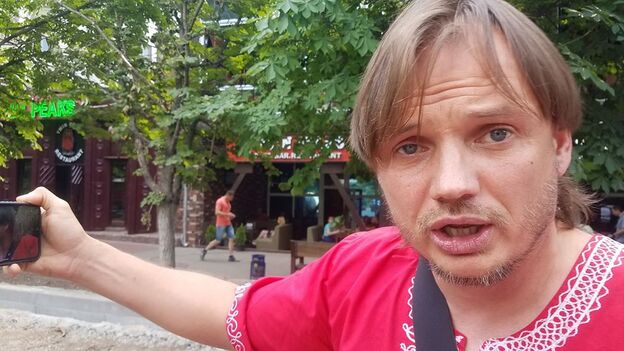
Saldo’s deputy for information policy became his longtime acquaintance – 46-year-old Kyrylo Stremousov, a well-known pro-Russian provocateur and marginal political activist in Kherson. Until his death Stremousov and Saldo remained the only “speaking heads” of the occupation administration well known to local residents. Other collaborators avoided publicity and were not in a hurry to appear in the information space – a tendency that largely persists today.
Appearing in Kherson around 2009, an unknown fisheries inspector from Henichesk quickly requalified as a journalist, creating together with local businessman Ustyn Maltsev the information agency “TAVRIA NEWS,” on the site of which he abundantly posted videos of his numerous performances.
The talent of the political adventurer manifested already in 2010, when he deceived the trade union of the Kherson factory named after Petrovsky into seizing their own enterprise. He was aided by representatives of Kyiv leftist organizations such as Andrii Manchuk. Later some activists from those actions ended up among participants of pro-Russian armed formations in Donbas.
After returning from travels across the American continent Stremousov became interested in esotericism and joined the “Concept of Public Security” movement – a conspiratorial organization that combined elements of Russian nationalism, neo-paganism and pseudo-scientific theories. One of the movement’s key ideas was the creation of a “single East Slavic state.”
The local KOB cell in Kherson numbered over 30 people. Their meetings took place in one of the city libraries. Odious figures like Serhii Kyrychenko and Hoshi Tambovtsev attended the sessions. For a long time this activity remained marginal, but during the 2014 events KOB activists began participating in pro-Russian rallies under Russian flags together with communists and representatives of Aksonov’s party “Russkoe Edinstvo,” led by businessman Heorhii Kalonov.
During the Revolution of Dignity Stremousov openly supported Viktor Yanukovych and in December 2013 created the public organization “For the President of Ukraine.” He then claimed to be in personal contact with Yanukovych.
After 2014 Stremousov became one of the most prominent local newsmakers thanks to a series of scandalous actions and conflicts. His name is associated with a clash with security forces, shooting at a security guard, an attack on former Kherson mayor Volodymyr Mykolayenko and threats to a journalist of the newspaper “Vhoru.” He seemed unaffected by all of it.
Frequent facts indicated that Stremousov cooperated with local police, which is why it reacted so sluggishly to his antics. Stremousov himself declared that he was almost an assistant to the head of the regional police Artur Merikov, flaunting this patronage.
At that time Stremousov also tried to start a political career. He ran for the Verkhovna Rada in 2019, and in 2020 for Kherson mayor, but both times he received less than 2% of the vote.
On his YouTube channel Stremousov actively spread conspiracy theories about “American biolabs” in Ukraine, the “artificiality of the COVID-19 pandemic” and the “fascization of Ukraine.” His channel was later blocked for spreading disinformation.
On August 20, 2020 counterintelligence of the SBU announced the uncovering of an FSB agent network in Kherson oblast. Then law enforcement detained and charged Tetiana Kuzmich with treason. Searches were also conducted at an employee of Media-Potok and blogger Kyrylo Stremousov, during which his phone and computer equipment were seized.
After the start of the full-scale Russian invasion in 2022 Stremousov openly supported the aggression and began publicly spreading Russian propaganda.
Becoming Saldo’s deputy in the MCA, he effectively served as the main spokesperson for the occupation authorities. In his numerous statements he announced the introduction of the ruble, possible annexation of Kherson oblast and other decisions that often did not correspond to the Kremlin’s real plans.
While working in the MCA Stremousov complained that Kherson collaborators lacked personnel potential, since few wanted to work in occupation structures.
After the Armed Forces liberated parts of Kharkiv oblast in autumn 2022, Stremousov on his channel suggested that Russian Defense Minister Sergei Shoigu shoot himself. Stremousov’s statements even interested the Russian Security Council.
On November 9, 2022 Russian propaganda media reported Stremousov’s death in a traffic accident near Nova Kakhovka. On the same day Russian Defense Minister Sergei Shoigu announced the withdrawal of Russian troops from the right-bank part of Kherson oblast. And in the evening Putin posthumously awarded Stremousov the “Order of Courage.”
The circumstances of Stremousov’s death raised numerous questions. Notably, the video of Volodymyr Saldo’s “mourning statement” was recorded two hours before the first reports of the accident appeared. One possible explanation cited was the deliberate removal of the odious deputy. According to MOST’s sources in law enforcement bodies, Stremousov could have been killed by his own people to cover tracks and eliminate one of the poorly controlled propagandists “who had long since gone too far.”
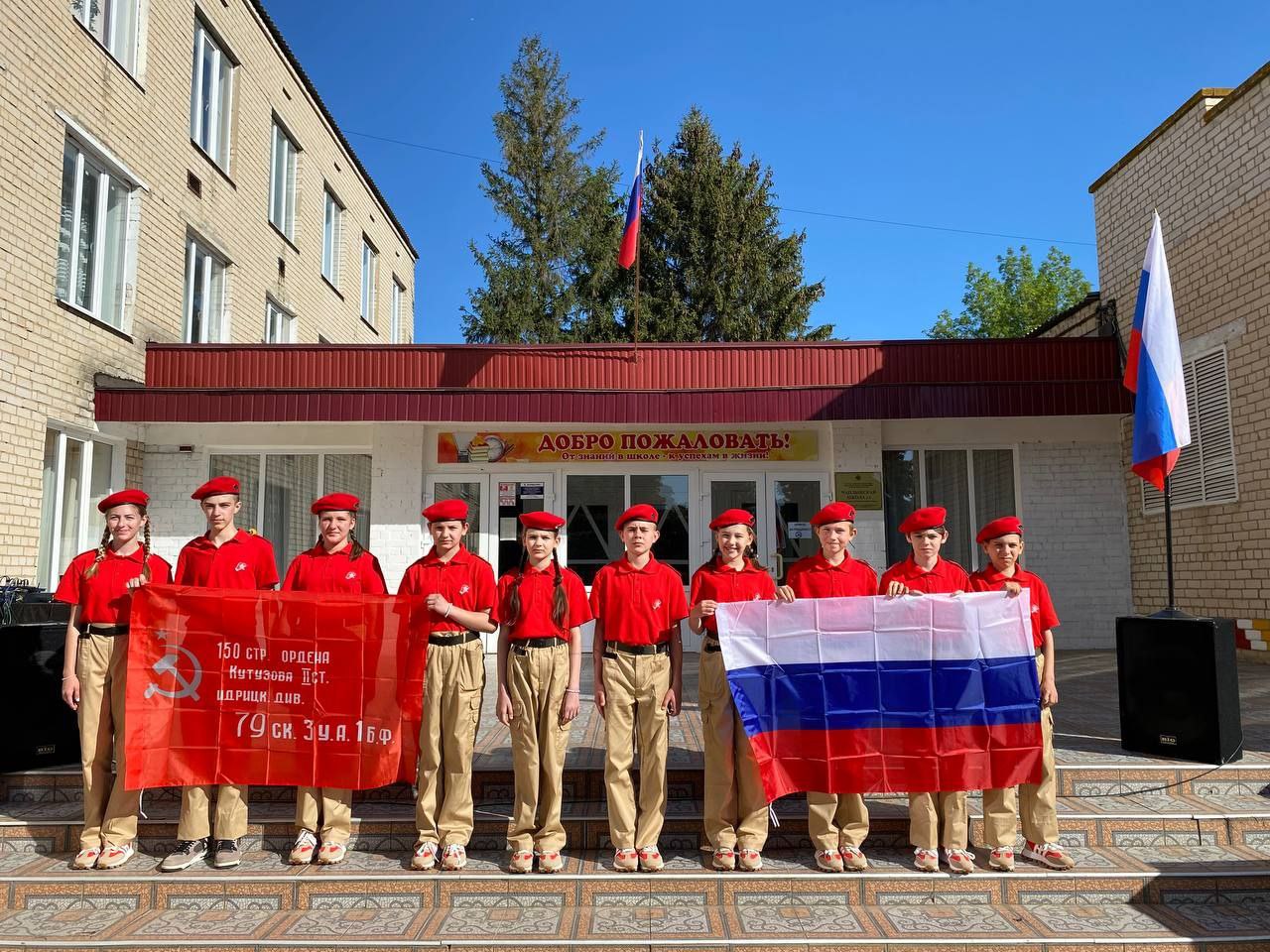
Even after his death Stremousov remains useful to the occupiers. Russian propaganda is trying to form an image of him as a “fighter.” In temporarily occupied Henichesk a mural with his image appeared, propagandists released films about his activities, and one of the Yunarmiya units was named after Kyrylo Stremousov.
If at the initial stage of the occupation MCA Saldo’s deputies were exclusively Kherson collaborators, after the Kremlin’s decision to annex the occupied regions the situation changed. By summer 2022 “watchers” from the “DPR” and the FSB began to be co-opted into the administration’s leadership.
Kateryna Gubareva
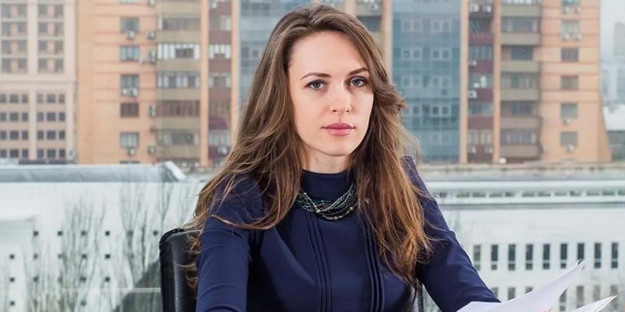
In June the Donetsk side reinforced Saldo with the wife of separatist Pavlo Gubarev – 39-year-old Kakhovka native Kateryna Gubareva, who became responsible for internal and international policy, social protection and headed the MCA apparatus.
Gubareva was born and finished school in Kakhovka, but her adult life is connected to Donetsk. It was there in spring 2014 that she and her husband took active part in anti-Ukrainian rallies. Later Gubareva entered the leadership of the terrorist organization “Donetsk People’s Republic,” even serving as “minister of foreign affairs” and a deputy of the local “parliament.”
In March 2022 Gubareva appeared in occupied Kherson and took part in organizing repressions against participants of pro-Ukrainian rallies.
In June 2022 Saldo appointed her his deputy in the MCA. In Kherson she lived in a house seized by occupiers from Kherson State University rector Oleksandr Spivakovskyi.
In the post she actively spread Russian propaganda, notably accusing Ukraine of being responsible for Ukrainian banks not operating on occupied Kherson territory while simultaneously promoting Russian “Promsvyazbank.”
In November 2022 Russian media reported her detention on suspicion of embezzling about 60 million rubles of budget funds. According to Russian media, she was first removed from her post and later detained in Moscow where she tried to find a new job. Gubareva was later released but for a long time remained under house arrest.
In December 2022 Gubareva announced that she refused to work in the occupation administration. According to her husband, her persecution may have been related to a conflict with Donetsk criminal authority Armen “Horlovskyi” amid the redistribution of property in occupied Kherson region.
After moving to Moscow the Gubarev couple turned into political freaks who occasionally appear at rallies demanding the release from prison another forgotten “hero of Novorossiya” – Ihor Hirkin (Strelkov).
The FSB also sent two of its officers to reinforce Saldo – first 55-year-old Chechen Aslan Arsanukaiev, who became curator of housing and communal services and construction, and in August – 48-year-old Russian Oleksii Katerynichev, responsible for security.
Aslan Arsanukaiev
Arsanukaiev’s career is closely linked to Russian special services. From 2003–2014 he worked as an FSB resident in Ukraine, including as senior advisor to the board chairman of Sberbank of Russia in Ukraine. Notably, in 2011 he even obtained higher education at the University under the Ministry of Finance of Ukraine.
After the Revolution of Dignity he was recalled to Russia, where from 2014–2021 he served as an FSB curator in state companies.
After the start of the full-scale war in July 2022 he was appointed deputy to Saldo for construction, housing and communal services, transport and natural resources.
On December 26, 2022 a search was reported at his house conducted by investigators of the Russian Investigative Committee. Media reported that over 10 million rubles and $50,000 were seized during investigative actions. Arsanukaiev was detained on suspicion of embezzling budget funds on an especially large scale. Investigative actions were conducted as part of a probe into embezzlement of funds allocated for road construction on the temporarily occupied territory of Kherson oblast.
The last time Russian propaganda media mentioned Arsanukaiev was in June 2023 – in the context of dealing with the consequences of the Kakhovka HPP explosion.
Oleksii Katerynichev
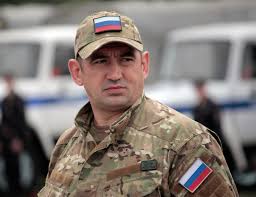
On August 18, 2022 the first deputy of Volodymyr Saldo for security became another career FSB officer – Oleksii Katerynichev. His appearance in the leadership of the occupation administration was so important to the Russian handlers that Vitalii Bulyuk had to be demoted to the status of an ordinary deputy so that Katerynichev could become the sole first deputy.
However, he held that post for just over a month. On September 30, 2022 Katerynichev was eliminated as a result of a pinpoint strike by the Armed Forces of Ukraine with a HIMARS multiple launch rocket system on the house where he lived in Kherson.
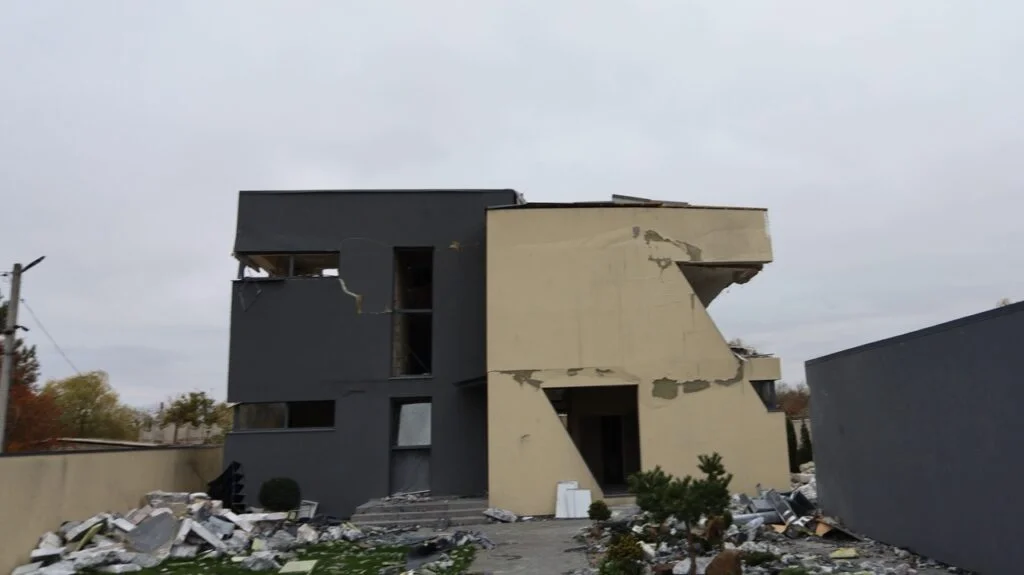
Little is known about Katerynichev. Since 1996 he served in a combat unit of the FSB and took part in the storming of the Beslan school in 2004. In 2021 he moved to serve in the Russian Ministry of Emergency Situations. That year he accompanied federal emergencies minister Yevgeny Zinichev during a trip to the Kitabo-Oron waterfall, but did not save him from a tragic death. After that Katerynichev was reportedly placed in the reserves, but in 2022 he appeared in occupied Kherson.
***
After the annexation of the territories occupied by Russia in October 2022 the region’s management system was rebuilt according to the Russian administrative model. In this construction there was no place for the “military-civilian administrations.”
Consequently members of the old MCA team began to look for their place in the new occupation nomenklatura. Vitalii Bulyuk, Serhii Cherevko and Ihor Semenchev-junior received positions as deputies in the so-called regional “government.” Meanwhile Aslan Arsanukaiev and Kateryna Gubareva lost their positions and faded into oblivion. Kyrylo Stremousov and Oleksii Katerynichev, having failed the test of power, found their rest in cemeteries.
On January 23, 2023 Volodymyr Saldo, already in the capacity of acting occupation governor of Kherson oblast, by his decree terminated the existence of the “military-civilian administration” of Kherson oblast.