

Kherson City Court acquitted a resident of the village of Kizomys, Vlas Baranovskyi, who was accused of cooperating with Russian military personnel during the occupation of the right-bank part of the Kherson region.
The verdict states that the prosecution did not prove that the man’s actions fell under part 1 of Article 111-2 of the Criminal Code of Ukraine (“Assistance to an aggressor state”). But the story did not end there. And its course is worthy of attention. Because if you look at the situation from the perspectives of the prosecution, the defense and Baranovskyi’s relatives, three completely different narratives emerge.
In the indictment, in the accounts of the victims and the prosecution’s witnesses, the resident of Kizomys Vlas Baranovskyi is portrayed as a person who collaborated with the invaders during the Russian occupation of the village, providing them, as stated in the Kherson City Court decision, with information “about patriotically oriented residents of Kizomys and owners of weapons”.
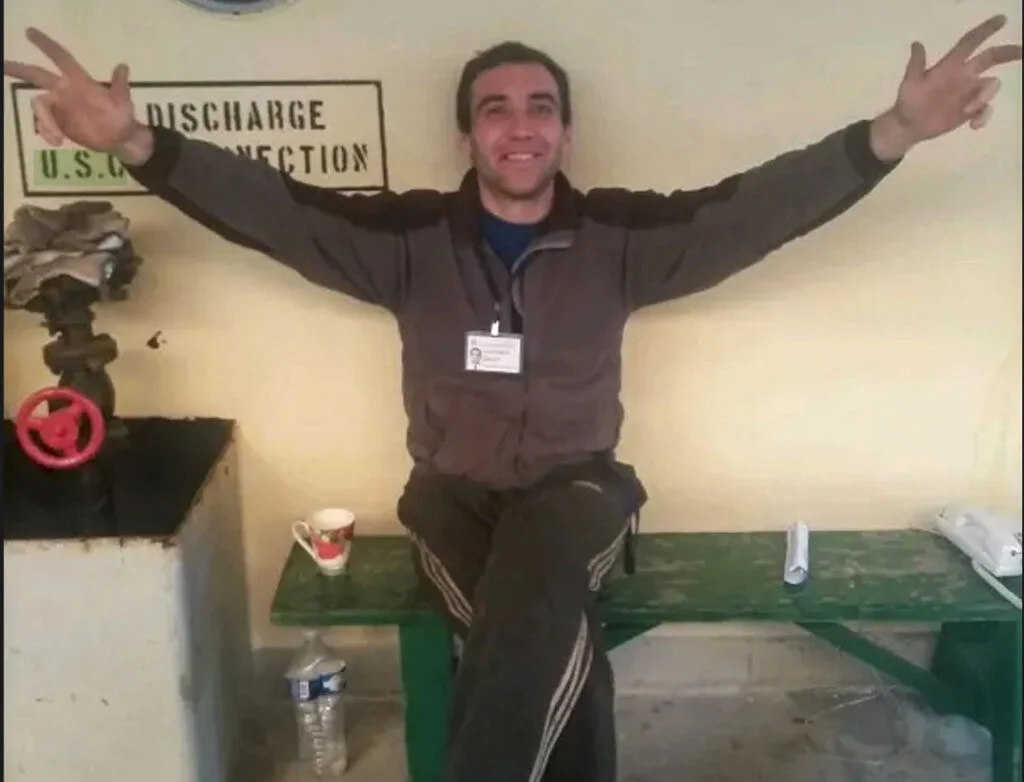
Baranovskyi himself, his relatives, lawyers and the witnesses the defense brought to court said that the man did not cooperate with the occupiers, but became a victim first of an unfortunate accident and then of slander by people with whom he had difficult relations for many years.
From the prosecution’s point of view
In the part of the verdict that sets out the prosecution’s position, it is stated that Baranovskyi allegedly knowingly provided Russian soldiers with information about pro-Ukrainian-minded fellow villagers who owned hunting weapons, thereby facilitating the “illegal detention, torture and robbery of civilians”.
It is further stated that on August 15, 2022 the accused accompanied Russian soldiers to the house of a local resident, and the occupiers, threatening to kill him, demanded that the man hand over the weapon he kept. That man was a prosecution witness and said that Russian soldiers broke into his house, searched the house and yard, and found nothing that interested them.
Then the Russians, according to the accusatory part of the verdict, again accompanied by Vlas Baranovskyi, arrived at the yard of another Kizomys resident and broke into the house, demanding that the owner hand over the weapon he stored. The occupiers took the man’s hunting rifle, and, as the man and his wife said in court, stole money and jewelry, causing damage totaling more than 155 thousand hryvnias.
After the search, Baranovskyi, according to prosecution witnesses, allegedly shouted that he would “teach everyone the Russian world”.
Prosecutor of the Oleshky District Prosecutor’s Office Dmytro Shyshenko, who represented the prosecution in this trial, requested that the defendant be sentenced to 12 years in prison with confiscation of all property.
From the defense’s point of view
In the part of the verdict that presents the defense’s position, the story “takes on” details that make it appear completely different.
According to the document, Vlas Baranovskyi owned a chainsaw, and during the Russian occupation, when he could not work in his main profession (a sailor), he did odd jobs cutting firewood for fellow villagers.
And on August 15, 2022 two young fellow villagers asked to borrow this saw for temporary use. The man refused, and some time later, while he was not at home, he heard the sound of his chainsaw. He rushed home and saw that the tool had been stolen, the shed broken into. Baranovskyi decided that the saw had been taken by the young people who had asked for it. He went to their parents.
Near the shop he met Valentyn Kucherenko – a relative of one of those young men. Kucherenko, as stated in the verdict, was intoxicated. He verbally abused Baranovskyi brutally, then ran home, soon returned with a rifle and began shooting in the direction of Baranovskyi. He missed. And Baranovskyi, not wanting to be shot, ran away from the scene of the confrontation. He wanted to reach his godfather’s house and wait out there. But on the way he came across a minibus with Russian soldiers.
The bus stopped, two soldiers got out and asked the man where he was running to. He answered that he was fleeing from a fellow villager who was shooting at him. The occupiers dragged the man into the minibus, laid him on the floor and demanded that he show where that fellow villager lived. When they arrived at Kucherenko’s place, he said that he indeed had shot at Baranovskyi because the latter allegedly stole grapes from him.
After this, the Russians, as the defense notes and the witnesses it called confirm, ordered Baranovskyi to leave, and he did not take part in what happened next.
These events did not develop further until Kizomys was liberated. When the village was freed from the Russians, Valentyn Kucherenko informed Ukrainian forces that Baranovskyi had allegedly collaborated with the Russians. Moreover, according to Yuliia Baranovska, Vlas’s sister, the Kucherenko family subjected her brother to vigilante justice: tied him to a “pillory”, beat and insulted him. In his house, says the sister, an unauthorized search was conducted, as a result of which the interior was smashed.
«Serhii, the son of the Kucherenko couple, – Yuliia recounts, – filmed the abuse of my brother on photo and video and posted them on social networks, and also sent them to local residents».
As stated in the verdict, the defense asked the court to declare the victims’ testimony unreliable, since there are grounds to believe that it was the victims who cooperated with the occupiers, not Baranovskyi.
«The victim’s wife, – says Ihor Bilov – one of the lawyers who represented Vlas Baranovskyi’s interests, – during the occupation worked on village improvement tasks when Kizomys was being prepared for a pseudo-referendum. She said she did not receive money from the occupiers for this, and it is impossible to verify the reliability of her testimony. But it is known for certain that the Kucherenko family received humanitarian aid from the Russians. The son of this couple traded in second-hand goods, traveled to Crimea for stock, exchanged hryvnias for rubles».
By contrast, villagers who testified in this case said that Vlas Baranovskyi did not receive anything from the occupiers.
The defense also pointed out that the defendant was initially charged with treason in wartime, and only later, shortly before the trial, the charge was reclassified to “Assistance to an aggressor state”. Crimes under these articles are investigated by the SBU according to Ukrainian law. Baranovskyi’s case was investigated by the police.
«…The assignment of the pre-trial investigation to a body other than SBU investigators was unjustified, in the absence of an ineffective pre-trial investigation, as a result of which the defense believes that proper legal procedure was not observed. The guilt of the accused has not been proven by proper, sufficient and admissible evidence. Assigning the investigation to the police is a material violation of human rights»
states the part of the verdict that sets out the defense’s position.
Regarding another Kizomys resident, whom Baranovskyi allegedly led to the Russian soldiers, there is much that is unclear in this story, because everything is based on the victim’s testimony. According to Yuliia Baranovska, this victim is a friend of Valentyn Kucherenko. And, according to lawyer Ihor Bilov, the victim’s wife collaborated with the Russians, which was proven by the investigation and the court; the woman was convicted and is serving a sentence.
The lawyers asked the court to acquit Baranovskyi because, in their view, the indictment was based solely on assumptions, and expert examinations were carried out only on the basis of the victims’ testimony.
From the accused’s relatives’ point of view
Yuliia Baranovska told MOST’s correspondent that her brother’s relationship with Valentyn Kucherenko has been difficult for many years.
«Our family, – says Yuliia, – has a pond that Kucherenko has long wanted to buy. We do not sell the pond, Vlas raised ducks and geese there».
According to Yuliia, it was because of the pond that Valentyn Kucherenko held a strong dislike for her brother.
She finds the situation with the search conducted by Russian soldiers in the Kucherenko family home very strange: “Valentyn said that the arrival of the Russians caused him great moral suffering. And yet the next day he and his wife went to Bilozirka, where the occupying military commandant’s office was located, to ask for the return of what had been stolen”.
Yuliia Baranovska says that on the same day the Kucherenko couple went to Bilozirka, Russian soldiers returned to Kizomys, and this time went to her brother’s house.
«Vlas, – the woman recounts, – was not at home then. The Russians smashed windows and doors. A neighbor saw this. She asked the occupiers: ‘What are you doing?’ They replied: ‘We were told that a robber lives here. We must punish him.’ My question is – who pointed them to my brother?».
Yuliia considers the accusations of aiding the Russians and passing information to them absurd: “What treason and what assistance to the occupiers can we talk about if Vlas, as a villager, knew well who participated in the ATO, who worked in the police, but did not report any of these people or their family members to the Russians?!”
The same opinion is shared by lawyer Ihor Bilov: “For some reason the ‘treason’ manifested itself only in August 2022. That is strange. And regarding the alleged informing the Russians about weapon owners, given that about half of the men in Kizomys are hunters, the occupiers could have found weapon owners without informants”.
Yuliia Baranovska says that prosecutor Dmytro Shyshenko offered her brother to plead guilty to treason and to write a statement requesting to be included in exchange lists. Vlas Baranovskyi categorically refused.
«These proposals, – the woman says, – Shyshenko made when he visited the pre-trial detention center where my brother was held. There were several such visits that the prosecutor did not coordinate with the lawyers».
Speaking about the prosecutor’s interest in a successful outcome for him, Yuliia notes that Dmytro Shyshenko and Valentyn Kucherenko are acquainted: “Kucherenko ran a recreation base known in the village as ‘Prorishka’. Police officers and prosecutors liked to relax there. Vlas once worked at that base: he ferried people there across the river. He saw Shyshenko among the vacationers and saw how he communicated with Kucherenko”.
According to lawyer Ihor Bilov, a motion was filed during the hearings to disqualify the prosecutor due to his possible personal interest in the outcome of the case. But the court decided that there was no convincing evidence that the victim and the prosecutor were acquainted, or that the latter had a personal interest.
Yuliia Baranovska says that there are two character references in her brother’s case: from the Bilozirka settlement military administration (the village of Kizomys is part of the Bilozirka settlement community) and from the local eldership.
“The characterization from the military administration, – says Yuliia, – is negative, but it was written by people who did not know Vlas, and this characterization contains inaccurate information, in particular that my brother abuses alcohol, whereas he has not consumed it at all for many years. The eldership’s characterization, where people know Vlas, is positive. So the question is – on whose words was the military administration’s characterization written?”.
Now Vlas Baranovskyi, who spent three years in pre-trial detention, is undergoing treatment because his time in custody has badly affected his health. He and his lawyers are also preparing for an appellate hearing.
«The prosecution will certainly file an appeal, because in cases of cooperation with the Russians it does so even when the court’s verdict is somewhat more lenient than the prosecutor demanded. And in our case the court acquitted the accused and released him from pre-trial detention. Actually, given the circumstances of the case, the decision could not have been otherwise»,
says lawyer Ihor Bilov.
Yuliia Baranovska says that her brother’s acquittal is only the first step in the fight for justice: “I will seek to hold accountable all the people through whom our family endured so much suffering”.