

The Coordination Council on support for civilian hostages and their families, created under the executive committee of the Kherson City Council, will be reformatted according to the wishes of public organizations.
This decision concluded the meeting held on 18 February 2026 at the Kherson City Military Administration (HCMA), attended by representatives of public organizations that unite former civilian hostages and care for them, as well as the head of the HCMA Yaroslav Shanko, his deputies Mykhailo Lynetskyi and Natalia Chornenka, and HCMA staff.
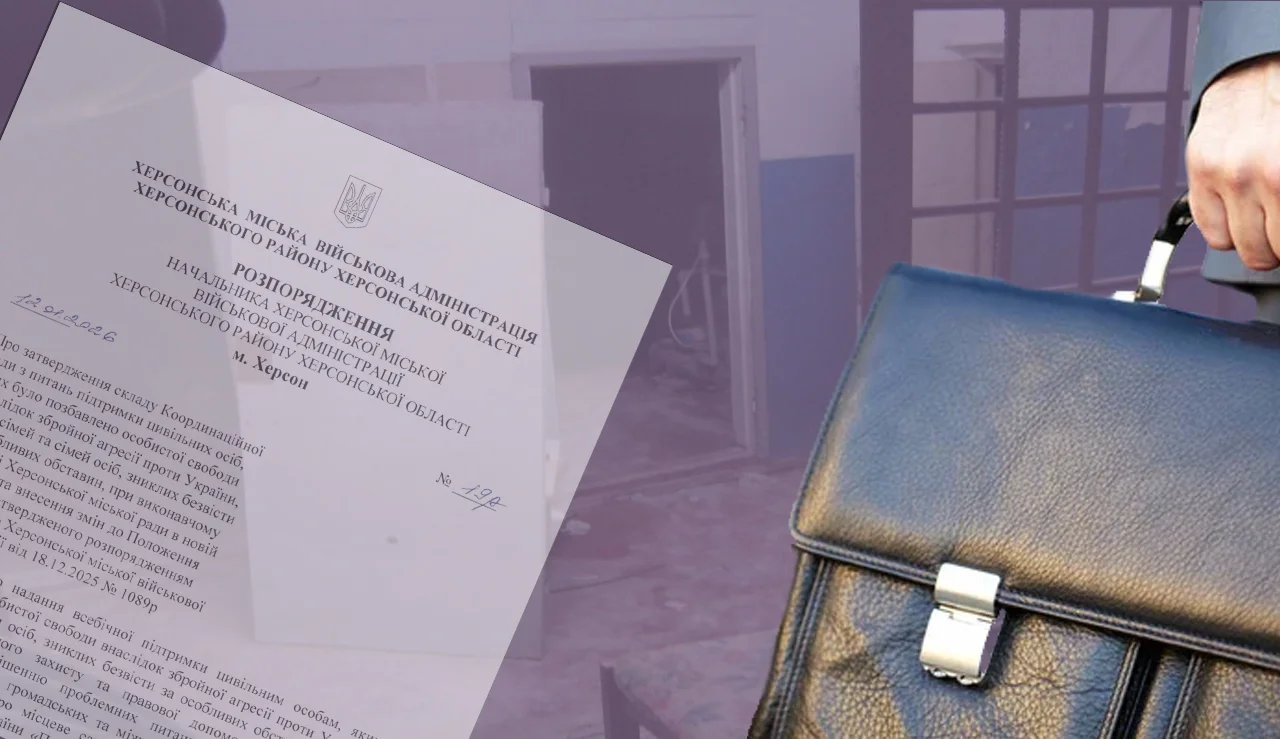
During the meeting a decision was made to cancel the order of the head of the Kherson City Military Administration No. 19r approving the composition of the Coordination Council. According to this order, the council included 23 people, of whom 10 were officials and 13 were representatives of public organizations. Moreover, some officials joined the Coordination Council as former civilian hostages and as representatives of public organizations.
As a result, an imbalance arose that former civilian hostages interpreted as an attempt by the HCMA to make the Coordination Council subordinate to officials, which MOST wrote about in January 2026.
The full name of the advisory body is the Coordination Council on the Support of Civilian Persons Who Were Deprived of Their Personal Freedom as a Result of Armed Aggression against Ukraine, Their Families and the Families of Persons Who Went Missing under Special Circumstances, at the Executive Committee of the Kherson City Council. The Coordination Council was created by Order No. 1089p of the head of the Kherson City Military Administration dated 18 December 2025. It was then headed by Roman Baklazhov – head of the charitable foundation “11 November”, a former civilian hostage.
At the meeting held on 15 January the Chair of the council was to be elected. There were two candidates: Olga Chernyak, an employee of the Department of Labor and Social Protection of the Population of the Korabelnyi District Council in the city of Kherson, and Roman Baklazhov. Twelve of the twenty people present at the meeting voted for Chernyak, and eight for Baklazhov. The Chair was not elected due to objections from former civilian hostages and public representatives.
During the meeting held on 18 February, Yaroslav Shanko supported the public representatives, noting that the ratio of former civilian hostages to officials on the Coordination Council should not favor the latter.
«We, – Shanko said, – will ensure that the composition of the Coordination Council is two-thirds formed of representatives of public organizations and of the civilian hostages themselves or members of their families. And one third – representatives of state authorities and local self-government bodies who implement policy in this sphere».
Decisions were also adopted to draft a new Regulation on the Coordination Council and to hold new meetings of it in the near future, during which a leader will be elected. Yaroslav Shanko appointed another of his deputies responsible for interaction with the Coordination Council on behalf of the HCMA: instead of Natalia Chornenka these matters are now overseen by Mykhailo Lynetskyi.
According to a council member, deputy head of the charitable foundation “11 November”, and former civilian hostage Mykola Megeria, all this became possible thanks to numerous appeals by public representatives to central state authorities, to law enforcement, and also to the media, in particular to the online outlet MOST.
«The HCMA, – Megeria says, – after all these appeals came to meet us halfway. There are very positive shifts. But there are also some aspects that still upset. The biggest concern is that the city authorities want the officials who will be part of the Coordination Council to have the right to vote there. That is, they will have the ability to oppose decisions they do not like, to manipulate».
During the meeting they also discussed a number of problematic issues related to civilian hostages. In particular, it was noted that the issue of providing assistance to former and current civilian hostages and their family members remains unresolved if a hostage does not have the appropriate official status but there is documentary evidence of the person’s captivity.
According to Yaroslav Shanko, he will raise such issues with state authorities.