

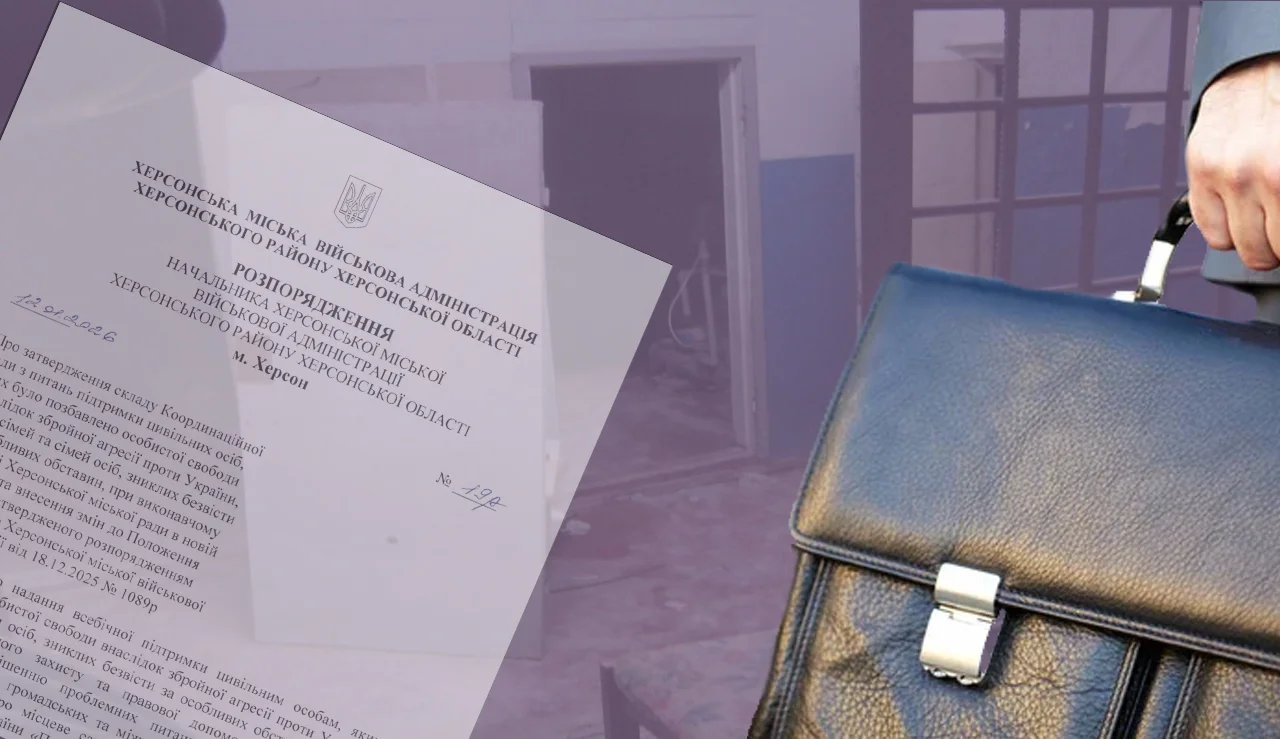
The Coordination Council on civilian prisoners created under the executive committee of the Kherson City Council could become completely subordinate to the local authorities, and representatives of public organizations would perform a decorative function there.
The full name of the advisory body is the Coordination Council for the Support of Civilian Persons Deprived of Personal Liberty as a Result of Armed Aggression against Ukraine, their Families and the Families of Persons Who Went Missing Under Special Circumstances, at the Executive Committee of the Kherson City Council.
The Coordination Council created by order of the head of the Kherson City Military Administration No. 1089p of 18 December 2025. It was then headed by Roman Baklazhov – head of the charitable foundation “11 November”, a former civilian prisoner.
And on 12 January 2026 an order was issued by the head of the Kherson City Military Administration No.19p approving the composition of the Coordination Council. According to this order, 23 people joined the council, of which 10 are officials and 13 are representatives of public organizations.
“By the order of 12 January, – says Roman Baklazhov, – the number of council members was increased, and the people introduced to it by that order (mostly officials) began to express dissatisfaction that I was the one heading the council. Although the members of the council who had been working there since December had no complaints about me. And it was the new members of the council who initiated the election of the chair”.
The chair of the council was elected at a meeting held on 15 January. There were two candidates: Olga Chernyak, an employee of the Department of Labor and Social Protection of the Population of the Korabelnyi District Council in the city of Kherson, and Roman Baklazhov. Twelve of the 20 people present at the meeting voted for Chernyak, eight for Baklazhov.
According to Roman Baklazhov, the nomination of Olga Chernyak and the vote for her looked prearranged: “I have information that a council member, the acting head of the Department of Social Policy of the Kherson City Council Alla Holovata, before the Coordination Council meeting called the officials who are part of it and instructed them to vote for Olga Chernyak”.
Roman Baklazhov noted that Alla Holovata is essentially subordinate to the deputy mayor Nataliya Chornienka, who oversees social policy in the MVA.
After the vote, some council members were outraged because they interpreted the attempt to elect Olga Chernyak as chair as an attempt by the Kherson City Military Administration and Chornienka personally to gain control over the advisory body. By the way, it was Chornienka’s signature that approved the appendix to the 12 January order listing the composition of the council.
“Olga Chernyak, – says Roman Baklazhov, – works at the Korabelnyi District Council in the city of Kherson, which Chornienka led for a long time. As far as I know, she still retains her influence there. I understand that my indignation and the indignation of the people who voted for me can be seen as merely a personal offense, but that is not the case. Our goal is to preserve the council as a truly effective advisory body and to prevent its transformation into a platform for bureaucratic games”.
The head of the “11 November” foundation believes that Chornienka wants to install her own person as chair of the Coordination Council in order to fully control its work.
“This, – says Roman, – defames the dignity of the prisoners, many of whom took part in the resistance movement. We risked our lives not for officials to continue the practices of the Yanukovych era”.
At the same time, Olga Chernyak is being promoted to the position of council chair not as an official, but as a representative of civil society.
“Chernyak, – says Roman, – joined the Coordination Council not as an official but as a representative of the public organization “SEMA Ukraine” and as a former civilian prisoner. I cannot say anything bad about her as a person. But will she be able to fully chair an advisory body created to protect the rights and interests of civilian prisoners, who often have conflicts precisely with the authorities? Whose side will the Coordination Council be on with such a leader?”.
According to Roman Baklazhov, the inclusion of the official Olga Chernyak in the Coordination Council as a representative of a public organization is an attempt by the Kherson City Military Administration and by Nataliya Chornienka personally to make the council “manageable” and subordinate. And it was for this reason that on 12 January the council’s composition was supplemented with officials.
“Into the council, – says Baklazhov, – they added certain officials whose presence, to put it mildly, is surprising. For example, heads of city departments of capital construction and housing, employees of district councils. This creates an obvious conflict of interest and devalues the very idea of an independent advisory body”.
He noted that the inevitable conclusion is that the true goal of the city authorities was not to create a structure that would act in the interests of people affected by Russian aggression, but rather a kind of “buffer” to extinguish potential conflicts with former civilian prisoners and their public organizations.
“Now, – says Roman, – officials and representatives of public organizations that closely cooperate with the authorities have the majority in the Coordination Council. A structure controlled by the Kherson MVA is being created, where other public organizations will be present “for show”, without having the opportunity to seriously influence decision-making and to protect their rights and the rights of their members”.
He noted that Chernyak, although herself a former civilian prisoner, is also a person deeply integrated into the bureaucratic environment.
“Her husband, – says Baklazhov, – Ihor Chernyak, is the head of the Personnel and Staffing Department of the Kherson City Military Administration. He, by the way, was also held captive, but the main thing now is his current place of work. I am convinced that Olga Chernyak, in the event of disagreements between civil society and the authorities, will always be on the side of the latter. But the Coordination Council is an instrument of trust between the authorities and people who have survived captivity, loss and disappearance of loved ones. What kind of trust can we speak of if the authorities behave like this?”.
Roman Baklazhov says that representatives of public organizations who do not want the Coordination Council on civilian prisoners to turn into a structure subordinate to the MVA plan to send an appeal to the head of the Kherson MVA, Yaroslav Shank, asking him to remove officials from the council, leaving only one representative from the departments of social protection and health care.
The same view is held by another member of the Coordination Council, Mykola Meheria – deputy head of the “11 November” charitable foundation.
“A conflict is brewing, – he says, – which may even lead to representatives of public organizations who did not support Olga Chernyak leaving the council. And these are the organizations most actively oriented towards making radical decisions to improve the lives of former prisoners of the Kremlin”.
Roman Baklazhov noted that there is an effective form of cooperation between advisory bodies and the authorities without officials being members of the council: “Officials can, if necessary, be invited to council meetings, as the Public Council at the Kherson Regional Military Administration does, of which I am a member”.
Because of the position of some members of the Coordination Council, the meeting at which the chair was elected has been suspended for an indefinite period.
If it is not possible to resolve the issue at the local level, members of the Coordination Council will appeal to the Office of the President of Ukraine and to the Commissioner of the Verkhovna Rada of Ukraine for Human Rights.