

In January this year it became known that nine Kherson residents whom the Russians accused of “international terrorism” were handed unlawful sentences.
As the relatives of the detainees told the online publication МОСТ, the prisoners’ lawyers have now filed appeals.
On January 30, 2026, in the city of Rostov, at the Southern District Military Court, sentences were announced to the Kherson residents announced the verdict. Entrepreneur and Red Cross volunteer Yuriy Kaiov was sentenced to 14 years of imprisonment. Former Armed Forces servicemen Denys Lialka and Serhiy Kovalsky, as well as head of fishing production Serhiy Heydt and manager Serhiy Ofitserov, each received 17 years. Eighteen years were given to former Kherson city council employee Oleh Bohdanov and head of the customs post “Kherson–port” Yuriy Tavozhnyansky. Entrepreneurs Kostiantyn Reznik and Serhiy Kabakov were sentenced to up to 20 years of imprisonment.

According to Ukrainian and Russian (not controlled by the Kremlin) human rights defenders, the case of the “Kherson nine” is unprecedented because of the size of the group and the brutality of the torture the civilian prisoners endured. The Russians claim that all the defendants were detained on October 6, 2022. However, they were in fact kidnapped in Kherson by Russian servicemen and FSB officers much earlier: in July and in August. Later they staged their detention, falsified evidence and fabricated the case.
Earlier МОСТ wrote about two prisoners – Kostiantyn Reznik and Serhiy Ofitserov.
In serious condition without medical care
According to relatives of the civilian prisoners from the “Kherson nine”, the prisoners are currently likely held in the detention center (SIZO) in the city of Rostov. Relatives receive information from Russian lawyers who represent the civilian prisoners’ interests, or from Russian volunteers who help Ukrainians.
However, not all lawyers communicate with the relatives.
“We, – says Mariia, the stepdaughter of Serhiy Heydt, – have no contact with the lawyer. We learn about news from relatives of other prisoners. Sometimes one of the volunteers writes: he reports that he brought a parcel for Serhiy, it was accepted, that is, he is still in the SIZO”.
Olha, the wife of Yuriy Tavozhnyansky, also says that the lawyer representing her husband does not communicate with her: “I know from relatives of other prisoners only about the verdict and the appeal. Unfortunately, I have no other information”.
The prisoners were brought to Rostov from Moscow, where they had been held in the “Lefortovo” detention center.
“In Rostov, – says Yuliia Puhach, sister of Denys Lialka, – the food and living conditions are much worse than in “Lefortovo”. My brother spent some time in a damp and cold cell where 27 people were held, although the cell is designed for a much smaller number of prisoners. There people slept sitting and took turns using the beds to sleep in shifts”.
Yuliia says that after the verdict of the Russian court of first instance the fate of the prisoners became uncertain: “Under Russian law, during the appeal proceedings a person must remain in the SIZO, and there is a possibility that this requirement may be ignored and the people sent to colonies. And during transfers a person “disappears”: even lawyers may be told nothing, and they later search for the prisoner by sending inquiries”.
This is how the prisoners over more than three years of their ordeals were sent from Simferopol (they were brought there from Kherson in October 2022) to Moscow, and from there – to Rostov, where in March 2024 the trial began. They were transferred one by one, with no one informed about it.
According to relatives, the health of the Kherson residents illegally held in the Russian Federation is very poor.
“As far as I know, – says Oleksandra – wife of Serhiy Kovalsky, – my husband has external hydrocephalus, that is, a brain tumor – a consequence of torture. He does not receive adequate medical care. He only takes painkillers and vitamins that are passed on by the lawyer. Of course, that is not treatment. But the SIZO administration does not allow other medicines to be passed, and proper examinations and specialized help are, unfortunately, out of the question”.
Oleksandra Kovalska says that her husband has spinal problems as a result of numerous beatings, and rib fractures are also taking their toll.
Another Kherson prisoner – Serhiy Kabakov – asked for medications because he has serious health problems, but the SIZO administration did not allow it. Yuliia Vorona, the prisoner’s niece, says that the parcels received by her relative and other civilian prisoners often arrive very late and incomplete.
“The parcels, – says Yuliia, – are held in the SIZO for a week or more before being handed over, and people receive spoiled fruit if it was in the parcels. There are also cases when some products disappear from parcels, and the SIZO administration gives no explanation. Only the simplest medicines can be passed, for example, some painkillers. In response to lawyers’ complaints the administration says that prisoners are supposedly provided with everything necessary, although that is not true”.
According to Yuliia, the SIZO administration refused the lawyers’ request to conduct medical examinations of the prisoners, because each of them is in serious condition and is not receiving adequate medical care.
Asked about the condition of another prisoner, Kostiantyn Reznik, a friend of Serhiy Kabakov, Yuliia replied that the 60–year–old Reznik – the oldest in the “Kherson nine” – judging by the reports she receives, has serious health problems, is struggling psychologically, but the man is holding on and hopes to return to Ukraine.
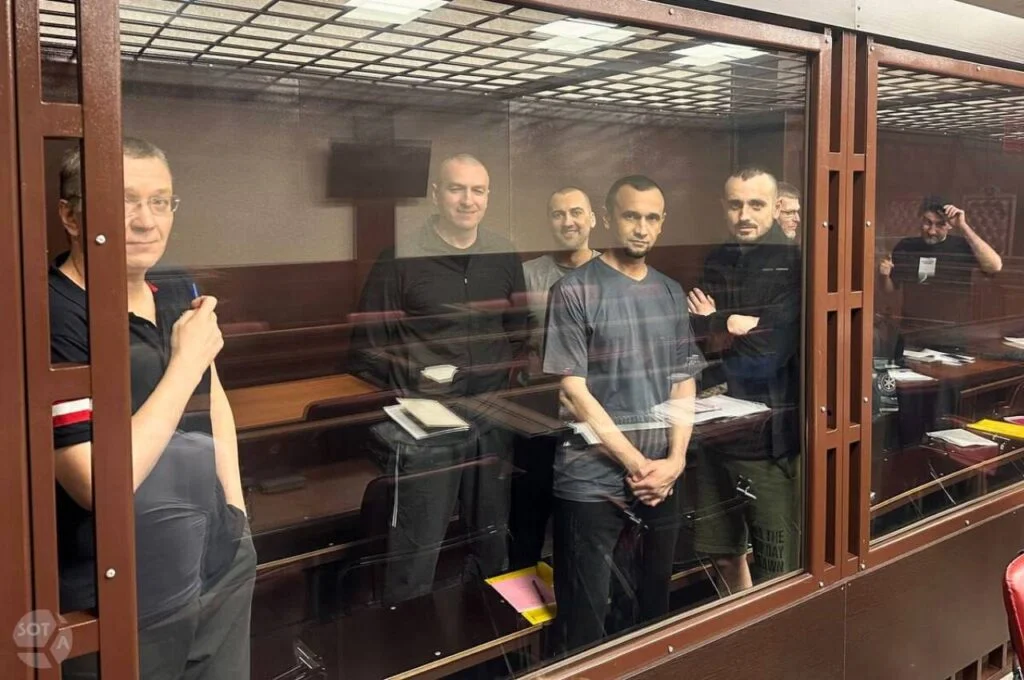
Relatives of the prisoners talk about the appeal without optimism, because they clearly understand what to expect from the Russian judicial system. Some even fear that the appellate decision may worsen the fate of the “Kherson nine”.
“I have, – says a relative of one of the prisoners, – acquaintances – relatives of a civilian prisoner for whom a trial of first instance has already taken place in Russia and there is already an appellate court decision. The latter reviewed the sentence and instead of 20 years sentenced the person to 29 years and six months (in the Russian Federation the harshest punishment after life imprisonment is 30 years of imprisonment, – МОСТ). Therefore I fearfully await what the appellate decision will be for the “Kherson nine”.”
Questions without answers
Why was the show with the “Kherson nine” staged? What is the point of this for the occupiers? What goal did they have in arranging this sham trial? Why did Russian security forces release some people kidnapped in Kherson (notably well-known people in the city – officials, deputies, journalists, public figures, volunteers…), while turning ordinary townspeople into “international terrorists” by grossly fabricating evidence?
We asked some Russian human rights defenders, who now live outside the Russian Federation and who monitored the situation in Kherson – in particular, the kidnappings of local residents by the occupiers – these questions.
The human rights defenders did not provide answers.
So let’s try to reflect on the situation with the “Kherson nine” without them.
The indictment in this case was compiled by investigator Ulanov, an investigator for particularly important cases of the Investigative Directorate of the FSB of Russia, agreed by the first deputy head of the Investigative Directorate of the FSB Mikhail Savitskiy, and approved by the first deputy Prosecutor General of the Russian Federation Anatoly Razinkin. That is, high-ranking officials participated in preparing the case.
The Russians designated three Kherson occupation officials as the potential victims of the “international terrorists”, whom one can count among TOP traitors: former first deputy head of the regional council Vitaliy Bulyuk (now deputy occupation governor), MP from the “Servant of the People” party Oleksiy Kovalov (minister of agriculture in the occupation government of Kherson region) and pro-Russian activist Kyrylo Stremousov (another deputy occupation governor).
This story was covered by leading Russian pro-Kremlin media: TASS, the television channel “Russia 24”.
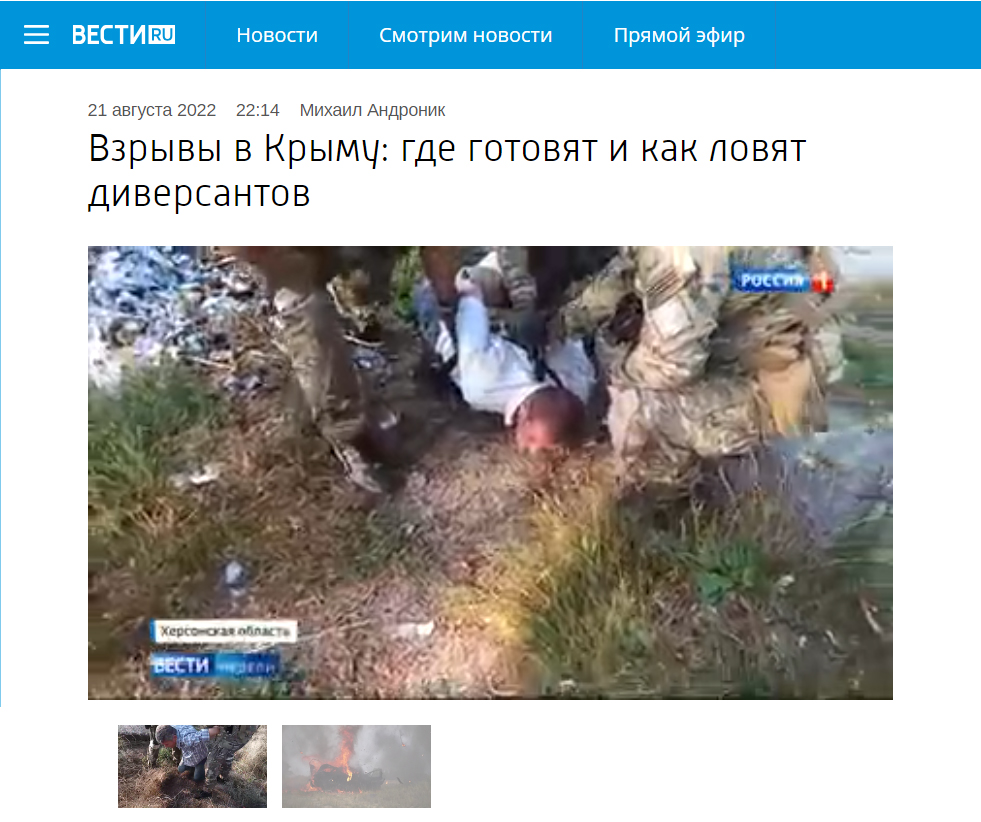
All the components of a loud and sensational case were in place. It is possible that the intended outcome was a story about how the Russian special services worked very well and heroically saved three occupation officials from “Ukrainian terrorists”.
But the occupiers’ plan probably began to “crack at the seams” even before the Russians officially announced the “detention of terrorists”. At the end of August 2022, when the prisoners from the “Kherson nine” were already in captivity but the Russians had not yet staged the performances of their “detentions”, Oleksiy Kovalov was killed.
The criminal case fabricated by the Russian special services was sent to the Prosecutor General’s Office of the Russian Federation on November 20, 2022. And on November 9, in a very strange car accident, Kyrylo Stremousov died. Shortly after that, on December 12, 2022, there was an attempt on Vitaliy Bulyuk’s life; the traitor received serious wounds.
As a result of these events the Russians lost arguably the main propaganda potential of the story about the “Kherson nine” – the tale of the “heroic rescue” of occupation officials. Two of the three “rescued” indeed died, and the third became the victim of another assassination attempt.
Moreover, in the autumn of 2022 events began to occur that were much louder and more resonant than the case fabricated by the Russians about “attempts on officials”. A large-scale counteroffensive by the Armed Forces of Ukraine began, during which Kherson region was liberated from the occupiers. Perhaps that is why the Russian security forces accelerated events and acted as crudely as possible.
According to reports by Russian human rights organizations not controlled by the Kremlin, in particular “Memorial”, in the last days of September 2022, during the AFU’s offensive on Kherson, the Russians one by one led people from the “Kherson nine” to a room on the second floor of the regional office of the National Police, where various weapons, grenades, explosives were laid out on the tables, and forced them to take all this in their hands, leaving fingerprints. Some were forced to leave fingerprints inside vehicles.
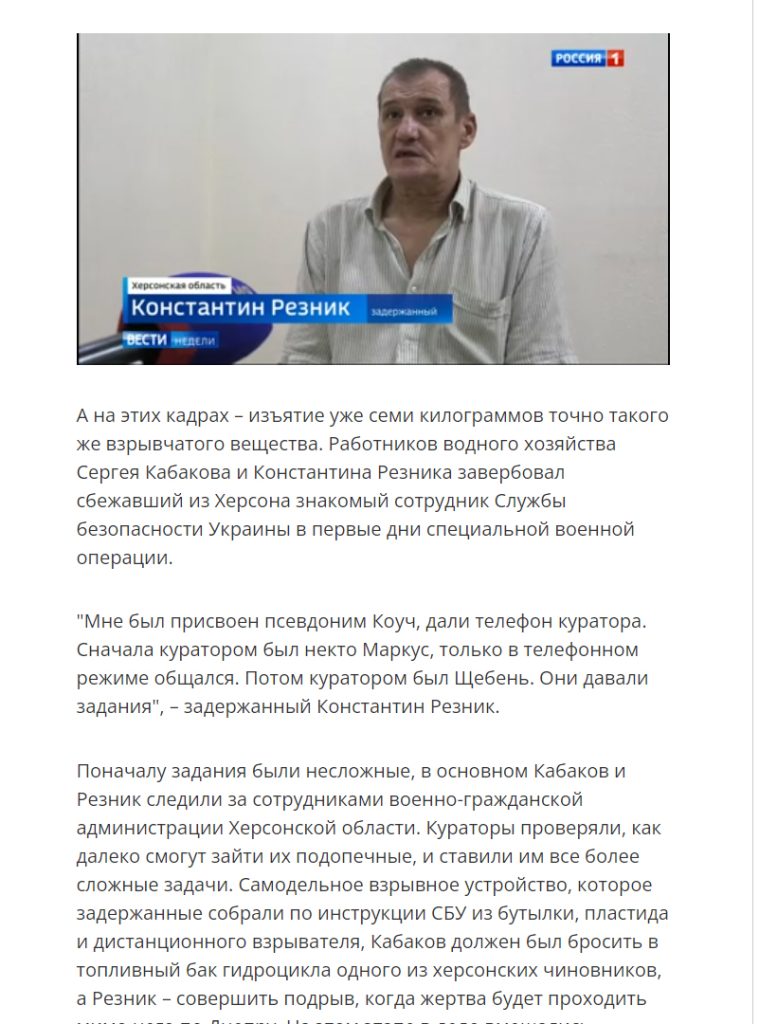
The propaganda performances staged in September with the “detentions” of prisoners who had already been in captivity for more than a month looked utterly absurd. Especially the scene of the detention of Kostiantyn Reznik and Serhiy Kabakov, where they confiscate a bottle of baby food “Agusha”, which they call an “explosive device”, and a plastic box resembling a soap dish that the prisoners call a “remote control”. Moreover, they say this during the detention, not trying to pose, for example, as victims of a provocation, as true offenders would likely have done.
By the way, at the trial the prisoners and their lawyers said that the baby food bottle had a manufacture date later than the day Reznik and Kabakov were kidnapped. But the court ignored this.
It follows that the “detention” performances were prepared in haste, and the Russians in that situation did not concern themselves with making everything look at least somewhat convincing.
At the beginning of October the prisoners were forced to sign sheets of paper under a text covered by a blank sheet. After that the kidnapped were taken to the FSB directorate in Simferopol. There they were photographed and had their fingerprints taken.
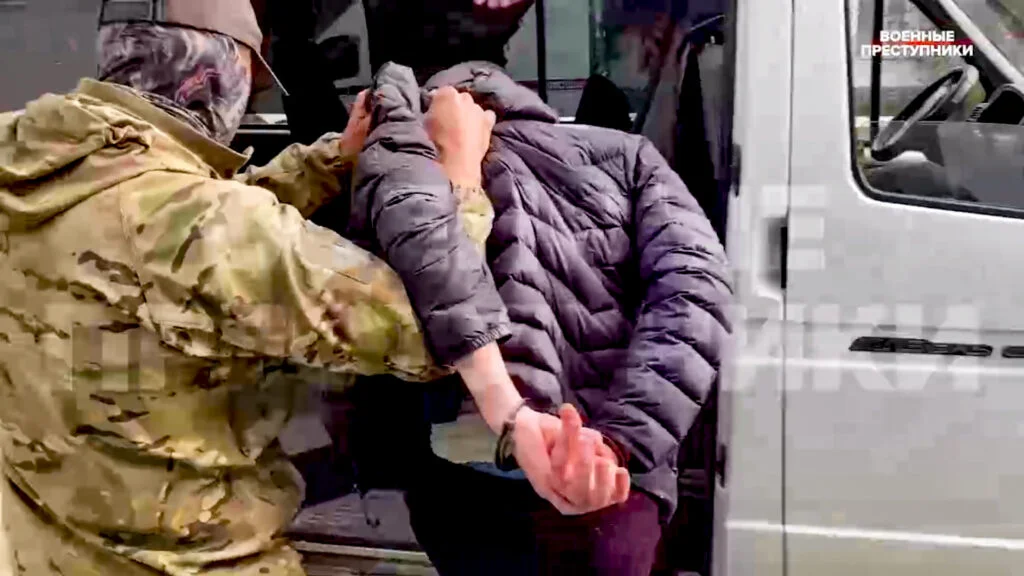
As one of the prisoners, Yuriy Kaiov, told at the trial, he was introduced to a Russian female lawyer who said that no one guaranteed the detainees’ safety, and the interrogation methods would not differ from those in Kherson, i.e., torture would be used, so it was worth confessing to everything and signing everything. In Simferopol the prisoners learned about the charges of “international terrorism”. They were forced to sign “testimonies” without reading them. Decisions about the arrest of the Kherson residents, who were involved in the criminal case “on international terrorism”, were made in the occupation Kyiv District Court of Simferopol.
According to testimonies of the prisoners documented by Russian human rights defenders during court sessions, and judging by what the relatives of Kostiantyn Reznik and Serhiy Ofitserov told МОСТ correspondents, the “international terrorism” case was fabricated precisely in Simferopol. Moreover, it was done very quickly. Because after the transfer of the prisoners in the second half of October 2022 to Moscow’s “Lefortovo” SIZO they were summoned for interrogations infrequently. Probably because the case was already ready to be sent to court.
But the liberation of the right-bank part of Kherson region by the Ukrainian army finally deprived the “Kherson nine” case of its propaganda potential. It began to look no longer like a demonstration of the capabilities of the Russian special services, not like intimidation of the inhabitants of the occupied territories, but like a disgraceful farce.
Probably the Russians therefore completed the case with a verdict, so as not to be completely disgraced, at least to put on a brave face despite a poor performance. What will they do next? It is impossible to predict, and for now one can only hope that the prisoners from the “Kherson nine” will be included by Russia in lists for an exchange, and will eventually return to Ukraine.