

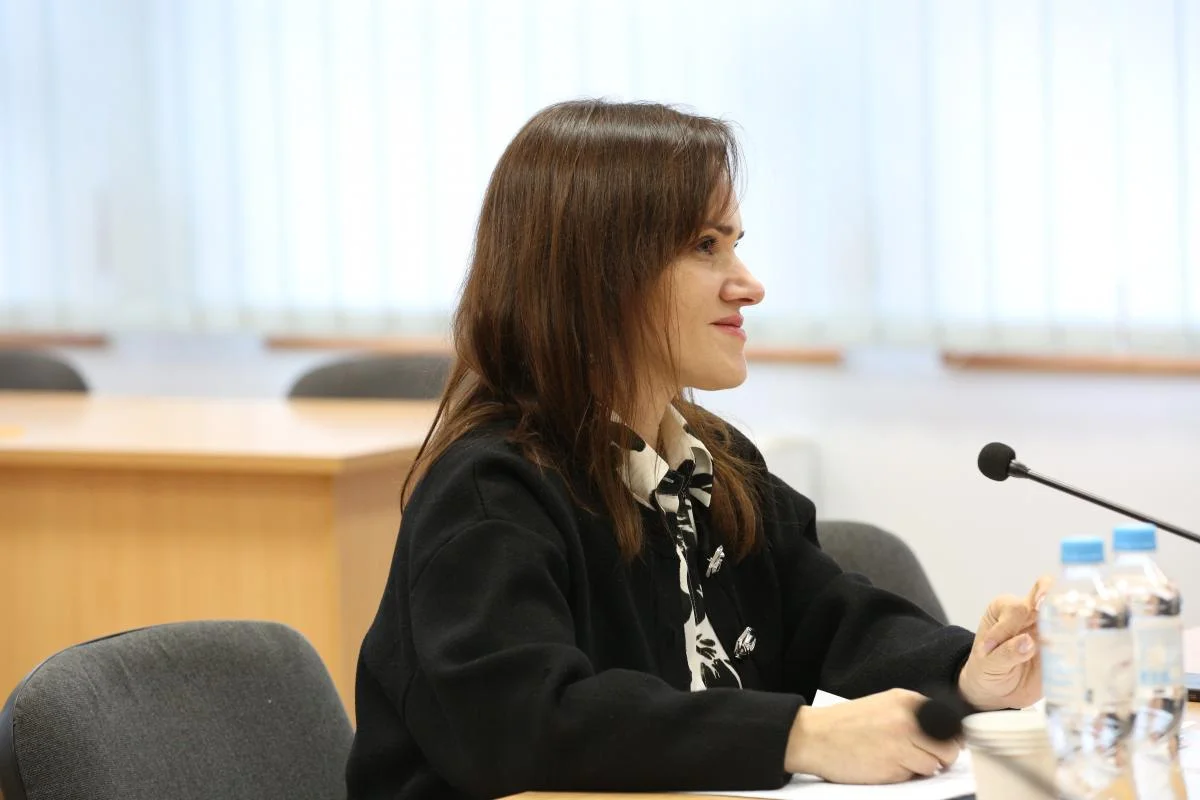
A judge from Kherson region, Inna Khaydarova, was unable to confirm her ability to serve in the position at the Odesa Court of Appeal due to numerous violations of integrity and professional ethics standards that were discovered during a review by the High Qualification Commission of Judges of Ukraine.
The decision was made after the commission reviewed the conclusion of the Public Integrity Council, which studied her activities and identified a number of serious facts that cast doubt on the judge’s ability to perform duties honestly and impartially.
As a result of the evaluation, Inna Khaydarova scored only 417.24 points, which is a critically low indicator, since the minimum threshold for passing the evaluation is 600 points.
Significant attention was drawn to Khaydarova’s trip to the territory of Crimea temporarily occupied by Russia in 2014–2015, where she stayed for 249 days.
The Public Integrity Council noted that the prolonged stay in the occupied territory occurred without urgent necessity, which creates risks to national security and undermines the authority of the judiciary.
The judge explained that after the occupation of Luhansk region and the suspension of the Rovenky court’s work in 2014 she was forced to leave territory under Ukrainian control, her salary was not paid, she was not transferred to another court, and her own housing in Berdyansk was unfit for living. Due to the absence of relatives in territory under Ukrainian control she temporarily moved to Crimea and did not maintain any contacts with the occupation authorities.
However, the PIC found these explanations insufficient to confirm integrity. It noted that when crossing the administrative border of the Autonomous Republic of Crimea Judge Khaydarova could not practically avoid communicating with representatives of the Russian occupation authorities, in particular with “border guards” and “customs officers.” She was forced to comply with their demands: to provide identity and entry documents, to undergo customs inspection and control of personal belongings
In addition, in the 2016 integrity declaration Khaydarova did not indicate information about an administrative offense, in particular about stopping in a zone where this is prohibited. Inclusion of this information in the declaration was mandatory, but the judge did not provide documentary confirmation of entering these data in other reporting documents.
Also, during the review of Khaydarova’s dissertation for the degree of Candidate of Legal Sciences in 2019 self-plagiarism was detected. Parts of the text were copied from her previous academic publications and works of other authors without proper citation. The candidate replaced the letters «с», «і» and «о» from Ukrainian with Latin ones 47 times across 15 pages.
Khaydarova explained that these passages reflect the main results of her research and are not self-plagiarism, however the PIC believes that the candidate committed self-plagiarism.
In its conclusions the PIC noted that Khaydarova’s overall behavior did not meet the requirements of a judge’s ethics and diligence, since her actions indicate signs of misconduct and violate the basic principles of a judge’s professional ethics, the norms of behavior that ensure public trust in the court, as well as the principle of personal responsibility for the administration of justice.
The High Qualification Commission of Judges of Ukraine adopted a decision not to confirm Khaydarova’s ability to work as a judge of the Odesa Court of Appeal.
Additionally, the Public Integrity Council drew attention to a number of discrepancies and incomplete information in Judge Khaydarova’s asset declarations that require explanation. The declarations did not indicate the KIA Sportage vehicle which the judge used periodically on the basis of a power of attorney from the father of her child.
In the declarations for 2020–2022 the judge did not fill out the item about decisions made individually or collegially, although in previous declarations this item was filled in. Also, real estate objects in Kherson for 2015–2017 were not indicated, which raises doubts about the completeness of the declarations.
Furthermore, the right to use a land plot in Berdyansk in previous years was not reflected, although a house there was indicated, and the registered place of residence in Luhansk was not accompanied by information about a real estate object.
Additionally, the 2013 KIA Sportage vehicle that the Candidate used on the basis of a power of attorney from the father of her child was not declared. Data indicate that the price of the car in 2014 was about $25,000–35,000, while the owner’s total income for the previous five years amounted to only about $24,000. Even if the car was purchased on credit a reasonable observer may doubt the legality of the source of funds for the purchase.
In addition, a case to recover debt on an auto loan came before a court where the Candidate was administering justice, which creates a potential conflict of interest.
Note that on January 17, 2014 Khaydarova was appointed to the position of judge of the Rovenky City Court of Luhansk region for a term of 5 years.
By Decree of the President of Ukraine dated April 21, 2015 she was transferred within the five-year term from the Rovenky City Court of Luhansk region to serve as a judge of the Suvorovskyi District Court of the city of Kherson.
On August 22, 2016 she was transferred within the five-year term from the Suvorovskyi District Court of the city of Kherson to serve as a judge of the Kherson City Court of Kherson region.
In 2019 the judge’s term of authority expired, and she did not perform judicial duties, and in 2021 Khaydarova opposed the judicial reform.
In October of the same 2021 she filed a lawsuit asking to declare unlawful the inaction of the President of Ukraine regarding the failure to issue a decree appointing her to the position of judge of the Kherson City Court of Kherson region within the prescribed term.
The Administrative Cassation Court within the Supreme Court, as a result of the case review, by its decision of December 23, 2024 partially satisfied the claims. The court recognized the inaction of the President of Ukraine regarding the failure to issue the decree on appointment to the position of judge of the Kherson City Court within the period provided by law as unlawful and decided to oblige the President of Ukraine to consider the submission of the High Council of Justice dated February 23, 2021 regarding the appointment of Khaydarova to the position of judge of the Kherson City Court of Kherson region.
In 2025 it became known that the judge purchased an apartment in Odesa worth 2.7 million UAH.
In December 2025 appointed to the position of judge for an indefinite term.