

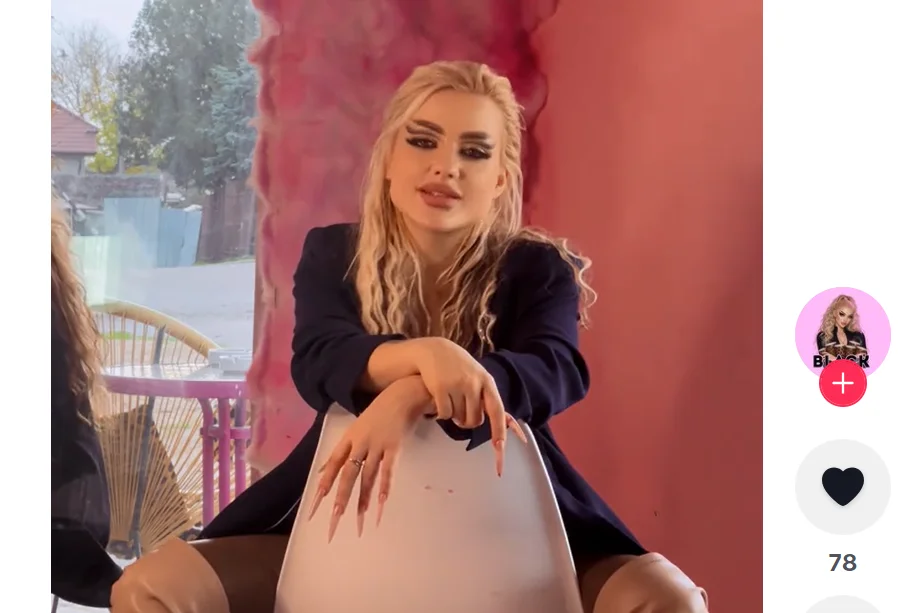
The Main Department of the State Service for Food Safety and Consumer Protection in Kherson Oblast is demanding an explanation from Kherson blogger Anastasia Verbovska over a TikTok video in which she promoted her own café.
The blogger told this to a representative of the Institute of Mass Information in Kherson Oblast, Serhii Nikitenko.
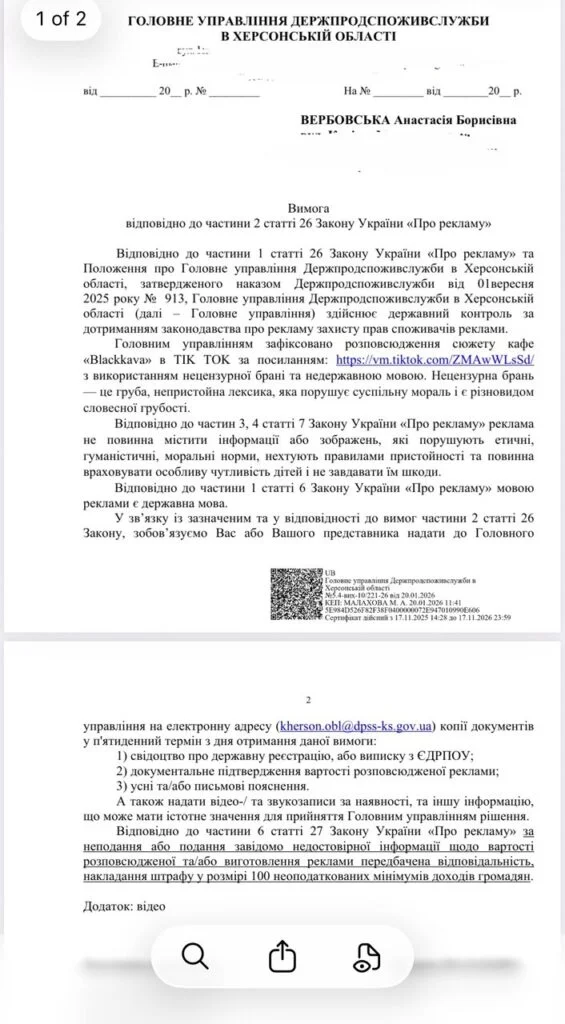
The regulatory authority sent the demand letter to Anastasia Verbovska’s email.
The service noted that the blogger’s video contained advertising “using obscene language and a non-state language”.
It concerns a video in which Verbovska talks about coffee and pastries in the shape of a sex organ, which is a signature “gimmick” of the Kherson café Black kava.
Marina Malakhova, an official of the State Service for Food Safety and Consumer Protection, under whose signature the letter arrived, demands that the blogger provide:
- certificate of state registration;
- documentary proof of the cost of the distributed advertisement;
- oral or written explanations.
Anastasia Verbovska herself says she does not understand why the video is considered advertising at all.
“It’s not entirely clear to me how these people saw advertising in this ironic video. And moreover, how do they imagine that I paid myself for advertising my own café? Regarding the obscene words that the official heard in the video, the word “member” appeared there. I suggest she fine her own party “Servant of the People”, which, according to its statute, keeps records of its “members”. We, essentially, like her party, keep records of the same thing, but our products are also tasty,” she commented.
At the same time, the blogger agreed that Russian was spoken in the video, but explained this by saying that she is still learning Ukrainian.
“Regarding the Russian language, here I agree that I have a problem. I am only learning Ukrainian, so I cannot fully run the blog in that language. But this is only for now; soon Ms. Malakhova will be watching my videos in Ukrainian as well. I think they will be even more interesting,” the blogger said.
In addition, Verbovska added that she does not understand why the State Service is addressing her as a private individual while referring to the Law “On Advertising”.
“I am not an advertising agency, not a media outlet. So I do not provide any advertising services,” the blogger said.
Volodymyr Zelenchuk, a lawyer for the Institute of Mass Information, explained that Ukraine’s advertising legislation applies to bloggers, streamers and content creators, even if they advertise their own business.
According to him, cases where the advertiser and the distributor of advertising can be the same person are called self-advertising. However, the requirements for self-advertising are the same as for any other paid advertising — the law does not provide exceptions for individuals.
The lawyer drew attention to the language of advertising: it is forbidden to use any languages in advertising except Ukrainian, the official languages of the European Union, minority languages and the languages of indigenous peoples.
“Russians are not a national minority or an indigenous people of Ukraine, and therefore the use of the Russian language in advertising is a violation of advertising legislation,” the lawyer noted.
Zelenchuk noted that the State Service can demand documents and fine violators of advertising legislation, regardless of whether it is a company or an individual blogger.
“Control bodies for compliance with advertising legislation (in this case — the State Service) can both request documents from persons involved in the production or distribution of advertising and fine them for violations. Bloggers, streamers and content makers are also subject to the control of the State Service,” Zelenchuk said.