

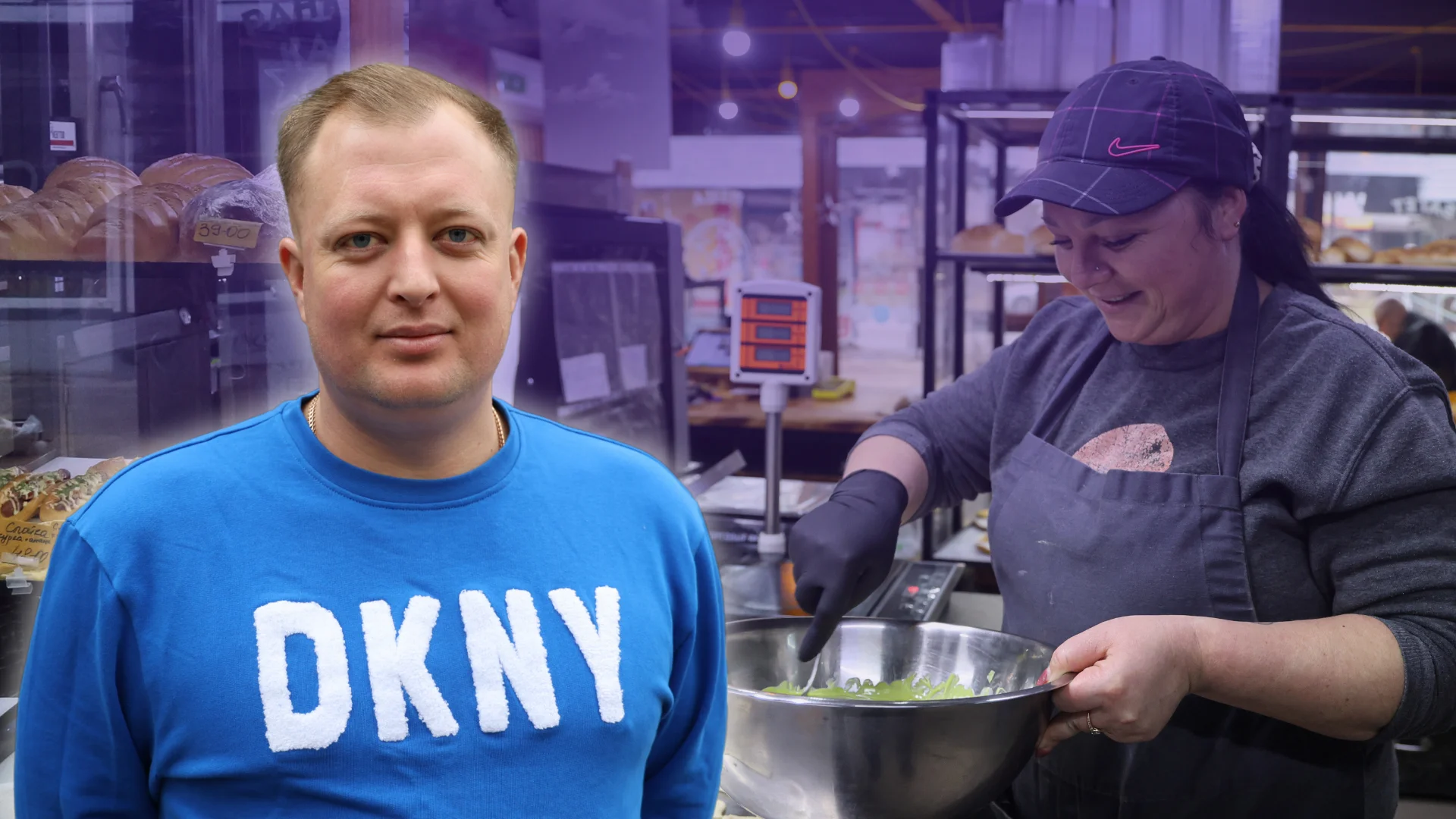
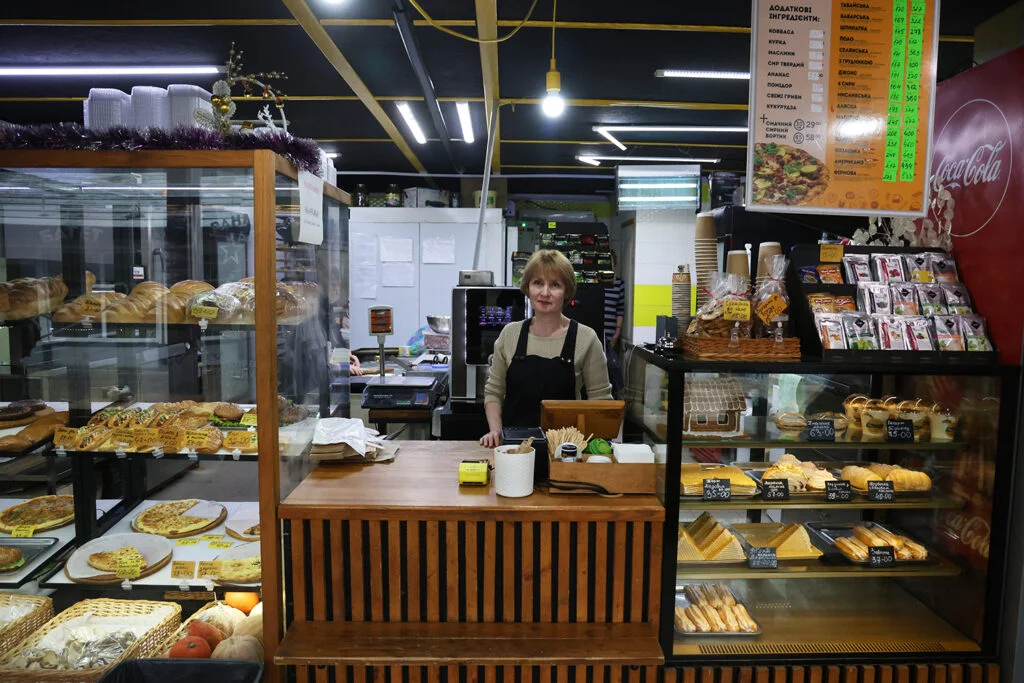
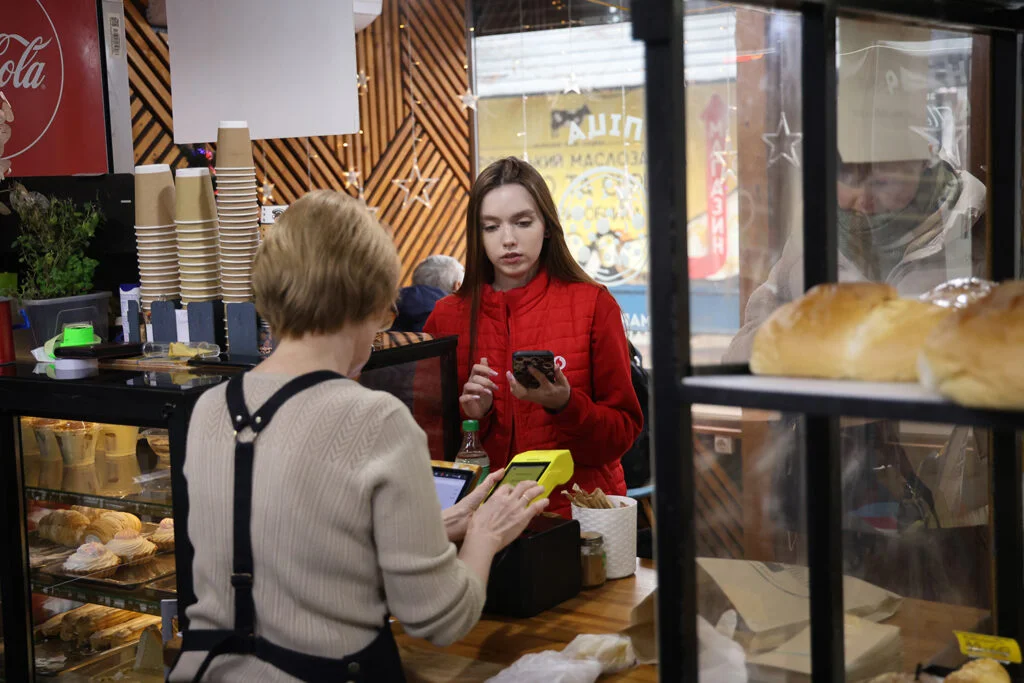
It smells of fresh pastries and coffee. The room is decorated for the New Year. On the display is a Christmas gingerbread house. At one of the tables, two school-age boys are watching something on a smartphone. At another, a woman is enjoying coffee with a pastry. Customers come and go taking treats with them. Music is playing. You can hear the sounds of the kitchen, separated from the dining area for visitors only by the counter and display cases.
But if you look out the window, Kherson realities are added to this idyll — anti-drone nets.
“It’s very good that they appeared,” says Natalia, a cashier at the “First Bakery.” “Previously, Russian drones actively hunted cars here, dropping explosives.”
This establishment is a more than eloquent illustration of how Kherson lives now. The city is in constant danger and is defending itself by all available means. At the same time it desperately preserves the attributes of peaceful life: the pleasure of tasty food and fragrant coffee, decorating premises for the holidays, music and coziness.
However, Kherson comfort costs far greater efforts than in territories that are not frontline.
Not thanks to, but in spite of
The franchise “First Bakery of Your City,” or, as it is commonly called, “First Bakery,” appeared in Kherson in 2018. The first establishment opened on Universytetska Street near Luchanskyi Hospital.
“Then we opened a new place every six months,” says Oleksandr Vlasov — owner of the “First Bakery” establishments in Kherson.
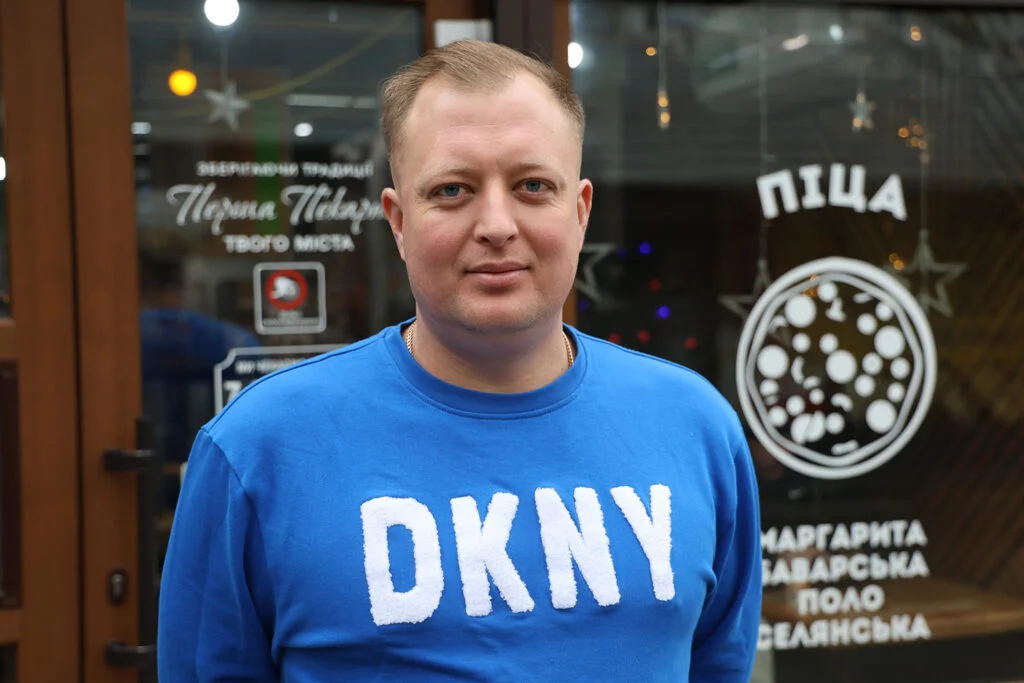
Now the network consists of four establishments in the regional center. Control over two establishments, in Oleshky and in the village of Velyki Kopani, was lost due to the Russian occupation of the left-bank part of Kherson Oblast.
The establishment in Velyki Kopani was supposed to open on March 8, 2022. Oleksandr Vlasov says it was a very ambitious project: “Power source — one hundred square meters of solar panels, water source — our own 33-meter-deep well.”
Speaking about working in Kherson, Vlasov notes that it is difficult to work here not only because of Russian aggression. A big problem is the lack of quality products in the city. And some things necessary for work are impossible to buy here at all. Many companies that manufacture and sell foodservice components do not operate in Kherson because of the security situation.
“Flour, potatoes and some other products have to be brought from Mykolaiv, because what is sold in Kherson is simply terrible. It gives the impression that rubbish that cannot be sold elsewhere is brought to the city,” says the entrepreneur.
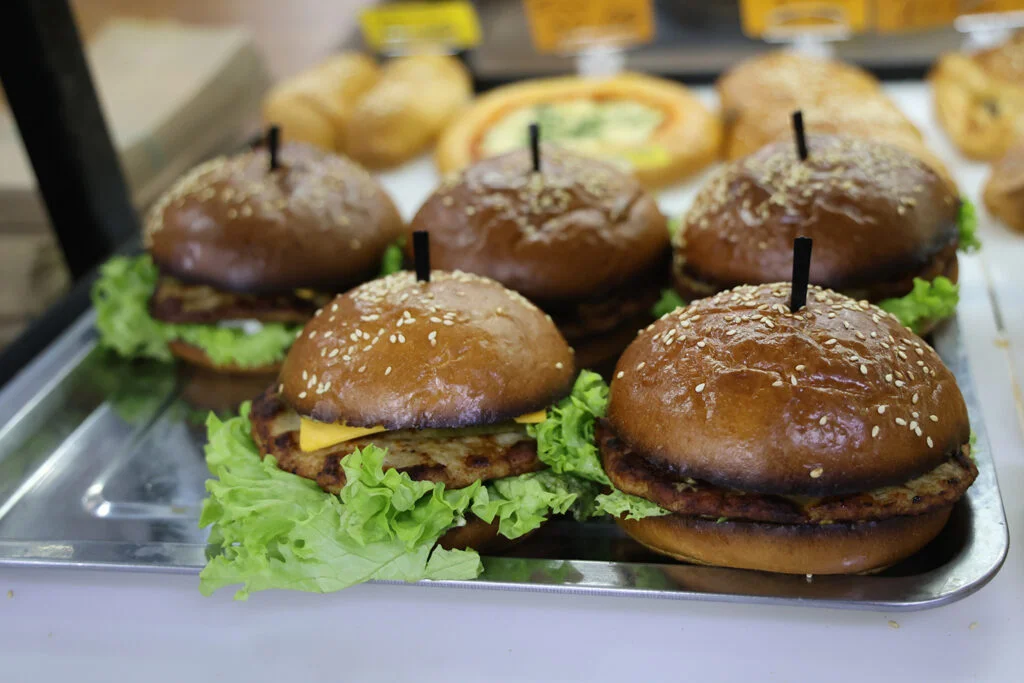
Some things have to be purchased in other regions and delivered to Kherson by “Nova Poshta” or by other means. The consequence is very high logistics costs.
“There are days,” says Oleksandr Vlasov, “when I rack up up to 120 kilometers driving around Kherson in the car because I need to pick up products at the same ‘Nova Poshta’, deliver them to the establishments, and otherwise we cannot operate.”
Asked about the “First Bakery”‘s participation in business support programs for frontline territories, Vlasov says he participates in such programs. However, these programs are neither Kherson’s nor Ukrainian.
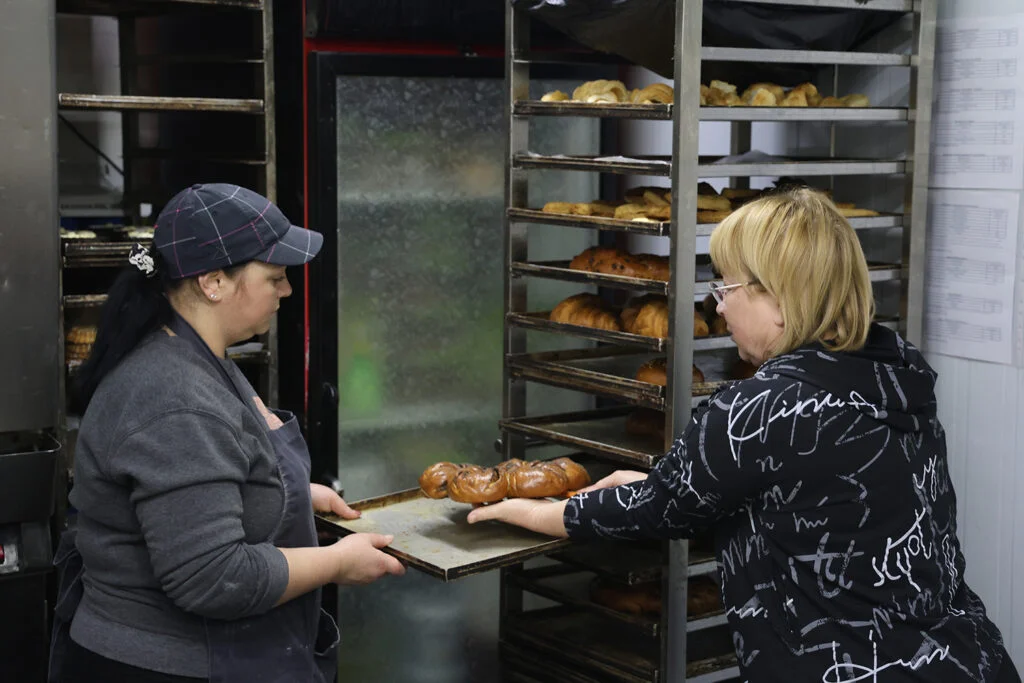
“I received,” says the entrepreneur, “a grant from the DRC (Danish Refugee Council – MOST) — I bought bread ovens. Thanks to an American grant we have equipment for rolling out dough. There are prospects for cooperation with the British.”
Oleksandr is not thrilled with the local authorities. He says Kherson officials still do not understand the conditions in which entrepreneurs work here and try to find violations and grounds for fines everywhere.
“There is no local support. Still, at least they should not interfere,” says the entrepreneur.
A big problem is generators, which are very necessary given the frequent power outages in Kherson. Right now there are two generators in the network capable of powering a bakery, one of which Oleksandr Vlasov borrowed from acquaintances.
“We are not coffee shops,” he says, “where simple and inexpensive generators will do. A 30–35 kilowatt generator capable of powering bakery equipment costs $12–15 thousand. We cannot afford such expenses.”
How they survived during the occupation
The eight months during which Kherson and the right-bank part of the region were under Russian occupation became a test of viability for the “First Bakery.”
“The first few days,” says Oleksandr Vlasov, “we were in a state of uncertainty, but later we resumed operations. In such a situation, if you do nothing, you can go crazy.”
He says employees and customers were also happy about the resumption of work: “We immediately had queues. Maybe because of us and some other businesses becoming active, people were watching how those nearby would behave.”
If before February 2022 Kherson branches of the “First Bakery” network were connected to the nationwide franchise and bought some products there for their operations, the war and the Russian occupation created conditions where only a fully self-sufficient business could survive.
“When there were no supplies from outside,” says Oleksandr Vlasov, “we had to improvise.”
He recounts that together with his friend Andrii Derkach he drove around villages: “We bought pigs, geese, ducks, cottage cheese, oil, potatoes… And these were not Russian products. Moreover, during the entire occupation we worked with Ukrainian flour: we found a supplier.”
The liberation of Kherson and the right-bank part of the region was a huge celebration for Oleksandr and other bakery workers.
“I found a generator,” Vlasov recounts, “brought 15-meter extension cords, and for the first three days after liberation we operated 24 hours a day. People came to charge their gadgets. There was a real point of resilience that really worked. After de-occupation our bakeries immediately began to operate because we were used to extreme conditions.”
The entrepreneur says that now Kherson branches of the “First Bakery” network are an autonomous business that does not depend on the franchise. They have their own supply channels for raw materials and components for dishes. The assortment is formed by customers. They sell what is in demand. New items are added if people ask about something and such a product is not available.
Life in a horror movie
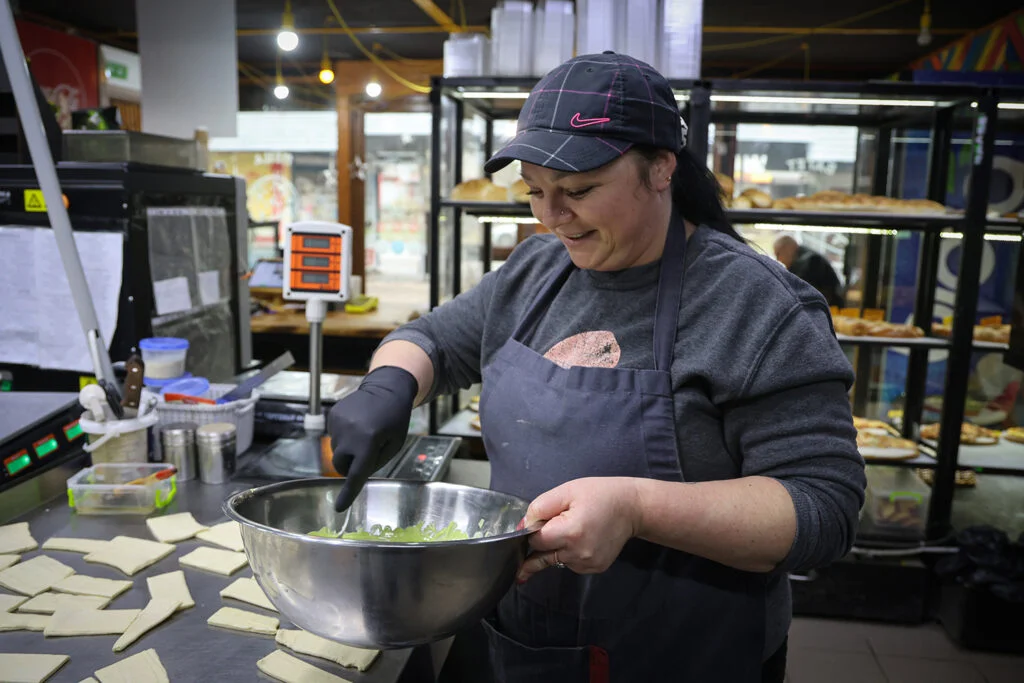
Natalia Ilchenko has worked at the “First Bakery” in Kherson since the first day the chain’s establishments opened. She was a cashier at the bakery near Luchanskyi Hospital, and for the last three years has been the cashier at the bakery on Kulyk Street.
The woman says that work for her is not only a way to earn a living, but also a “breath of fresh air” that helps preserve mental health in Kherson realities.
“It helps a lot,” the woman says, “communication with customers and colleagues. That is what gives strength. I love my job. I love my regular customers when they come and expect a smile from you. No matter what, whatever the mood, I always try to smile at them.”
Among regular customers, Natalia says, there are many lonely people and pensioners. The latter, by the way, now make up the majority of the city’s population.
“Some people,” says the cashier, “when they come, buy something inexpensive because they are very poor. For such people each visit to us is an event, because they come primarily for communication, so as not to be alone.”
The woman does not hide that living in Kherson is very scary: “Going to work is still okay. In the morning it’s crowded. But returning home is a horror movie. You meet only stray dogs. And above your head — drones.”
Once Natalia even had to run away from a Russian drone that wanted to hunt her. Fortunately, she managed to find a hiding place, and everything turned out fine.
However, danger lurks for Kherson residents at work as well. Of the “First Bakery” establishments, the one on Universytetska Street in the red zone operates under the most extreme conditions.
“This establishment,” says Oleksandr Vlasov, “was shelled six times. Equipment was damaged. But the bakery continues to operate. The girls there are stubborn. As cashier Olena tells me, you cannot drive them out of there with sticks.”
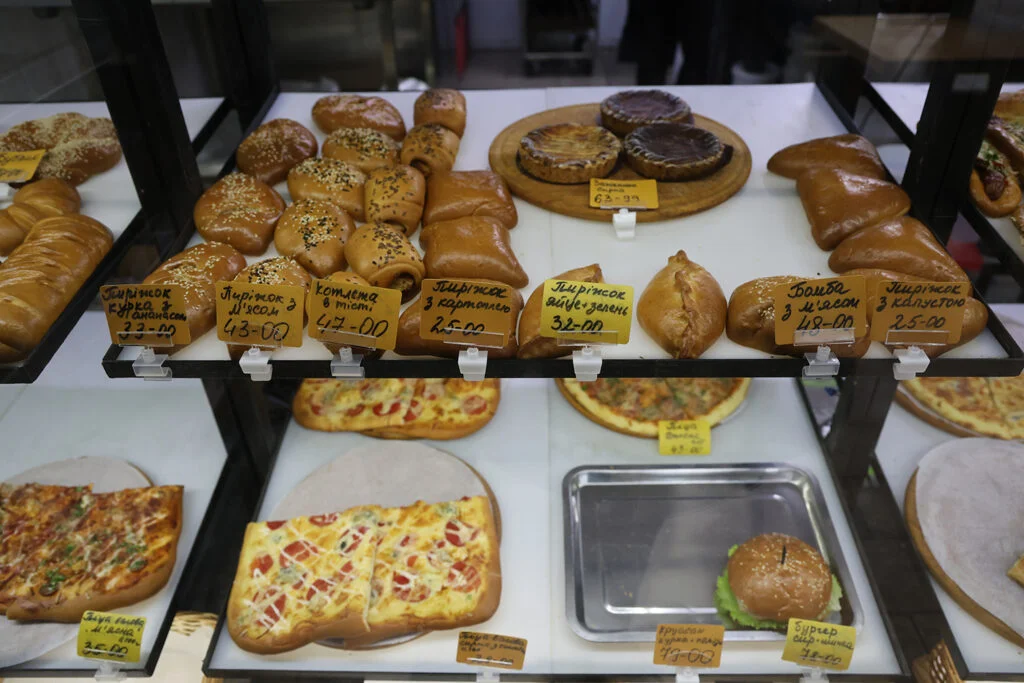
The situation in the city forces each establishment to form a staff of people who live close to work.
“Sometimes,” says Oleksandr, “a person who wants to work and has the appropriate skills applies to us, but we cannot take them because they live far from work, and moving around the city over long distances is very dangerous now due to shelling, drones, and ‘petal’ mines.”
Plans — own production and… Mykolaiv
Hanna comes to the “First Bakery” for treats almost every day. She buys pizza, buns, pastries.
“Usually,” the woman says, “I come here after work. I buy baked goods for home and to take to work for a snack.”
She notes that establishments like the “First Bakery”, as well as coffee shops and other small people-oriented businesses, are very necessary for the city and its residents to have the opportunity to distract themselves from realities and feel positive emotions.
Asked about future plans, Oleksandr Vlasov says they are big.
“I want,” says the entrepreneur, “to expand the network, create our own production. And I want to start working in other regions, for example in Mykolaiv. I think we have prospects there.”
For Kherson business, according to Oleksandr, the main thing now is to survive, and residents of the city and region can help with this.
“By buying something,” he notes, “in the stores of large nationwide chains, people give their money to other regions. It is better to make as many purchases as possible from Kherson residents. This is taxes to the local budget, salaries for our people, and city development. I think it would be fair if people who come to us to charge gadgets during power outages would also be our customers.”