

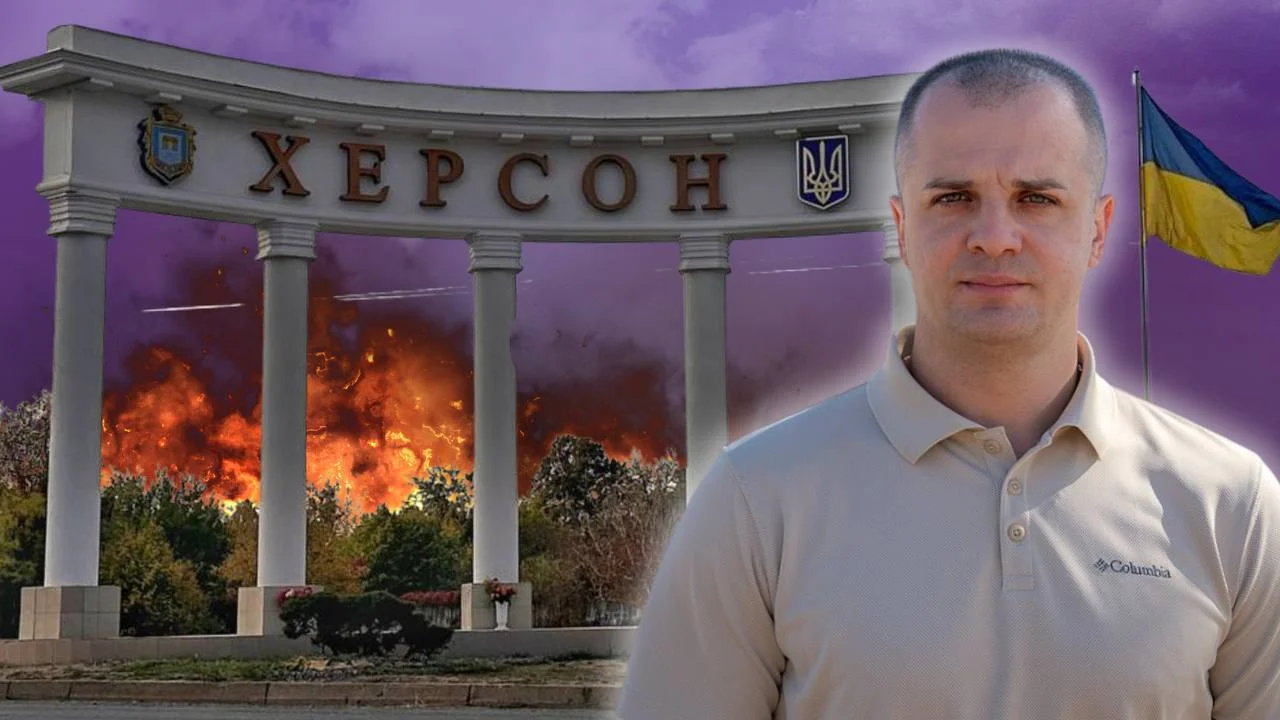
Every day Kherson faces unprecedented challenges — shelling by Russians with various types of weapons, drone, air and missile attacks. At the same time, the city must function, and the city authorities must ensure its livelihood.
About security, the needs of the community, politics and the daily decisions on which the life of wartime Kherson depends, MOST spoke with the head of the Kherson City Military Administration, Yaroslav Shanko
— Before your appointment to this position you already worked in government bodies, in the regional military administration. How difficult was it to fit into the system of state power after the police, and who is easier to work with — officials or police officers?
Everywhere has its own specifics. I consider myself a systematic person. And that is, rather, a plus for working in public administration or the police. The other question is that these are generally different directions — work in the police and in state administration bodies. The adaptation was not easy. But I am guided by the desire to make my city and region better. This is absolutely honest, it is not a slogan, but an honest position. I have a desire to delve into some new areas.
— Which areas did you first start to get into?
To say that I already know something 100% is, in my opinion, wrong. The most important for the city are municipal management areas, ensuring the work of communal services, and the operation of the apparatus structure. These are the pillars on which the administration’s work should be based to ensure the city’s functioning. Every day there are new challenges, new problems. From security issues to the activities of municipal enterprises.
— Following Ukrainian tradition, every official who comes to office begins their work by criticizing their predecessors. Tell us about your predecessors — what did you inherit?
I do not want to judge my predecessors. The people of Kherson, who saw their work, are the ones to judge. I can only say that I have remarks in many areas that I would have done differently. I am now trying to reconfigure the work of certain structural units according to my vision of organizing the process. I place a particular emphasis on interaction with the military, because, no matter how you look at it, we are a city military administration, and our primary task is to ensure, together with the military, the defense of our city.
— Your main task – is it to assist the military?
Yes. First of all, I am the head of the city military administration. I am not the mayor. I was not elected by the people, I understand this clearly, but due to the circumstances that have arisen, I perform the duties of the mayor. 3 in 1 — the executive committee, the city council and the military administration.
— You diplomatically avoided the question about predecessors, so I will phrase it a little differently. If you were now working in the city police department, would you open a criminal case against Roman Mrochko?
As a law enforcement officer I will say this: if I saw elements of a crime somewhere, I would definitely react and enter the information into the Unified Register of Pre-trial Investigations.
— Has at least one fact been entered so far?
According to our statements, yes. Even the underground schools. There are three criminal proceedings — one opened for each of the schools.
— What is the general fate of these schools? I walk past one of them and understand that this is several tens of millions poured into concrete. What should be done with them next?
I absolutely agree with you. This is precisely the story I inherited. My vision was: first — to sort all this out, because the matter had public resonance. We conducted an audit, went to the sites, carried out an inspection and saw that the completed works did not correspond to what was stated in the acts. We recorded all of this.
— So your subordinates signed false certificates of completed work?
I cannot assess who exactly among those subordinates signed those acts…
— You came to work, called Kholodov in, asked how this happened…
In any construction there is technical oversight and many other instances that gave their conclusions. I went the route of having concrete documents that testify to the performance of certain works. I formed a commission and tasked it to check whether this corresponds to technologies, whether we follow the project, whether we meet deadlines. The overall picture showed there were remarks on deadlines and on the performed works. We compiled this into one case and appealed to the police to give us an appropriate assessment, an expert examination was carried out — whether it is so or not. Because one thing is to conduct visual observations, and another is to carry out specific expert examinations. We recorded this, criminal proceedings were opened on these facts, and the investigation is still ongoing. We are open to law enforcement agencies regarding which documents need to be provided.
— You realize this may take years. Meanwhile it stands there, tens of millions poured into concrete. And there is no benefit from it. What will we do next?
Well, first, regarding the problems that exist now, the investigation will determine whether it reaches court or not; if there are any damages, they must be compensated. That will depend on the expertise.
— Those firms are fictitious. They will disappear tomorrow. One of them is being tried in the Lviv region for repairing a school canteen. They already say there are no people. They will flee abroad.
De jure there are definitely entities that were engaged in the construction.
— I’m talking about them. This “Megastroy” is registered to a taxi driver from Poltava. Another firm is registered to a person who has no property except a car.
I cannot influence the course of the investigation, but I am ready to assist. If damage was inflicted on the budget, the funds must either be returned or the works completed. Let’s put it this way: to break even in this story. I do not want to take responsibility for things I was not responsible for. It is necessary to move into the legal plane and understand for each object that we are acting according to the law and there are no questions about them.
— And then they will start finishing construction?
Funds for these objects exist, allocated by the state. They are still in the budget. I was asked whether these underground schools are needed and what to do with them. The position is: in a zone of active hostilities, in-person education cannot take place. But in the future these objects are definitely needed. We understand that no educational institutions can function without proper security conditions. If the security situation and the legal plane allow us to complete them in the future, then of course this should be done. Because you are right — these are millions buried in the ground.
— Is it 30 million in payments?
No, 62 million. For three schools. And there were actually four objects. 95 million was reallocated because the fourth object, school 56, will not be built. And that money was reallocated to regional objects where the security situation is better in order to build such facilities there.
— Did the firm that actually built these schools, rather than the one that won the tender, approach you?
They did not approach me personally, but I know there are some debt obligations there.
— Your predecessor (Roman Mrochko, – MOST) started an election campaign. How do you assess — in the state we are living in now, are elections even possible?
In a state of war, elections are definitely inappropriate. Regarding the election campaign of some people or former leaders, I cannot say anything because I do not know whether that is so. You need to ask the specific person about that.
— You said, by the way, that you are not an elected mayor. After working for half a year, have you developed a desire to run in elections after the war?
I’m not even thinking about that. My position remains as it was: I am an apolitical person, my task now is to work so that the city is protected and develops during the war.
— Everyone builds their own plans and calculates possibilities. Do you have any thought about running in elections?
No, maybe this will be the law enforcement sphere. While I am an active police officer and law enforcement officer, I consider such options. Thoughts about a political career do not arise now.
— What is the main problem you are working on right now?
Ensuring security is priority number one. There cannot be anything else during a war. For the city to function normally, the work of communal services must be ensured. This is very difficult. Many daily challenges. New problems every day. In all directions. In particular, now the heating season. There has not been such a winter in the city before. Every day we see how the Russians shell critical infrastructure facilities. We must get out of this as optimally as possible and help the city function.
— How will the half of the city that does not receive heating live? I know that electric heaters and gas heaters are being sent. How to get them and will this allow people to survive this winter?
We have 1,951 heaters in stock, distribution has already begun. They were in our reserve for an emergency. And, of course, after the shelling of the CHP and the energy infrastructure, such a situation, unfortunately, occurred. Together with district councils we identified categories of people who will receive them first. These are people with limited mobility, people with disabilities, the elderly, families with children.
Thanks to the cooperation of the regional administration with Naftogaz, we will be given another thousand heaters. They should arrive this week. And also with all donors we work with, we discuss this issue. The Red Cross has already agreed to help us with heaters.
— How do you obtain this equipment?
You need to contact the head of the condominium association, the building captain or quarter representative, or the district council directly and leave an application. Or call the hotline 0800101102 — everything will be recorded and processed.
— I can’t help but ask — perhaps it’s time to initiate through the Cabinet of Ministers the cancellation or change of the order banning the installation of individual heating, at least for Kherson?
Yes, we have already submitted all our proposals so that for zones of active hostilities there would be the possibility to deviate from this norm. Because we understand that critical infrastructure facilities were targets, are and will be. And you cannot just hope that everything will be fine. You must understand that the Russians are a treacherous enemy; they will try to hit infrastructure, terrorize the civilian population, sow panic as happened with the bridge in the Korabel neighborhood. They do not achieve any military goals this way.
— After the meeting in Kherson the President stated there would be an improvement in the security situation. Do you feel any improvement?
The process is moving in a positive direction. We understand that the Russians launch a huge number of drones — from 800 to 1,200 per week just over our community. Thanks to our military and the Defense Forces, we have a large percentage of suppression or diversion. And believe me, if there were no defense, this would be a desert, it would be completely impossible to stay here.
— Tell us about personnel. How acute is the issue now — both in shortage and in quality. How are you dealing with this situation?
The situation is critical in all areas. Even within the administration — we lack people in all directions. There are no areas that are 100% staffed, and I cannot say “I’m not worried about this direction.” The same applies to municipal enterprises.
— I looked at the work of “Parks of Kherson” about a month ago, and I see that this enterprise works and can even be proud of it.
Absolutely. But they also lack specialists. For example, there is a new direction that “Parks of Kherson” is engaged in — repairing roofs. We help people overcome the consequences of strikes. They lack specialists, and they need to be trained. It so happened that “Parks of Kherson”, which should be involved in parks and landscaping, are today engaged in eliminating consequences.
— Roof repairs, they say, will be financed from the budget starting next year. How much money is allocated for this?
We based it on the estimates provided by the communal enterprises. If I am not mistaken, about 15 million will be allocated to “Parks of Kherson” specifically for eliminating the consequences of shelling, including work on roofs.
– Returning to the issue of personnel. Why don’t you call on fellow police officers for help? Don’t you take them as deputies or elsewhere?
First, the situation with personnel in law enforcement agencies (– MOST) is no better. And secondly, the mechanism for employing anyone from law enforcement in the system of the military administration or public administration is also very complicated. Changes to the structure by presidential decree are required. For now, at minimum, I took a military advisor — this is Viktor Sikoza, Hero of Ukraine, former commander of the 36th brigade. A very authoritative person in military circles. He helped establish communication with the military.
— Was there any initiative for forced resettlement of people? I understand that this is not regulated by law, but we have as many as four MPs in the region. Did you turn to them regarding any legislative changes?
Evacuation generally continues on an ongoing basis. And we had cases when we declared mandatory evacuation in a forced manner for families with children, under Resolution 841.
— I see many children in the city. In some children’s clubs there’s a queue of children because there are so many and the city has nothing for them to do.
According to our data, about 5,000 children are in the city. I agree with you that this is a lot for a city located in a zone of active hostilities.
We have a number of settlements where mandatory evacuation has been declared — the Korabel neighborhood, Antonivka, Sadove. Fortunately, there are no children there now. In Antonivka there are slightly more than 20 people, in Sadove up to 20 people. And in the Korabel neighborhood — over 200, mostly elderly people.
— Can the state make a decisive decision and at least forcibly move people out of Korabel? Because this endangers those who serve them there — police officers, doctors, municipal workers.
Forced resettlement is a state-level issue regarding the adoption of legislative changes. From a legal standpoint, it is a gross violation of human rights. I know for sure that the issue has been and is being worked on. But there is no mechanism for forced resettlement now. Therefore, we take preventive measures. We go ourselves. Right now, with Oleksandr Prokudin, we meet with people in the Korabel neighborhood and ask them to leave. Yes, there are problems. We cannot provide everyone with separate housing, and we say that honestly. There are temporary accommodation places in the city, region and other regions of Ukraine. Conditions there are not the same as at home. In certain cases we work out the issue of relocating people, families with children, with the possibility of separate housing. There are funds that step forward and say “We are ready to take a family with children and give them a house in the Kyiv region.” We offer it. There are successful cases where people left and now live in the Kyiv region.
— But there are stories when people went to Khmelnytskyi region and returned to Ostriv.
Yes, unfortunately such cases exist.
— Regarding nets. We see that several streets have already been covered. What are the plans for next year? Which streets are planned to be covered and how effective is this?
The city will definitely be covered with nets — 100%. To be honest, this is a great merit of the regional administration. It is a systematic effort. Without them it would be very difficult. Many thanks for the process taking place across the city and the region. There are designated routes and paths along which nets will be stretched. This is being done in cooperation with the military.
As for effectiveness — it is certainly better than having none. Yes, it is not 100% protection from a drone or a drop. But it is an additional protective element that has shown its effectiveness.
The most effective method of anti-drone defense is electronic warfare. A properly built protection system can yield an effective result.
— I can’t help but ask about the story when benefactors from France sent us nets, and the city did not allocate money for their clearance. The funds were collected by an organization that unites former prisoners of war.
I hear about this story from you for the first time. Thanks to the organizations that help with logistics and contacts, because nets are not only sent from France. We look for various options to deliver them here or find them at all. We will work on this problem. We were told that free nets are being sent and there are benefactors who will help obtain them.
In general, it is important to understand that much depends on the technical characteristics of the nets. Someone says we refused something. Characteristics are very important. For example, some cucumber nets have no protective functions at all.
Each net underwent testing. And the one that showed the best qualities and can stop a drone or a drop is the one we choose. But we do not refuse those that lack certain characteristics, because they can be used for other tasks.
— About next year’s budget. What will it be like?
In short, it is 2.7 billion, of which the revenue part is 1.2 billion. Most of our enterprises are subsidized by the city. More than 600 million of support for municipal enterprises is provided for next year.
— Where do the funds come from, what do we earn on?
It’s the personal income tax (PIT). 836 million. Also the single tax. There is no property tax. There is also excise tax, but that is not money that can significantly influence anything.
— Tell us about the story of canceling payment for outdoor advertising?
We are now working out the vision for billboards in the city. There are too many of them in our community. We have a vision, we have preliminarily worked it out that there should be a certain number of billboards.
— Right now people have a number of surfaces they earn from, and they were freed from payment. This is an ideal business.
In general, we want to somewhat support entrepreneurs. When I came here, it was clear that we practically had no small business. I hope that by the end of the year we will approve the Program for Supporting the Unbroken Business. We would like to provide opportunities.
— Will these be some grants?
I would like that. I do not want to announce anything to avoid being empty talk.
— My entrepreneurs asked me why they receive nothing, while advertisers who bypassed bans through corrupt ways and did what they wanted became the only ones released from the burden of paying the budget? Why advertisers and not restaurateurs, for example?
I would like us to approach this comprehensively. The process should not be selective.
— But it is selective, because now a company of a deputy or former deputy is released from payment.
I don’t know who the owner is — a deputy or not a deputy.
— It’s Ivan Bebko. Look, it looks like you exempted advertising from taxation so that these entrepreneurs would later give you spaces for elections.
I will not act selectively or lobby someone for my own purposes. Whoever it is — a deputy or some other person.
— Okay, let’s talk more about the budget?
A large share goes to social protection. This year we finally adopted a program to support veterans, prisoners of war, including civilian prisoners, their social and psychological accompaniment. I supervised this direction in the regional administration. In terms of veteran support, the city community was very lagging. This is a large financially costly story. There are programs to support medicine, including dental services, a program for obtaining medicines in pharmacies for privileged categories. We also need to support young medical specialists. So that in such difficult conditions someone would come here to work. Housing programs for young specialists in the medical field. These are directions that did not exist, and now we are trying to implement them.
— The Verkhovna Rada and the President gave you the authority to compose the budget yourself, adopt and control yourself. This is unique. Did you consider involving the deputies elected by the people in this? Have you communicated with them?
We did not have centralized meetings. Some deputies have been deprived of their mandates, someone is fighting, someone moved to another region.
It is a sensible idea to involve them because the people voted for them. But the only one who contacted me is Vyacheslav Bilkovsky. He is fighting now. Vitaliy Belobrov, my deputy, introduced me to him. He had many ideas about the possibility of protecting the community, very relevant ones.
— Finally, let’s talk about what positive things are happening in the city now?
First — great attention to the city’s defense. Much is not visible to ordinary citizens, but for security reasons we cannot talk about everything. I thank the people who live and work here. Municipal workers above all — they are heroic people. They work in extremely difficult conditions, suffer, get wounded and die, but are devoted to their city and their work.