

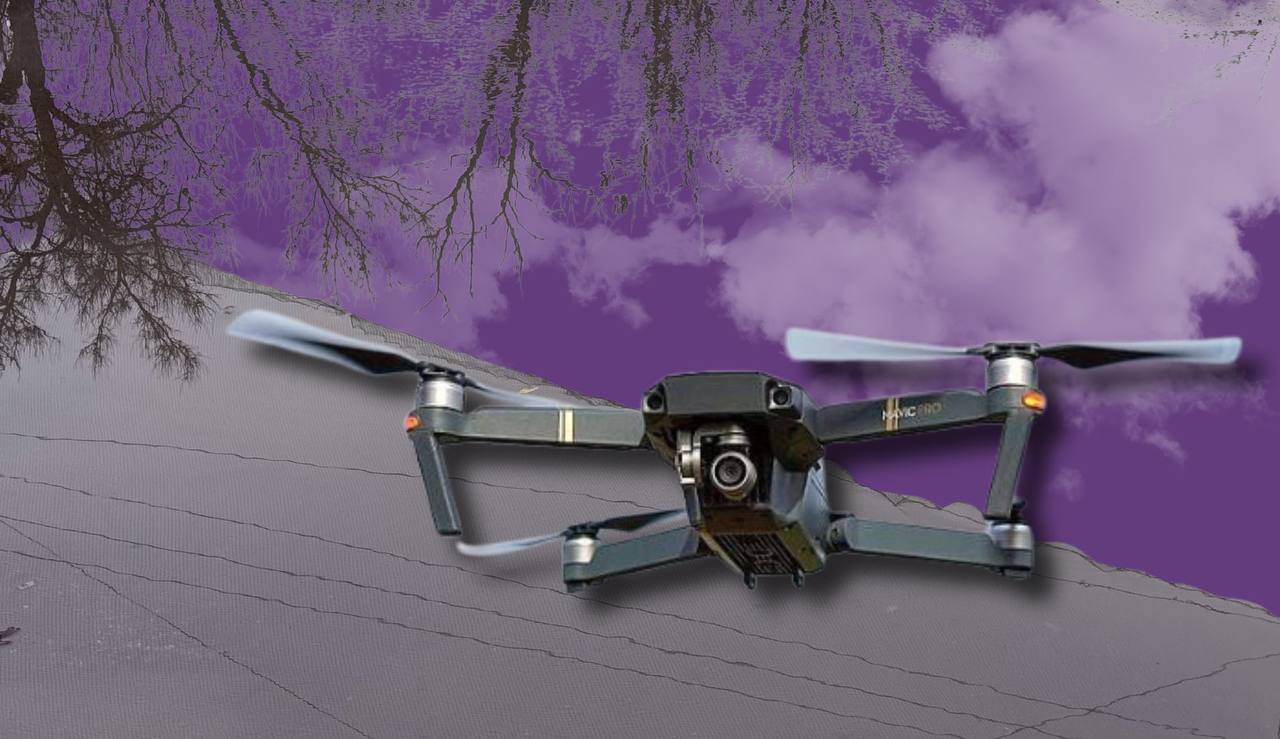
Probably, it’s a kind of superpower that people in Kherson have – an impossibly sharpened hearing: every time you go outside your ears automatically tune to sounds. It’s not about silence, the sounds of cars or children’s laughter. It’s like that scene from an adventure film when, through the ringing and vacuum after being stunned, a clear sound breaks through – “exit”, “incoming” and the biting noise of the deadly propellers that many already hate.
A year ago the danger flew in the coastal zone. Their appearance here was more a source of outrage and astonishment. Their habitat was the “red zone”. Somewhere over there, on Perekopskaya, and by the river. And now – they’re everywhere. And oppressively reminding of this are the labyrinths of nets that became a key change in the urban landscape in 2025-му.
Now the nets over the roads convey heavy meanings you won’t see in the news. A few meters above the ground – the height of human despair: “You could be killed here at any minute”.

There is one place here that’s tied to a personal summer story of mine.
Today anti-drone nets hang over this road as a harsh reminder of the level of danger that reigns around. But back then, in June, the shade under a broad tree canopy was considered a “safe” place.
It was a warm, welcoming day of the first month of summer. The morning, after a loud night, began as usual – just as noisy and full of its routine. The ears, as always, caught the sounds. And the open windows helped with that.
So, following an internal Kherson logic that many don’t understand: “while it’s quiet – I’ll go to the market”, the decision was made to head toward the bustling intersection. The market has existed there for a long time. And today vendors gather here to help locals get some goods: vegetables, dairy products from the village, a bit of meat, feed for animals and an improvised “flea market” along the road.
Having passed this stretch of road, I think it wouldn’t hurt to pop into the household goods shop as well. Well, since I’m already in this only “amusement park” for locals. I see people crowding under the awnings, but I don’t immediately understand why. I just walk through the crowd, enter the shop and look for what I need. Already on my way out I hear fragments of anxious conversations. Their gazes are fixed on their phones, and there’s a certain tension on their faces. Someone says: “The drone is a kilometer from us.

And, assessing the situation, I decide: well, a kilometer is a kilometer – I’ll go on, I’m here anyway. Who knows where it will fly.
Only a few minutes later I realize that literally before I arrived at that intersection, an ambulance had already taken away the wounded. There was a strike.
A hundred meters into the market.

“How are you? Like everyone else, we’re alive!”, – old acquaintances met.
“Take some fresh dill!”, – calls a friendly grandmother.
The market noise is joined by the sound of a generator. And suddenly – behind me, at that same intersection, – an explosion. A black ball of smoke rises up.
“Again, kamikaze,” – says the woman nearby.
“I could even hear it through the generator,” – notes one of the vendors.
“This is already the fourth one that has come here,” – says another.
All of this is striking. Even more so is how ordinary it sounds.
In such moments decisions are made even faster than usual. When drones fall a hundred meters from you, instincts kick in instantly. You have to reconfigure your route and hurry home. Shopping for today is enough. And somehow you still have to get through that intersection…
Just a couple of minutes and the distance to it is covered. I see police quickly carrying away a wounded man – he was slashed across the back.
The saleswoman from the neighboring shop had just given him first aid and holds a jar of antiseptic in her hands.
“Girl, hurry inside, because another one is going to fly [here] now!”, – I hear as I come alongside that shop. On the threshold stands a burly man who shouts at me in pure Kherson surzhyk.
Inside – alcoholic beverages are sold. Displays of bottles like shelves of books in a library. A place where people usually “grab something for the table” suddenly becomes an improvised shelter.
In a hurry two more enter the room: a mother with a young man and with them a small dog.
They were also “herded” inside. And what surprises: there is room here for people, but no room for chaos, no apocalypse in their eyes. As if the deadly danger out there beyond the glass doors is just a temporary external obstacle that has interfered with plans.
Instinctively, we all buried our gazes in our phones. Because all people of Kherson are subscribed to Telegram channels that warn about drones. Phones are our radars and some way to control external circumstances.
We track the movement. Indeed – another is approaching. Somewhere in a distant block an explosion is heard.
At that time the same burly man says to the saleswoman: “Pour me a glass of beer, since we’re already standing here…”
Some disconnected mix of the real and the subconscious – surrounded by strangers, in a room with a soft hoppy aroma, you wait out the danger you’ve already become used to.
“So why are we standing here? We need to buy cabbage,” says the woman and they leave. With their little dog, who silently looked at these strange people in the shop full of alcohol.
And that was the phrase that struck me the most.
Just like that. They go to the market to buy cabbage – under drones, under strikes, under the possibility of being killed in a minute.
At that moment I realized that this is not about bravery. And not about fearlessness. It’s about a survival habit that a war in its fourth year gives you. In that “shelter” one could stand for an hour or more. One could even go back home and plan nothing anymore. But these people chose to stick to the established vision of their day – there are simple everyday actions that allow you to survive. They need to be carried out despite everything.
Has Kherson changed in a year?
And how can one even say that anything changes in a war?
When a city for more than three years wakes up to explosions and falls asleep to them, when each day can be the last – it seems that time has stopped.
But if you lift your eyes and look around – there are changes. This city changes every day. And all of it through a wide spectrum of physical and psychological pain that its residents live through.
A year ago the appearance of drones caused outrage. Now they are perceived as part of everyday life.
A year ago people shouted: “Give me a rifle, I’ll shoot them down myself!”. Now they just quietly open Telegram and check where the next one is flying.
Almost four years of war transform everything: behavior, psyche, daily life, landscape, relationships, reactions, silence. And yes – Kherson has changed enormously. It’s frightening even to imagine what it will be like another year from now.
But one thing remains unchanged: the city is held up by people. Kherson today is 60 thousand human lives. The same 60 thousand who every morning tune their hearing, lift their eyes to the sky and still go out for cabbage.
They are the ones who hold this city and fill it with life. Because what is this city without people?
