
New occupation laws and nationalization
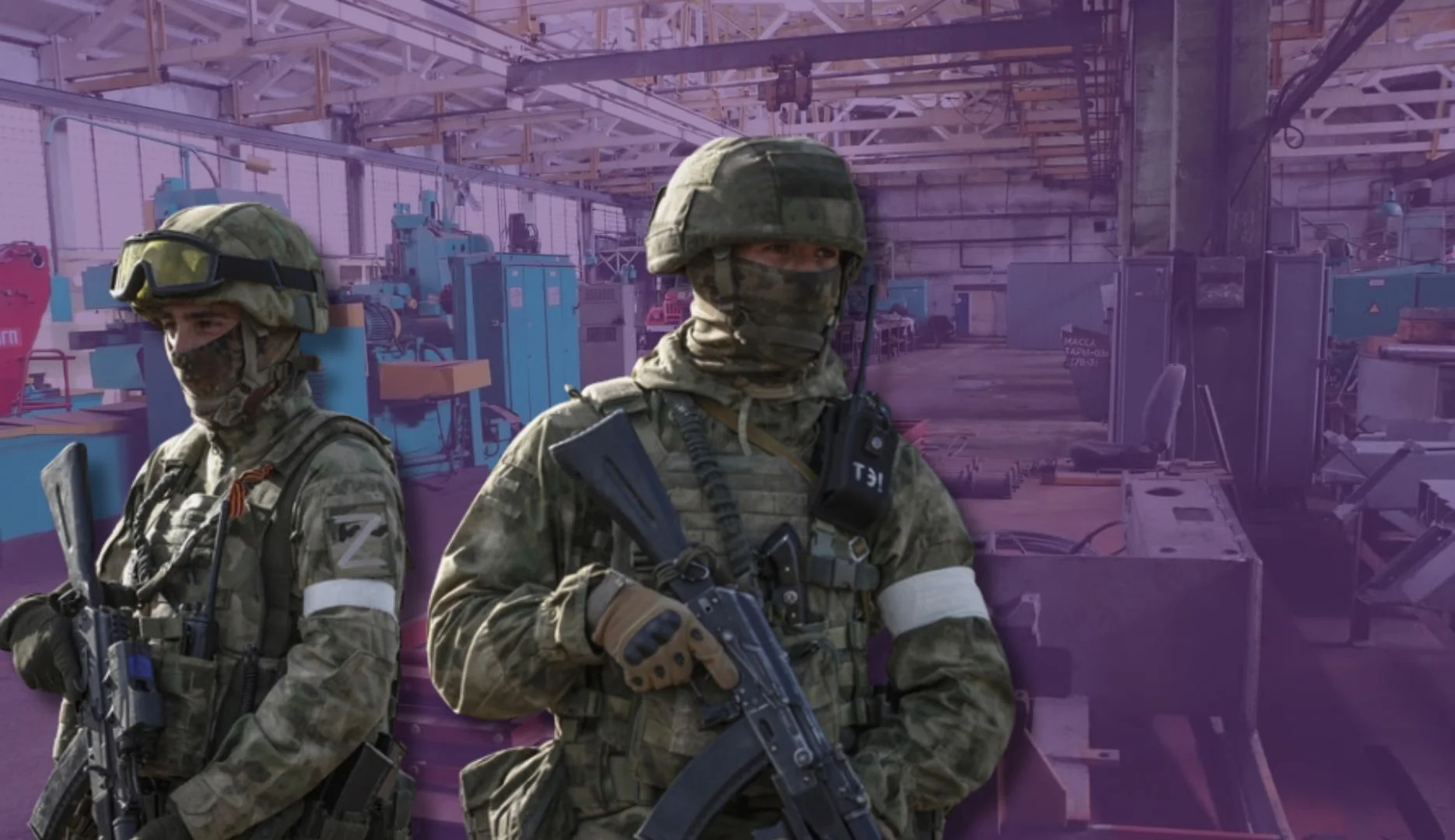
Since the beginning of the full-scale invasion, on the temporarily occupied territories of Ukraine, including Kherson region, the Russian Federation has launched a systematic mechanism for the illegal appropriation of Ukrainian businesses.
The occupation authorities call this process “nationalization” or “transfer to municipal ownership”, attempting to give a raider takeover the appearance of legality.
The main target is businesses whose owners left for territory under Ukrainian control, or those who refused to obtain Russian citizenship and cooperate with the occupiers.
Already at the end of 2022, the so-called governor of Kherson region Volodymyr Saldo stated that after holding a referendum all property, state, municipal and private, was “nationalized” in favor of the Russian Federation. At that time, according to Saldo, about 26 thousand Ukrainian enterprises could be included in the Russian registers.
Occupiers’ legal framework for “squeezing out”
To legalize the looting, Russia consistently introduced its own legislation that contradicts international law and Ukrainian sovereignty.
One of the first steps was to include Ukrainian business entities into the Russian legal field.
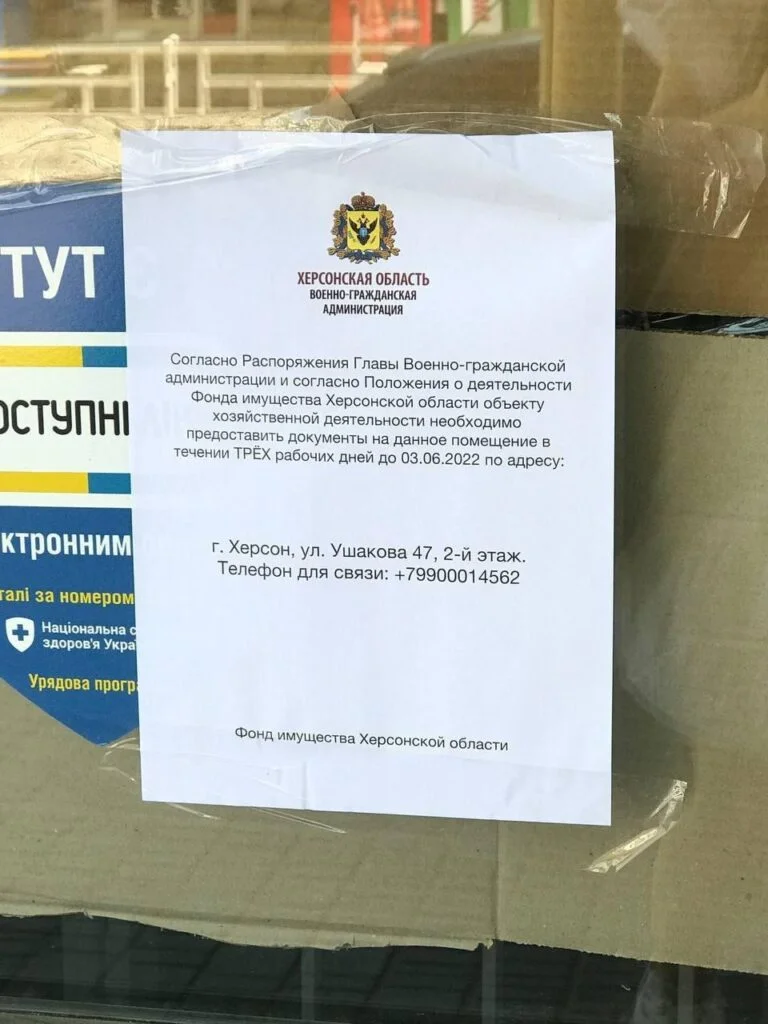
Thus, already in May 2022 the so-called Property Fund of the Kherson Military-Civilian Administration was created. Then the Fund began issuing the first orders to seize property, in particular a network of gas stations. These documents transferred property to temporary management without any signatures, only with a stamp “for documents”.
In a comment to MOST, investigative journalist and expert on temporarily occupied territories of Kherson region Oleg Baturin noted that all processes were governed by documents issued by the occupiers, but all of them were written hastily and with mistakes.
“I reviewed documents from the first and second waves of this grab — you can see there are such ridiculous mistakes, these documents themselves are null and void, they did everything very carelessly,” — Oleg Baturin said.
As another MOST interlocutor who witnessed those events said, it was at the end of May 2022 in Kherson that a pro-Russian ex-official from Poltava and ally of the eliminated former MP Illia Kyva Serhii Cherednichenko appeared, who became the head of the Property Fund. His functions included the initial identification and “description” of objects.
“Cherednichenko drove around Kherson… showed, said: ‘Look, f***, this is my house, I’m taking it’ and so on…”, — the interlocutor told.
Already a week after such tours, Cherednichenko began offering businessmen who cooperated with the occupation authorities to “take over enterprises” whose owners had left for territory under Ukrainian control.
Some Kherson businesses are still suing Cherednichenko for embezzlement. In particular, in the summer of this year LLC “Avtoplaneta Plus” for the second time filed a lawsuit against him. The suit concerned the illegal removal of the company’s cars, which were later handed over to the Russian army.
In June 2022 the occupation authorities announced the start of registration of property under Russian legislation. Even then it was about registration of both state and private property.
Later it was announced the creation of an Interdepartmental Commission on ownerless property, which was to identify and describe objects that had no owners. After that these objects were transferred to the balance of the occupation authorities.
This commission began working fully from August 2022 and was in fact overseen by Russian special services in order to structure the process and ensure collective irresponsibility.
“It was collective irresponsibility. No one could say that some specific person stole that property. It was a collective body that approved it — everything is legal”, — our interlocutor explained.
The commission included the so-called senator Kostiantyn Basiuk (who positioned himself as the “grey cardinal” and resolved most issues after Saldo’s poisoning), Cherednichenko and other collaborators who previously worked with former director of the Department for Development of Municipal Property of Kherson City Council Alisa Verbytska.
At the meetings of this commission, new owners received letters about the transfer of the seized enterprise to temporary management “to improve the social situation in the territory of Kherson region and the city of Kherson and to create jobs”.
The representative of the company was checked for whether he had experience, money and whether he was needed by the occupation authorities. In particular, one of the first new owners sought was for a concrete plant, to produce blocks for building fortifications for the Russian army.
“If they saw that a more-or-less adequate person with money — they let him in, but if, say, just Vasya comes, who has a banana cart, and he wants to take over some hotel… they just kicked him out,” — a MOST source said.
After the de-occupation of the right bank, Volodymyr Saldo created another occupation institution — the Fund for the Development of the Territories of Kherson Region. Its purpose was “to ensure proper accounting, maintenance, preservation of movable and immovable property of Kherson region”, including property that was part of the so-called “state treasury of Kherson region”. The founder functions of this Fund were initially exercised by the Military-Civilian Administration of Kherson region.
In 2023 the so-called Property Fund was transformed into the Ministry of Property and Land Relations of Kherson Region. It is currently headed by a former entrepreneur from Crimea Yurii Khozhaĭnov. After the annexation of the peninsula he began actively cooperating with the occupation authorities and receiving positions in occupation bodies. Incidentally, last year the powers of the Fund for the Development of Territories were also transferred to this same ministry, so now any actions regarding property are controlled by this pseudo-body.
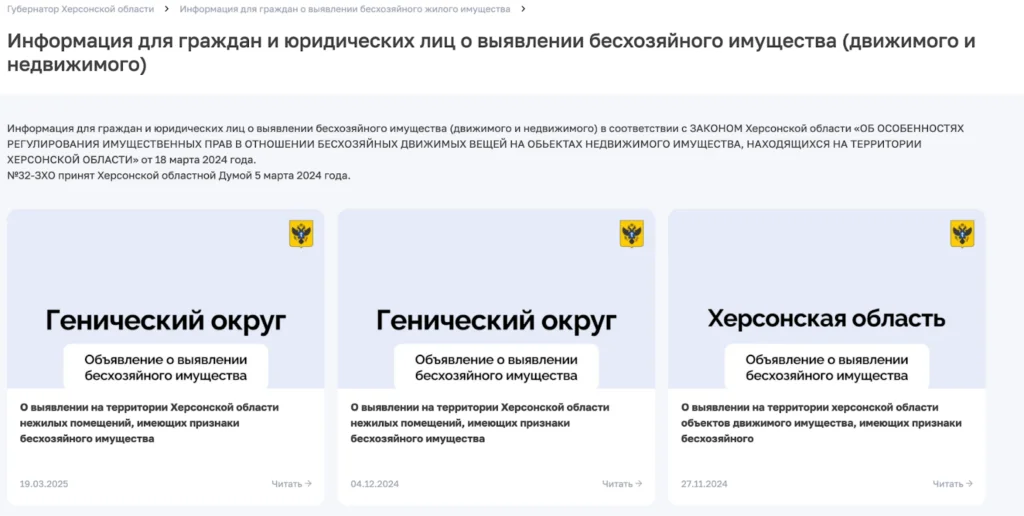
The latest radical steps toward appropriating business on the left bank were the adoption by the so-called Kherson Regional Duma of two special laws that create a comprehensive mechanism for seizing all assets.
The first — the law “On the peculiarities of recognizing property located in the territory of Kherson region as ownerless and on the acquisition of the right of state ownership of Kherson region to such property“.
The law directly applies to business assets, including land plots, buildings, structures, property complexes (that is, entire enterprises), as well as non-residential premises.
Relying specifically on this law, the pseudo-ministry keeps records of “ownerless property” that may be recognized as state property of Kherson region if the owner (a citizen of Ukraine) does not provide the originals of title documents certified on the territory of the Russian Federation within 30 days.
The second — the law “On the peculiarities of regulating property rights with respect to ownerless movable items on immovable property objects located in the territory of Kherson region” regulates the seizure of movable property (vehicles, equipment, finished products).
It allows any occupation structure to initiate a procedure to recognize property as ownerless, and the owner has only 10 calendar days after the publication of the notice to provide the originals of documents confirming ownership.
In case of sale of such property, compensation for its value is possible only for citizens of the Russian Federation or legal entities — residents of the Russian Federation, which effectively deprives Ukrainian owners of the possibility to reclaim assets.
These laws legally formalize two-sided raiding: movable property is confiscated quickly (10 days), and immovable property — through a more complex scheme, but the ultimate goal is the same — transferring assets into the ownership of the occupation administration.
Relying specifically on these two laws, the pseudo-ministry of property and land relations keeps records of “ownerless property”.
Overall, as of today there are data in Russian registers about the registration of about 3,000 organizations that have a registration address in Kherson region; this concerns both private and “state” entities, i.e. unlawfully re-registered or simply seized enterprises.

Specific cases of raiding and nationalization
On the temporarily occupied territories of Kherson region, the “nationalization” mechanisms are used both to appropriate the property of Ukrainian businessmen and politicians and to seize assets of foreign companies.
One high-profile case concerns attempts by the ex-MP traitor Oleg Tsaryov, who was recently deprived of Ukrainian citizenship, to re-register a production building and land plots in his name, which are located on the temporarily occupied territory of Oleshky.
We are talking about facilities at the address of the cardboard factory “Dunapack”, which belongs to the Austrian company Mosburger GmbH.
In February 2025 the occupation administration of the Federal Service for State Registration refused Tsaryov the registration of rights to the property. After that Tsaryov, who was convicted in absentia in Ukraine for state treason, decided to appeal the refusal through the occupation Arbitration Court of Kherson region, trying to use the illegally created Russian judicial system to legalize the raider takeover of foreign assets.
Another case illustrates the appropriation of assets related to local Ukrainian authorities.
Thus, the Russian occupiers announced the “nationalization” of all property of the mayor of Kherson Ihor Kolykhaiev, kidnapped by the Russians in June 2022.
In particular, the complex of LLC “Trading House Prodexim” in the village of Zaozerne, Kakhovka district — a powerful agricultural enterprise that before the invasion cultivated over 8,000 hectares of land — was seized.
Russian media broadcast the version that, after Kolykhaiev’s arrest, he allegedly asked his wife to find a Russian businessman to oversee the farm, and such a “supervisor” became a resident of Voronezh, Albert Rezca, head of the Russian LLC “Agrarian”.
However, this situation has all the signs of a banal raider takeover, especially after Volodymyr Saldo’s demand to take measures. It is asserted that thanks to the military police the occupiers entered this enterprise and now will facilitate its development, effectively transferring it under the control of structures loyal to the occupation administration.
In addition to direct appropriation, the occupation authorities actively use seized objects to create propaganda fakes about construction and development.
Thus, in the resort village of Zalizny Port the representatives of the occupation administration seized the private boarding house “Oksamyt”, owned by Ukrainian citizen Oksana Sambir. The occupiers simply repainted the building facade, installed a sign and presented it as a newly built Youth Center.
This repeats the story with the so-called government quarter on Arabat Spit, which the occupation authorities headed by Volodymyr Saldo and Russian Deputy Prime Minister Marat Khusnullin presented as a large new development.
In fact, the government quarter turned out to be an unfinished medical center of Dr. Volodymyr Koziavkin that stood on Arabatka for years. The occupiers simply “grabbed” the already existing complex of buildings to create the illusion of rapid construction of a new city and to demonstrate the supposed strength of Russia in developing new territories.
In addition, according to a MOST interlocutor, the seizure of large Ukrainian retail chains took place “on a call from Crimea”.
For example, at the beginning of the occupation the attempt by Volodymyr Saldo and Ihor Semenchev Jr. to take over the “ATB” and “Silpo” chains failed. Instead, from Crimea they sent the nephew of the scandalously famous Crimean millionaire Yosyp Faingold — Borys, who began sharing the store networks with Saldo.
“At first there was a plan that everything would belong to local collaborators like Saldo, but then Borya Faingold arrived and pushed everything aside. He probably just miscalculated, called the right people and presented his business plan. He says: ‘Guys, if I run it, you’ll get roughly this much.’ In response, Saldo was called from Crimea and told: ‘Okay, handle the referendum, schools, hospitals, the budget, and don’t get into commerce,'” — the interlocutor said.
According to him, Borys Faingold directly engaged in launching the seized “ATB” stores and pharmacies. He found managers through old Ukrainian contacts and brought in goods.
The situation around the “Tavriia” brandy factory in Nova Kakhovka is perhaps one of the brightest examples of open raiding that even the occupational law enforcement agencies cannot control.
Thus, in October 2022 Volodymyr Saldo issued an order to transfer the property of “Tavriia” to temporary management by the company “Crimean Wine and Vodka Holding” for a period of one year, citing the decision of that same Interdepartmental Commission mentioned above, about the alleged “ownerlessness” of the object.
Later, in February 2023, the occupation prosecutor’s office of Kherson region, checking the legality of this order, found that the decision about “ownerlessness” was erroneous, and the lack of legality of management facilitated the removal of assets and valuables by “unidentified persons”, which caused significant damage to the enterprise.
Despite the detected violations and the fact of embezzlement that even the pseudo-prosecutor’s office exposed, the Property Fund of Kherson region reported that the property of the brandy factory was nationalized and transferred to the ownership of Kherson region. The basis for this was that the factory’s CEO Volodymyr Rud did not provide the occupation authorities with originals or certified copies of documents confirming the right of ownership. Therefore, the cancellation of the order on the transfer can no longer be grounds for excluding this property from the list of objects that were transferred to the ownership of the occupation administration.
In fact the factory was seized, all its property was taken to Crimea, and there are simply no persons held accountable for this.
It is important to mention Olena Dmytruk. She was among those who engaged in the so-called “nationalization” of business in the occupied part of Kherson region. In Russian sources she is called the director of the Novokakhovka Bread Factory.
According to Russian registers, Dmytruk heads three organizations — LLC “Novokakhovka Bread Factory” (where she is also a founder), the Kherson Regional Consumer Union and the Trade and Procurement Cooperative “Novokakhovskyi”. In 2024 she rewrote her business to her daughter Sofia, who now owns six enterprises.
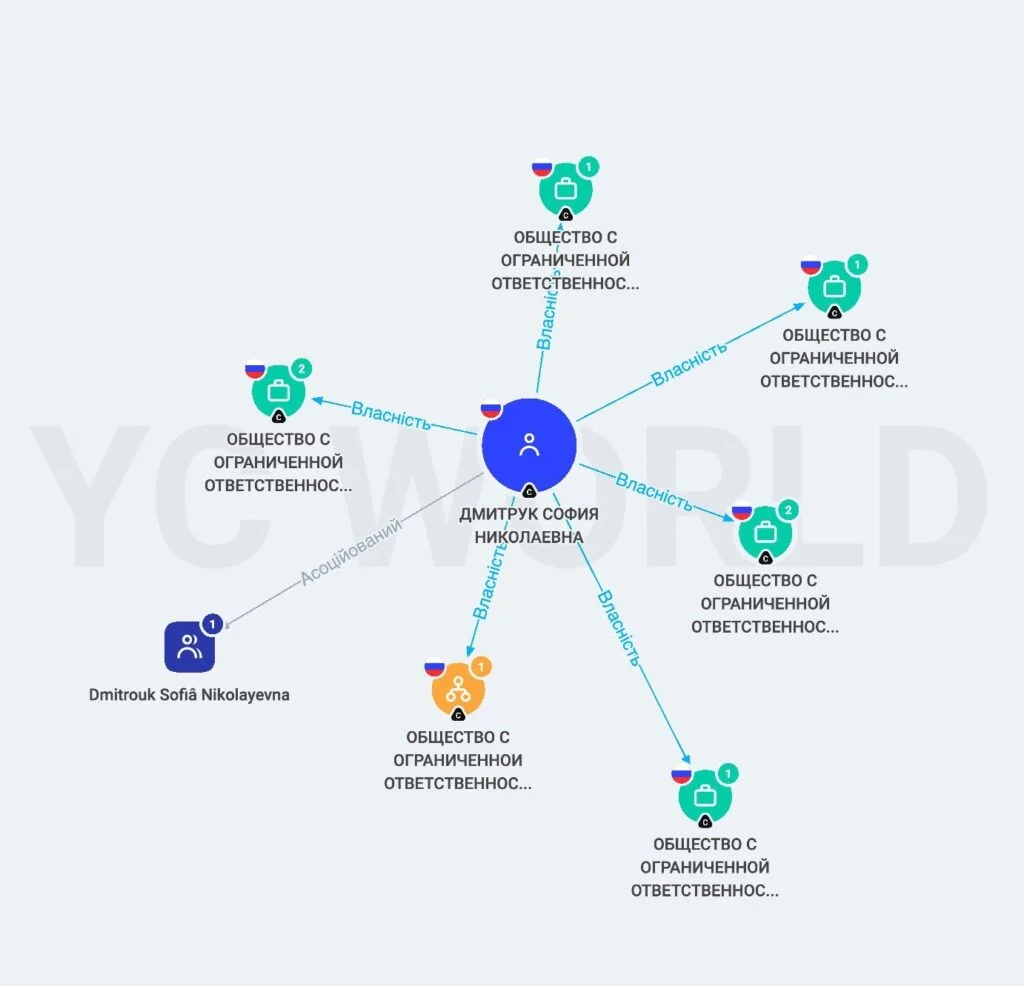
Interestingly, Dmytruk appealed to the occupation governor of Kherson region Volodymyr Saldo and asked for permission to manage the “Syta Khata” stores in Henichesk, explaining that their owners allegedly “self-excluded”. In the letter she also noted that she has experience managing similar facilities and is the owner of “Beryslav Bread Factory”.

Before the full-scale war, Dmytruk owned several enterprises on territory under Ukrainian control, including “Khersonlift”, “Zernokom AgroYug”, the Construction Structures Plant and Trading House “Yantar”.
In 2023 she took part in the pseudo-elections organized by the occupation authorities. Initially Dmytruk won the so-called preliminary voting of the “United Russia” party, and then became a deputy of the Russian-created “Kherson Regional Duma”. At the first session, on September 20, 2023, she was appointed first vice-speaker.
The same year the National Police informed Olena Dmytruk of suspicion of state treason committed during martial law.
Other “schemes” used by the occupiers in Kherson region are also known.
Armed groups would arrive at enterprises, break down doors and declare that the object was “nationalized” from now on. They could wave documents with unknown stamps in front of employees, referring to so-called “orders” of the occupation authorities.
“They acted according to this scheme, in particular, at the Novokakhovka Electromechanical Plant. They also seized buildings of village, town and city councils when unknown persons proclaimed themselves occupation elders or ‘mayors’. They would just come in and say: ‘Hello, now I’m in charge here’,” — journalist Oleg Baturin said.
In addition, the Russians used abductions as a way to profit. Many cases have been recorded when they captured and detained entrepreneurs to rob them or force them to hand over their property.
As a result of the illegal appropriation of businesses by Russian occupiers on the territory of Kherson region, all sectors have suffered — agricultural, tourism, industrial and trade.
“Everyone and the people suffered from this, because the Russians are squeezing out their property, and the entire Kherson region, and other temporarily occupied territories of Ukraine. Here one can only talk about the scale of losses: someone lost more money, someone, so to speak, less. But everyone suffered,” — summed up Oleg Baturin.
Voluntary transfer of property and cooperation of local collaborators
Besides direct raiding, the Russian occupation authorities used pressure and incentives for local collaborators, who voluntarily transferred their businesses to Russian standards in order to continue operating and gain benefits in the new conditions.
For example, top collaborators also submitted lists of their property for re-registration under Russian legislation to the Property Fund.
In particular, Kherson Regional Council deputy Vitalii Buliuk, who is now the deputy head of the occupation government, came to Serhii Cherednichenko in the summer of 2022 with a list of his farming enterprises for re-registration.
“He says: ‘Prepare the documents and include this in the commission. We’ll do everything there, prepare the firms’,” —
And although at the beginning of the full-scale invasion Saldo and Buliuk may have had joint schemes to profit from fuel, not so long ago Saldo rejected Buliuk’s company from participation in an investment competition, which may indicate a conflict between them that arose on the basis of the “deriban”.
Another deputy-businessman who gladly re-registered his property under Russian standards is Eduard Repilevskyi.
At the beginning of the occupation he held the position of the so-called Minister of Agriculture and Fisheries of Kherson region, but was later removed allegedly due to financial fraud.
In May 2022 Repilevskyi told Russian journalists that he had already established channels for selling agricultural products to occupied Crimea and was re-registering his companies according to Russian legislation. In particular, these were LLC “Agrobiznes”, FH “Mar’ianivske” and the football club “Tavriia”.
Eduard Repilevskyi’s son — former Kherson regional council deputy from the “Servant of the People” party Danylo Repilevskyi received a Russian passport in December 2022 and registered in Russia LLC “Agrobiznes”, FH “Mar’ianske”, LLC “Agro-Atlas”, LLC “Semyana Plyus”, LLC “Atol M” and began paying taxes in Russia. In addition, through these enterprises he organized the export of Ukrainian agricultural products to other countries, which were exported under the guise of being Russian. For this, Repilevskyi Jr. received a suspicion from Ukrainian law enforcement.
The same was done by Kherson regional council deputy from “OPZZh” and businessman Serhii Drozdik, the son of the occupation director of the Black Sea Biosphere Reserve Ihor Zhdaniuk — Oleksandr Zhdaniuk, the brother of the eliminated Kherson traitor MP Oleksii Kovalov – Yurii Kovalov and others.
The text was created with the support of the European journalistic network n-ost.