

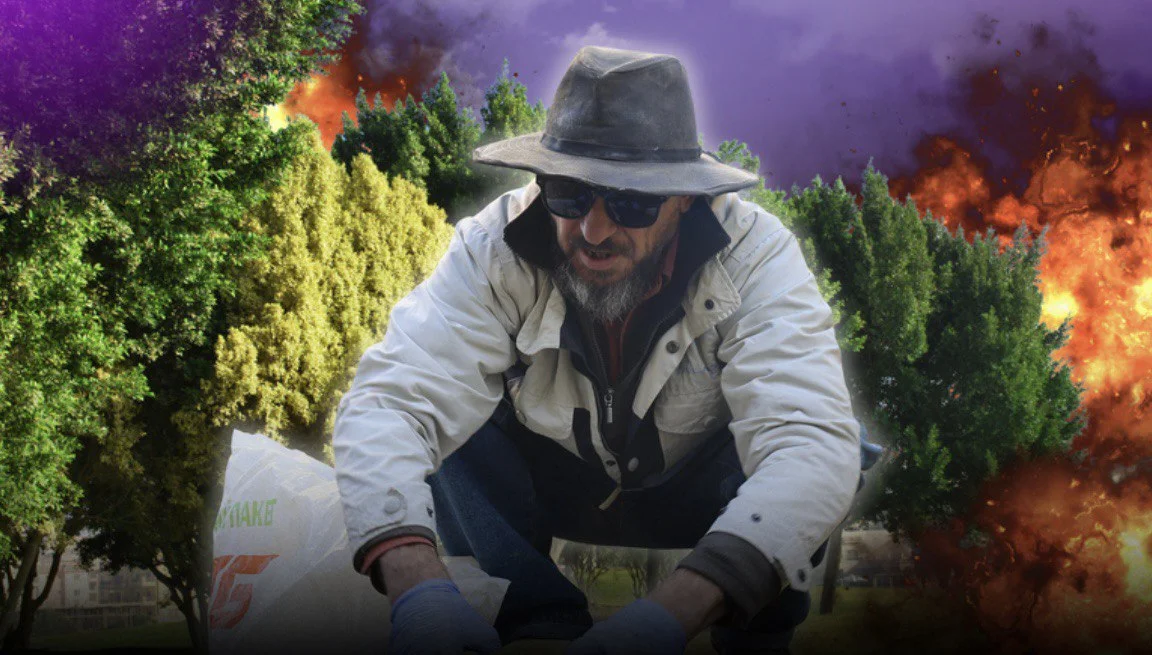
It all started with roses. The residents of a building in Kherson’s Tavriyskyi microdistrict planted them in their yard. It was 2023. Kherson had not yet been hit by aerial bombs, and enemy drones had not yet filled a large part of the city, turning it into a kill zone. But there were shellings from cannons, mortars and rocket artillery. So Kherson residents wanted something to counter the tension that had become an inevitable part of life in a frontline territory.
“God gave to you, so give to others”
“When we planted the roses,” says Liubov Oleksandrivna, a resident of one of the buildings, “we decided to plant cherries in the yard as well. Of course, we remembered Shevchenko’s lines about the ‘cherry orchard by the house.’ And we simply wanted a mini-orchard next to the building. In our yard there are cherries, but ordinary wild ones, so to speak. We will move them to Tarle Street, and in the yard there will be cultivated cherries — ‘Erdi’, ‘Shpanka’. We will take care of them. Mostly I will do it, because I am retired and have time.”
The woman says that when the trees the residents plant this autumn begin to bear fruit, it will be for everyone who wants them: “Who will harvest the crop? People. We do everything for the people. As the saying goes: ‘God gave to you, so give to others.’ And everyone will be happy.”
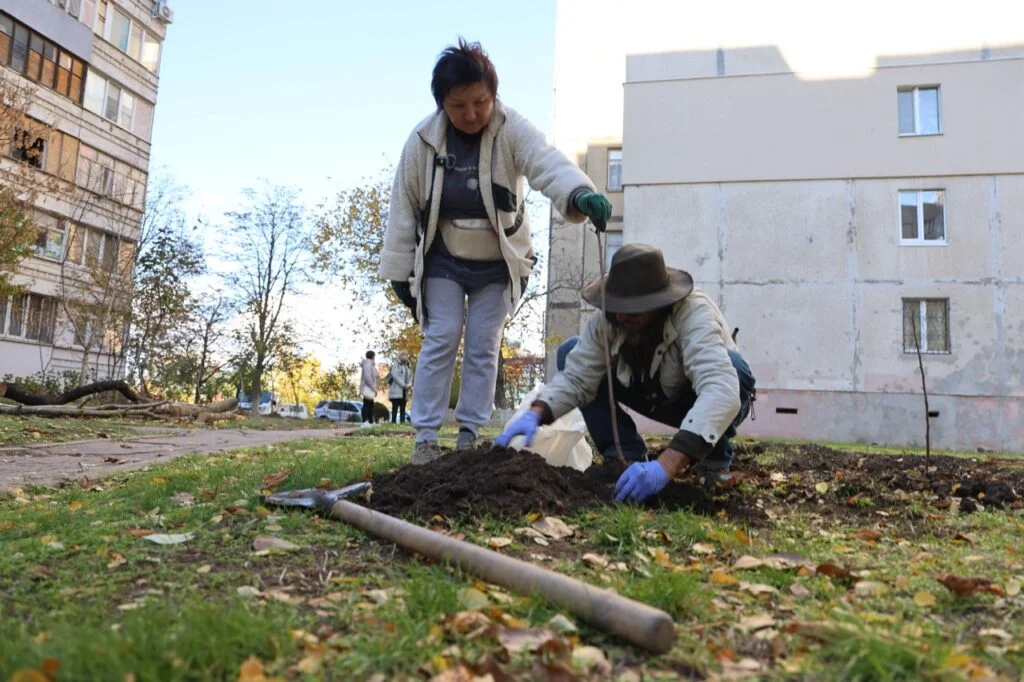
Local civic activists help Kherson residents transform residential areas into green zones.
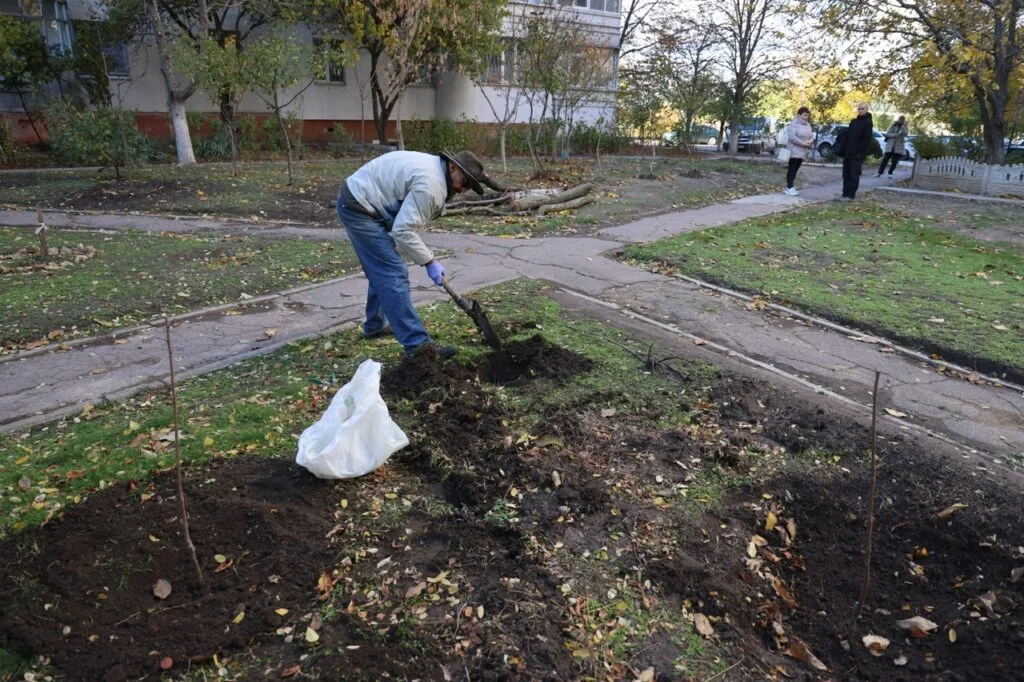
“We take the pruners, trim the tips of the roots a little…,” says Oleksandr Semenchenko, head of the civic organization «Урбан Ре-Паблік», giving a master class on planting trees.
He scoops a handful of white granules from a bag standing next to the planting hole and mixes them with the soil taken from the pit: “This is superphosphate.” He lowers the young tree into the hole and piles soil over the roots. The final stage of planting is watering.
“I am often asked how many trees I have planted. They ask how to plant trees. I don’t count how many I plant. And how to plant? Green side up,” jokes Oleksandr.
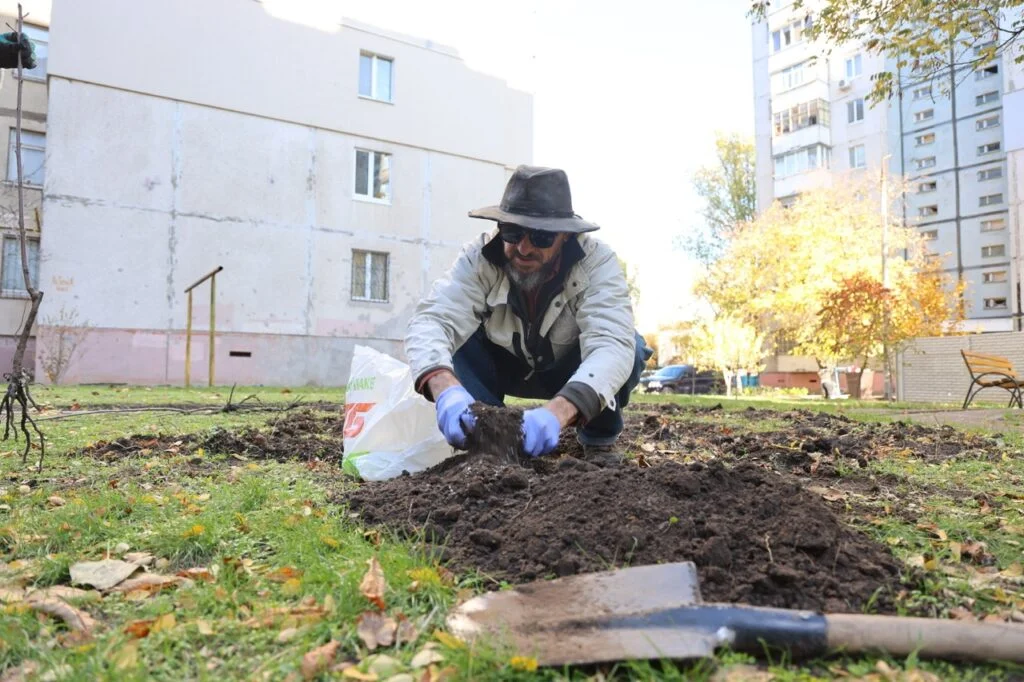
Then, in a more serious tone, he tells the residents of the building, pointing to the newly planted trees: “It would be very good to mulch (to cover the soil around the tree with a protective layer of mulch — special organic or inorganic materials — MOST). That would not be superfluous before winter.”
Green monuments
The trees planted in this troubled time by residents of Kherson’s Tavriyskyi microdistrict are not only an act of resistance to an adverse situation, but also a tribute to the outstanding Ukrainian scientist and breeder Volodymyr Symyrenko. The project “Ukrainian Small Garden,” within which residents of the Tavriyskyi microdistrict receive young trees for planting, is dedicated to his memory.
The project is overseen by several civic organizations and charitable foundations.
“Volodymyr Symyrenko,” says volunteer Nataliya Shalnova of the Charitable Foundation «Допомога Херсону», “was arrested on January 8, 1933. He was sentenced to execution for participation in an ‘anti-Soviet sabotaging organization.’ The execution was commuted to imprisonment for 10 years. From November 1933 until the end of December 1937 he was held in the Kherson corrective labor colony, where he tended orchards in the suburban area. In December 1937 he was released early from the colony with the wording ‘for honest labor and high performance.’ The pomological (pomology is the science that studies varieties of fruit and berry plants — MOST) station of the Symyrenko family in Mliiv (a village in Cherkasy region — MOST) was considered the best during the times of the Russian Empire and the Soviet Union, and is now a pride of Ukraine.”
According to Nataliya Shalnova, the idea initially arose to plant a few saplings of the apple varieties “Renet Symyrenko” and “Glory to the Victors” in Kherson in honor of the illustrious Ukrainian, which was done in spring 2024 in various parts of the city. Then the Charitable Foundation “Kherson-Ukraine” brought 500 rose bushes to Kherson from the Rose Village near Odesa. Over time the number of people involved in the project grew, and the initiative of civic organizations became a kind of psychotherapy in the frontline city; the idea has now taken the form of the “Ukrainian Small Garden in Memory of Volodymyr Symyrenko.”
“In October 2024,” Nataliya says, “representatives of 6 OSBB (associations of co-owners of apartment buildings — MOST) received several dozen saplings of Ukrainian varieties of fruit trees for planting near apartment buildings. Thus, the project acquires not only ecological and social features, but also becomes an action to preserve intangible cultural heritage. The project is financed thanks to donations from Kherson residents who live abroad. In the spring trees were planted by 12 OSBB. More than 300 saplings of fruit and ornamental trees have already been planted.”
Alley of Volunteers
Alla and Serhiy are a couple from the Tavriyskyi microdistrict who take an active part in planting trees. They began doing this back during the Russian occupation of Kherson.
“This is a dessert almond,” Alla says, showing the trees the couple planted. “And this is a young plum, which, by the way, is already bearing fruit. In our yards there are already small orchards. They are mostly tended by pensioners.”
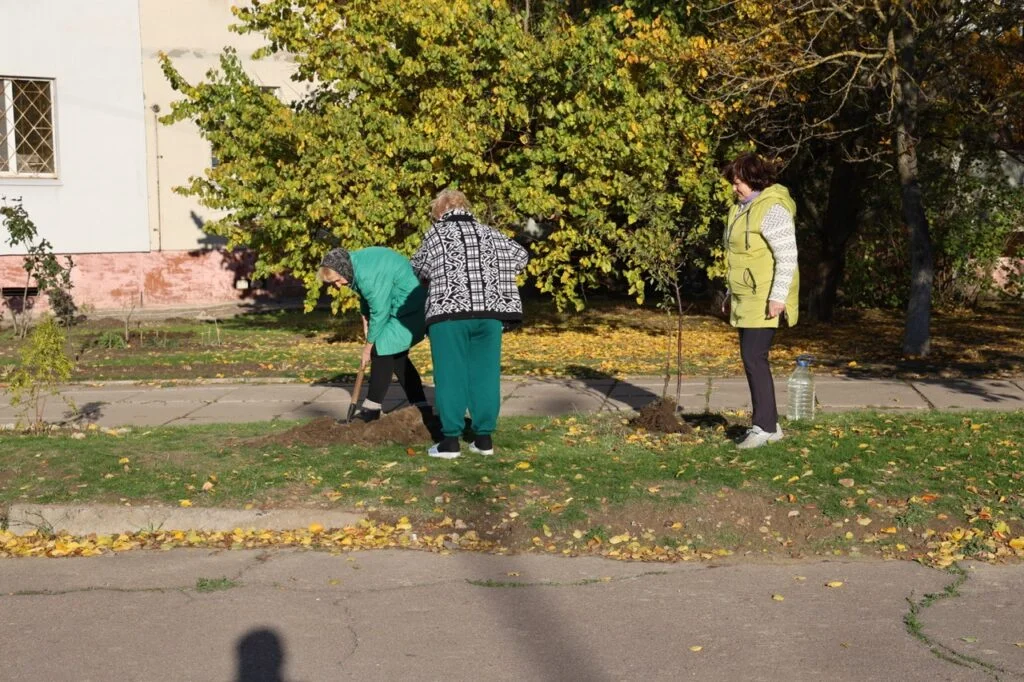
However, Kherson residents plant trees not only in yards. There is an alley in the Tavriyskyi microdistrict that runs along the sidewalk. Work on it began in the autumn of 2022, shortly after the city was liberated.
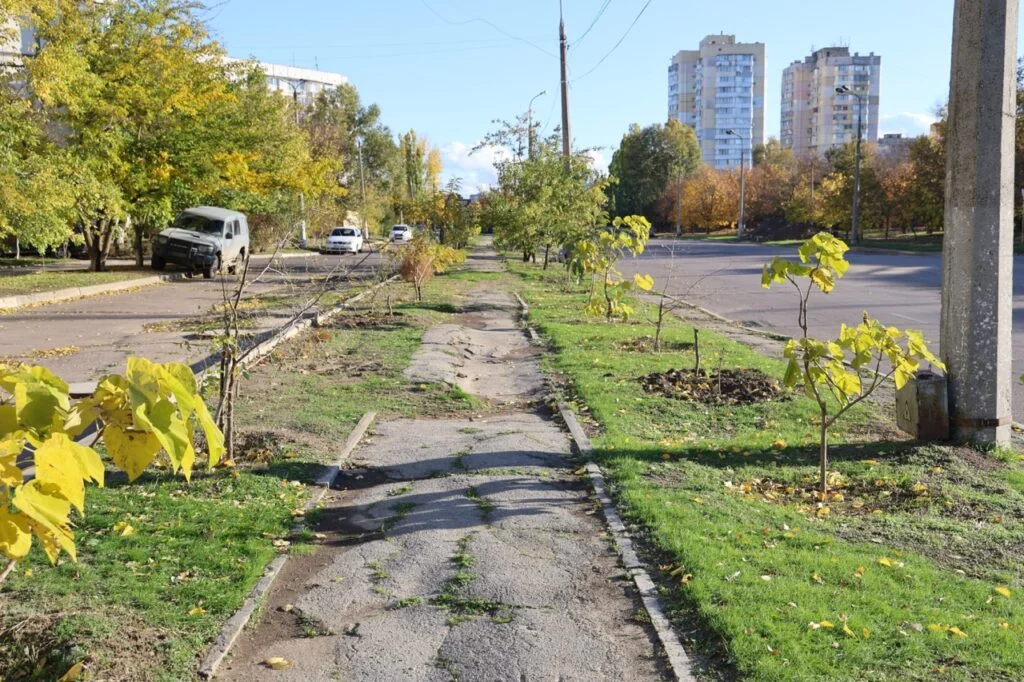
“This alley,” says civic activist Mykola Koshelyuk, who created and actively participates in the implementation of the “Ukrainian Small Garden” project, “has an unofficial name — Alley of Volunteers. During one of the shellings there was a strike here, which resulted in the deaths of two volunteers who were on the street.”
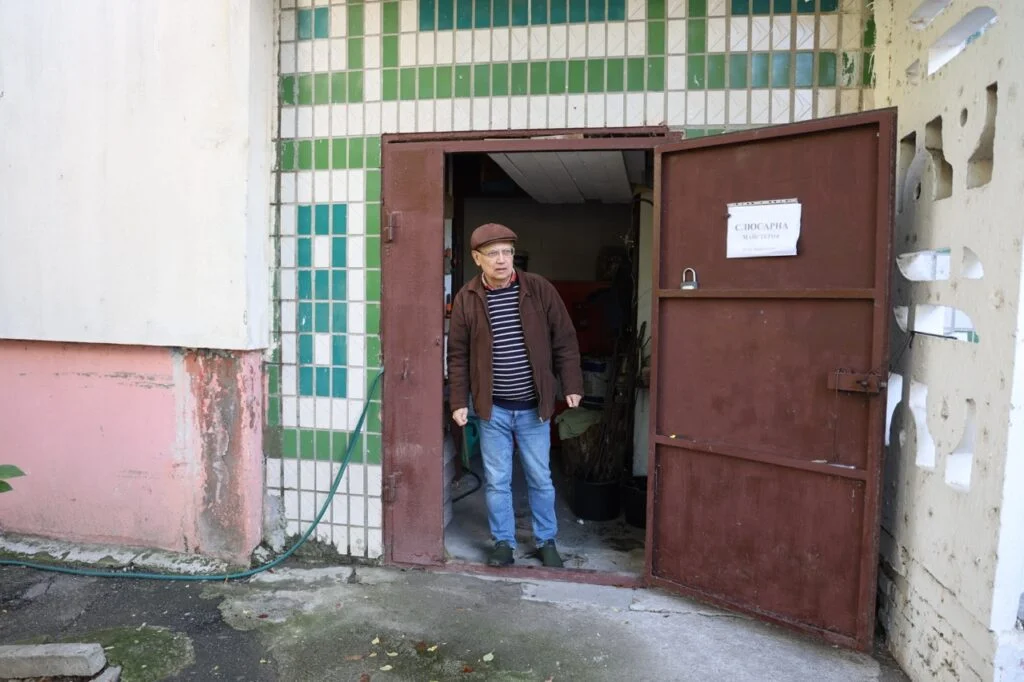
The man says that the saplings were bought by the whole community — with donations: “Many people helped. Including the military. When we were planting trees, they would come up and, learning what this alley was for, would give money. They said they wanted their contribution to be part of this cause.”
According to Mykola Koshelyuk, it was initially planned that the project would concern not only the Tavriyskyi microdistrict but would have a wider reach: the eastern part of the city, Kindiyka. But the situation forced changes. Now trees are planted only in the relatively safe part of Kherson.