

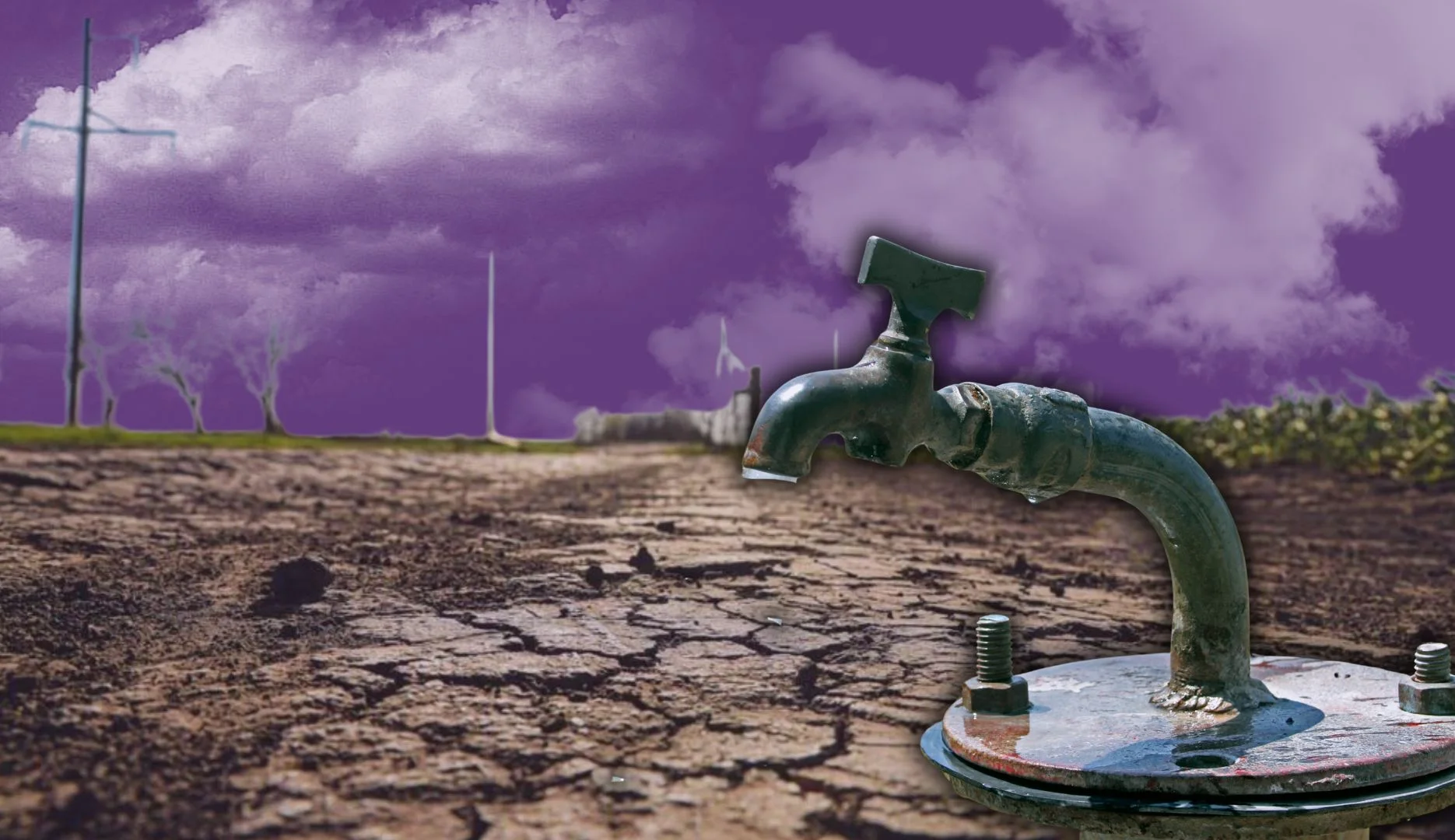
Kherson region has found itself on the brink of a new climatic reality. After the destruction of the Kakhovka Reservoir, the region lost not just a source of water, but the main limiting factor, without which the ecosystem that had formed over decades collapses. The process that began in the mid-20th century and transformed the arid south of Ukraine into a fertile agricultural area is now disintegrating before our eyes. Reduced precipitation, moisture deficit, the disappearance of a stable winter and increasing temperature stress threaten not only the agricultural sector but also the ability of people to live in these communities.
Artificial microclimate: creation and collapse
Yurii Kiriak, head of the Kherson Regional Center for Hydrometeorology, reminds us: over 70 years the region’s natural ecosystem changed radically. The creation of the Kakhovka Reservoir, the land reclamation and irrigation system, the shelterbelt systems, and the planting of forests on the Oleshky Sands transformed the climate of the south – dry steppes with a scorching wind turned into green oases. The reservoir itself lowered the surrounding temperature; evaporation from the reservoir and irrigated fields enriched the atmosphere with moisture, and filtration of water from the reservoir replenished the region’s groundwater. In the second half of the 20th century precipitation in the region increased by approximately 30% – this was a direct consequence of the climate influence of the factors listed above.
The destruction of the Kakhovka Reservoir shattered this model. The ecosystem that had existed for decades thanks to the reservoir’s water lost its foundation. And a return to the “natural” state is impossible: interventions in geology, changes to the natural relief of ravines, floodplains and riverbeds, and the development of a canal system have irreversibly reshaped the territory, destroying natural ecosystems that existed here for thousands of years.
No water – no harvest
In 2024–2025 it became clear: growing the region’s traditional crops without irrigation is extremely risky. The climate around the former Kakhovka Reservoir is changing not only on lands that were irrigated but across the wider territory. In the Velyka Oleksandrivka and Vysokopillia communities, which until recently showed stable yields, there was massive crop failure this year. Winter wheat and barley, sunflower, rapeseed, peas – the crops that formed the basis of agricultural production – in 2025 could not withstand the anomalous drought.
Official meteorological observations confirm the depth of the problem. In 2025, as of October 1, only 160.6 mm of precipitation had fallen in Kherson, which is only half of the average precipitation for that date and one third of the annual norm. In Velyka Oleksandrivka – 216.8 mm as of October 1, with an annual norm of 497 mm. Thus moisture is entering the region in volumes that are significantly lower than the levels that existed when the reservoir was present.
But if one looks at the period before the reservoir was built, the officially recorded annual precipitation minima in Kherson are 159 mm in 1921, 185 mm in 1945, and 218 mm in 1951. These data indicate that after the reservoir’s destruction a reduction in annual precipitation to such low levels is entirely possible. And considering that over the last 30 years, with an average norm of 430 mm, the region was considered a zone of risky farming, with 160–300 mm of precipitation one cannot even dream of achieving a harvest.
Uneven precipitation: when rain doesn’t help
However, the problem is not only the total amount of precipitation. As Yurii Kiriak explains, the pattern of its distribution is also critical. In 2023, with a total precipitation of 508 mm, 288 mm fell in Velyka Oleksandrivka over several ten-day periods – that is, in a short period of anomalously high intensity. Moisture does not have time to soak into the soil; almost all of it runs off into surface water bodies, and what remains on the surface rapidly evaporates under high temperatures. So the amount of moisture effectively useful to plants is significantly smaller than the statistics record.
Such an uneven moisture regime does not allow crops to develop fully. A prolonged spring drought interrupted by short downpours does not contribute to yield formation, it only increases plant stress.
Warm winters, hot risks
The temperature picture adds another worrying detail. Since the 1980s the region’s average annual temperature has risen from about 9 °C to 13.6 °C in 2024. Warming has been especially rapid over the last decade. At the same time, the duration of the winter period is shrinking: if winter used to last up to 130 days, it now barely lasts 40. And in 2023 and 2024 the phenomenon known as «Meteorological winter» was not recorded at all. After the meteorological autumn, meteorological spring began immediately.
This is not only a climatic anomaly but also a biological problem: the reduction of the cold period promotes the multiplication of pests, changes the soil microflora, and also increases the risk of atypical weather events – tornadoes, dust storms, hot dry winds.
Agriculture on the brink
2025 set a record for the number of appeals to the regional hydrometeorological center regarding crop losses: 497 farms filed requests, and 622 certificates of crop damage were issued. This is 18–20 times more than the average for 2018–2021. In many districts of the region this year proved disastrous in terms of yields. And this is despite the fact that a significant portion of information from temporarily occupied territories is simply unavailable.
The fundamental problem is moisture deficit. As of October 1, 2025 in many districts the total amount of precipitation did not exceed 217 mm. This is insufficient even for a basic vegetative cycle. Winter crops do not germinate, spring crops do not form grain, and even relatively drought-resistant crops lose their potential.
A way out of the dead end — is rescue possible?
Yurii Kiriak does not hide it: without a systemic approach the agricultural future of the south is in question. Individual farms are already experimenting with planting almonds, pistachios and other drought-resistant crops. However, even these are not a panacea. In 2025 there was massive die-off of acacia shelterbelts due to fires caused by dry grass. Thus adaptation requires comprehensive changes – not only new crops but also landscape management, fire prevention, and scientific support.
The question of water remains central. There are currently no alternatives for obtaining moisture other than Dnipro water. New mechanisms for accumulating and conserving moisture are needed, a revision of the reclamation concept, and the involvement of state and international investments. Restoring the Kakhovka Reservoir in its previous form is also debatable: the environmental problems of this object are obvious, but its role in sustaining life in the region is indisputable.
Not only the harvest is at risk
Climate changes are hitting not only the agricultural sector. In 2024 Kherson recorded more than 130 days with thermal discomfort, including 61 in July. At the same time air pollution is increasing: the number of exceedances of the daily maximum permissible concentrations of nitrogen dioxide exceeded 350 cases. These figures indicate a serious burden on the respiratory system of the population, especially vulnerable groups – children, the elderly, and people with cardiovascular diseases. Precipitation – is a natural atmospheric filter. In the absence of precipitation, air quality deteriorates significantly over time.
This adds another dimension to the climate crisis — the medical one. Deterioration in quality of life, increased demand for medical care, reduced productivity due to heat strokes – all of this is already being recorded in the region.
Kherson region faces a choice. One path is systemic adaptation, deep changes in water, agricultural and environmental policy. The other is gradual exhaustion and climate-driven depopulation of the region. While there are still resources and time, there is a chance to preserve the south as a viable territory. But action is needed now.