


Only 0.4% of news in Kherson media show signs of paid content, and this low rate has held for the third year. These are the data of a monitoring of five online media of the Kherson region for the presence of political and commercial paid content, counter-propaganda and improperly labeled advertising, conducted by the Institute of Mass Information from October 6 to 10, 2025. In total, 451 news items in five online media were analyzed: Kherson Online, Rayon.Kherson, Hryvnia, Vhoru and MOST*.
No political paid content and “black PR”
As a year ago, the study did not identify any material with signs of hidden political commissioning or counter-propaganda. While in many regions hidden political advertising remains common practice, in the Kherson region it has almost completely disappeared. And this is not accidental, but the result of several deep changes.
It is obvious that the war simply destroyed the market for “black” information services. After the occupation of part of the region, evacuations, loss of businesses and destruction of political structures, those who financed hidden political advertising also disappeared. Former clients — local politicians, businessmen or party headquarters — either left or lost any influence. In the new conditions, paying for a positive news story became pointless: independent media live not thanks to deals, but thanks to the trust of the audience.
It should not be forgotten that Kherson journalists also went through a complete reassessment of the role of the profession. During the occupation they literally became the eyes and voice of the city – a source of information on which people’s lives depended. After such an experience it is difficult to return to old practices when publication was determined not by public interest but by money. In most local newsrooms ethics is now not a chapter in a manual, but part of self-identity.
The Kherson media market was also significantly influenced by donor support and project cooperation with international foundations that clearly require transparency and adherence to journalistic standards. Donor organizations are interested in professional independence, and newsrooms are interested in a clean reputation. Thanks to this, media have gained the opportunity to finance quality content without the need to earn money from paid content.
“Audience trust has become the new currency. In a region that experienced occupation, the media themselves became a symbol of resistance. Therefore any sign of commissioned content is perceived painfully – it immediately damages reputation. Readers distinguish truth from PR and it is this that explains the high bar of standards local journalists have set for themselves. I won’t say that there are no cases when media praise politicians or, conversely, ‘take them down’, but these are so rare, and are mostly practiced by garbage sites that only imitate being media,” – says journalist of IRS-South Petro Kobernyk.
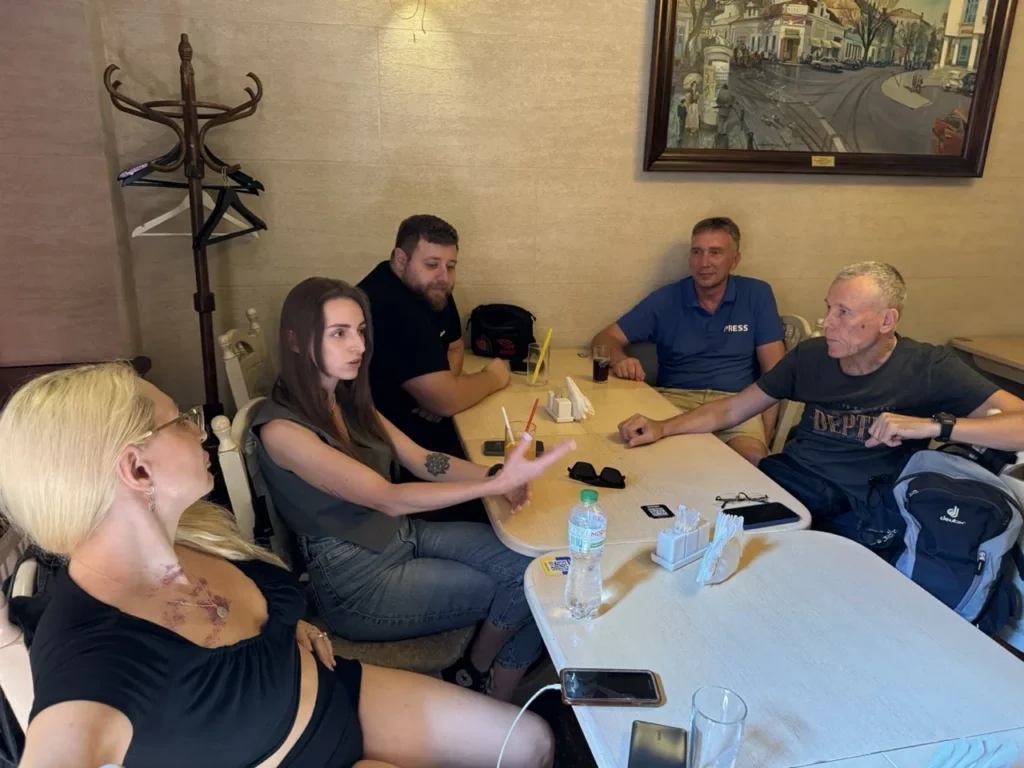
Traditional meeting of Kherson journalists in the summer of 2024. They usually discuss problems, lifehacks and other work-related issues. Photo: Serhii Nikitenko
Such a situation, combined with professional solidarity and the initial beginnings of self-regulation, may indicate certain signs of maturity.
“Newsrooms survived the hardest times without betraying their principles, and now have the most important thing – people’s trust, which cannot be bought with any contracts with politicians”, – is confident the deputy editor-in-chief of MOST, Yeva Vasylevska.
Exotic casinos are advertised in the Kherson region
However, analysing five local online media we found two materials posted on the Kherson Online site that contain elements of advertising for foreign gambling platforms. Both are written in foreign languages — Armenian and Azerbaijani. Obviously, there is no labeling in the articles. Translation of the texts showed that in both cases online casinos are being advertised, and both materials include links to an external platform operating outside Ukrainian gambling regulation.


Advertisement of Azerbaijani and Armenian casinos on a Kherson site. Screenshot:
khersonline.net
Advertising of online casinos similar to that which appeared on Kherson Online has a purely pragmatic goal — to obtain links to promote online casino sites. So the client does not necessarily need anyone to read this material.
Foreign gambling platforms cannot legally advertise in Ukraine, so they look for workarounds — through local sites that agree to publish native or pseudo-news texts.
For the newsrooms themselves it is a way to earn money. Possibly the materials were placed through an automatic advertising publication service. Some small regional sites connect plugins or RSS feeds that import materials from dubious sources without manual moderation. As a result, texts about Ukrainian and foreign casinos appear on the site that were not even written by journalists.
In the end only the advertiser wins: the intermediary site receives a small sum for views, and the gambling company gains an increase in search engine output.
It seems that no one cares what the reader who sees such “news” will think.
Such materials are a direct violation of Ukrainian law and a serious blow to trust in regional media. The Law “On Advertising” directly prohibits the dissemination of gambling advertising without a special license issued in Ukraine.
The owners of this media outlet, which was once the market leader, may not care about its future. At the same time these difficult times give independent and quality media an advantage to become leaders in the region themselves and all the prerequisites to maintain this leadership even when elections loom on the horizon.
Serhii Nikitenko, regional representative Institute of Mass Information in the Kherson region
*The online media MOST, a co-founder of which is the author of the publication, in accordance with the requirements of the IMI monitoring methodology, which provides for studying the most popular media of the region, was monitored by a regional IMI representative from another oblast to avoid a conflict of interest.