

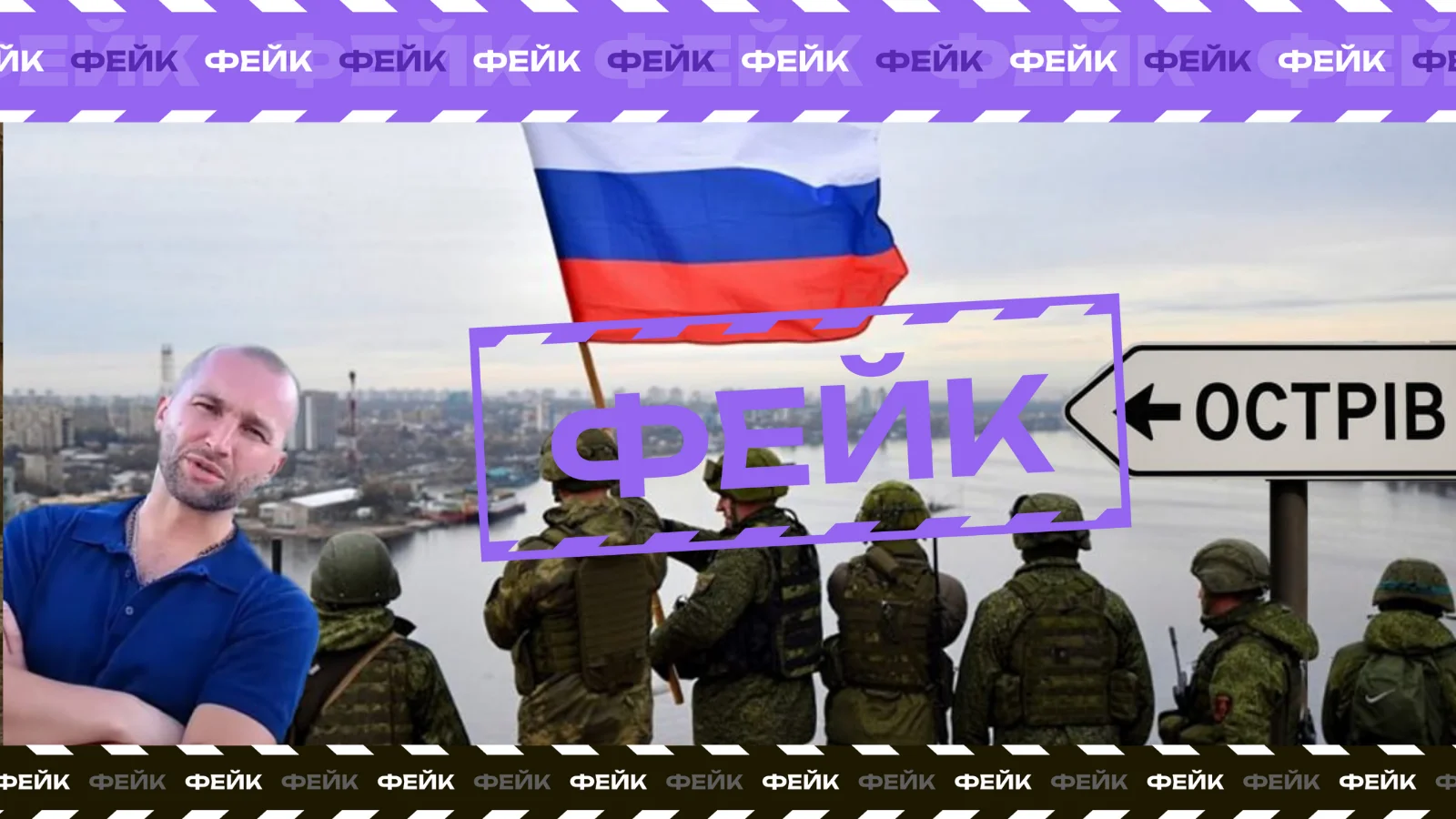
“Russian assault troops have captured the Kherson neighborhood “Ostriv”, and the population of our region continues to suffer from rabies!” – if you are hearing this nonsense for the first time, welcome! It means you simply do not read Russian information trash. We did this for you, preparing the usual digest of fakes and disinformation from enemy propaganda about Kherson and the Kherson region for the past week.
Russians occupied a non-existent district of Kherson
Towards mid-autumn, as if on schedule, we observe a wave of fakes about the activation of the Russian army on the Kherson front. As last year, at this time the Russians reported the start of a “storming of the regional center.” The scale of these “leaks” indicates that we are dealing not with isolated fantasizing writers, but with a targeted, well-thought-out provocation.
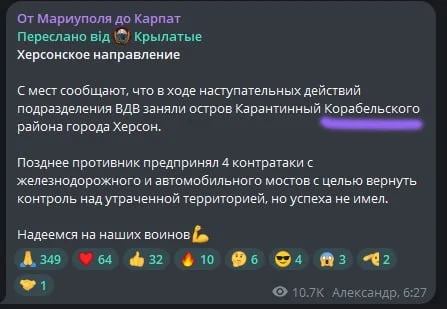
So on the morning of 15 October several information cesspools immediately reported that “Russian paratroopers landed within the Kherson Ostriv.” By mid-day these imaginary stormtroopers had created a bridgehead there, and by evening had supposedly established control over the entire neighborhood. Russian Telegram channels even began redrawing maps, marking part of Kherson as controlled by their armed forces. Admittedly, they are so far from reality that they do not even know the name of the district they allegedly “liberated,” calling it “Korabelskyi” when it is actually “Korabelnyi.”
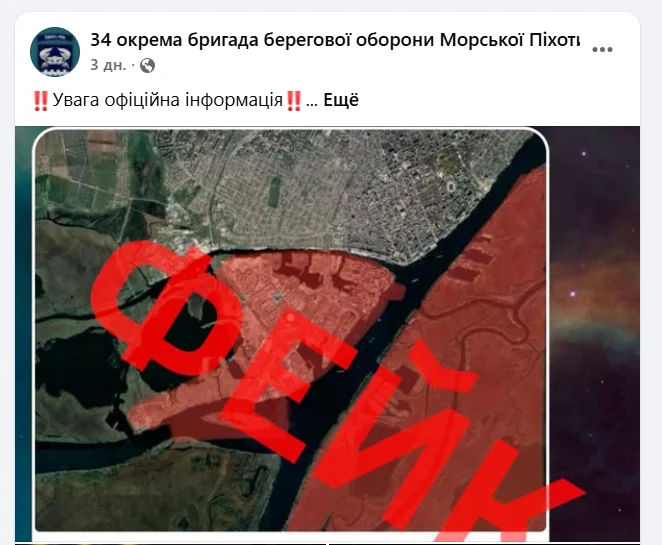
Naturally, this nonsense was not confirmed by either Ukrainian sources or residents of the island itself, who, according to Kremlin scribblers, should have been “welcoming the Russian liberators.” The occupiers’ lie was quite promptly refuted in the 34th Marine Brigade, which operates on the Kherson front. Ukrainian military denied the existence of any Russian bridgehead on the right bank of the Dnipro.
“Russian propaganda channels are again spreading another lie — this time about the alleged ‘landing of infantry’ in the area of the Ostriv neighborhood in Kherson. This is manipulation and disinformation. The situation in the area of responsibility is stable and controlled. Our warriors firmly hold positions and destroy all enemy attempts to approach the city,” the representatives of the 34th Brigade said on their Facebook page.
Towards the end of the week most enemy sources admitted their lie and tried to gracefully “back away” from the topic. The most stubborn continue to talk about the “captured Ostriv” and even the “liberation of several settlements on the right bank.” No photo or video evidence confirming the presence of Russian stormtroopers in Kherson in those days was published.
Another interesting nuance: none of the Kherson collaborators wrote about the alleged “assault” on the regional center. Why? Because the conditional Saldo simply knows the situation in the region better than the administrators of Russian Telegram channels, who live somewhere in Syktyvkar and from there “ford the Dnipro.”
Rabies returns
“Kherson residents are massively getting rabies, killing and burning their pets, and the Ukrainian authorities do not notice this problem” – this is roughly the bleak picture of life in the liberated territories of our region painted by Russian “journalists.” According to the occupiers, an epidemic of the mentioned infectious disease is ongoing on the right bank of the Dnipro. To support their claims they even provide photographic “evidence,” which, however, is fake.
“What happens if you make a pit with a dozen animal carcasses sick with rabies near a settlement? We continue to expose the mess in the Kherson region on the right bank, where incompetence blooms and stinks – quite literally. We are talking about uncontrolled spread of rabies, allowed by local ‘leaders’ and the military. This is no joke: wild dogs and foxes bite people, and there are no vaccines, no help at all,” say the administrators of the Telegram channel “Dneprovsky rubezh”.
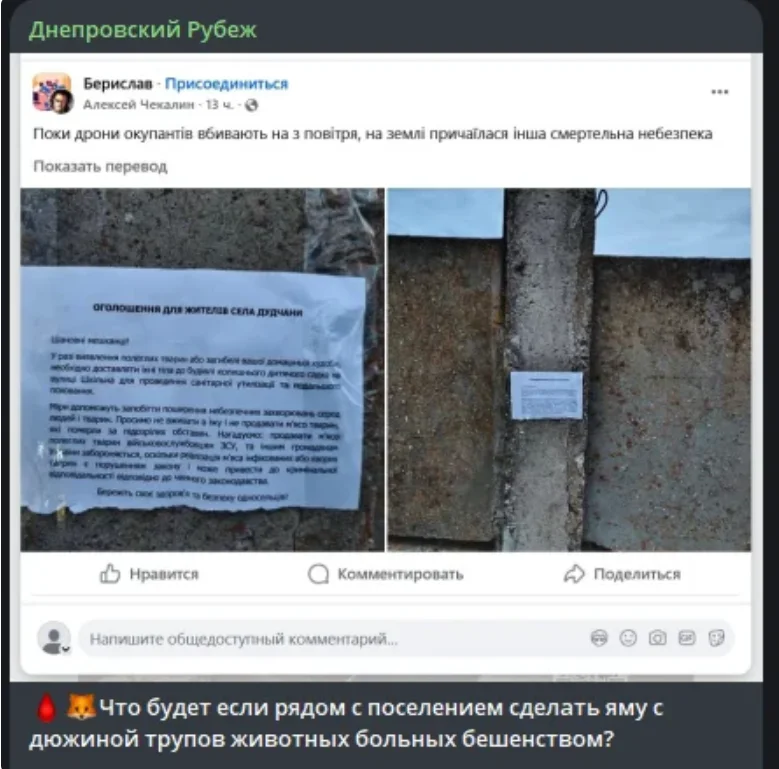
As “evidence” the propagandists posted photos that were allegedly taken in the settlement of Dudchany in the Beryslav district. They show notices urging locals to bring animal carcasses to a designated place for subsequent burial. To create an impression of veracity for their reports, the Russians published these images in one of the Beryslav communities on Facebook.
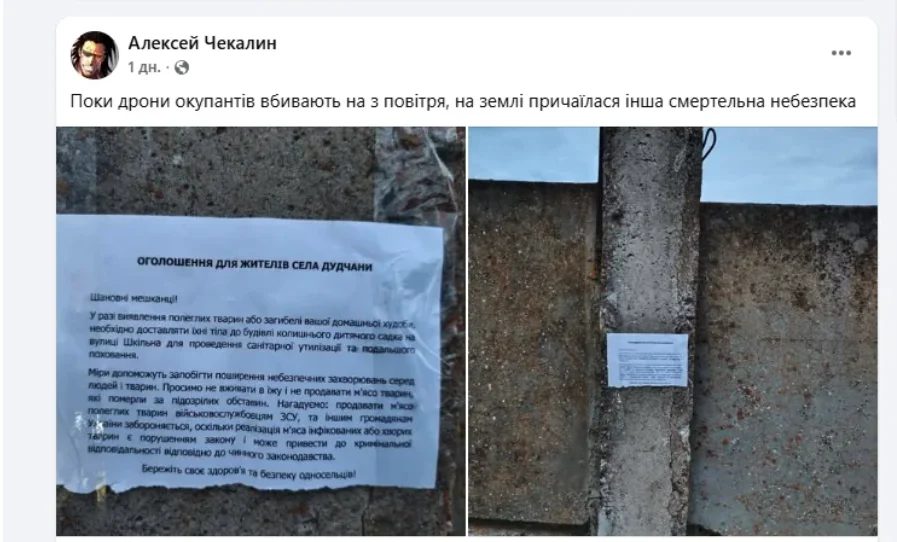
We found the corresponding Facebook post. It was posted in the “Beryslav” group, which has 57 members and had been inactive since 2023. The page of the author of the fake under the nickname “Aleksey Chekalin” was also registered on the social network in 2023 and since then, apart from the “rabid photos,” had no activity. So we are dealing with a bot.
And the most interesting part is the text of the notices themselves, which were allegedly posted in Dudchany. Here we are dealing with “hellish flour,” i.e., a poor translation from Russian into Ukrainian via online services.
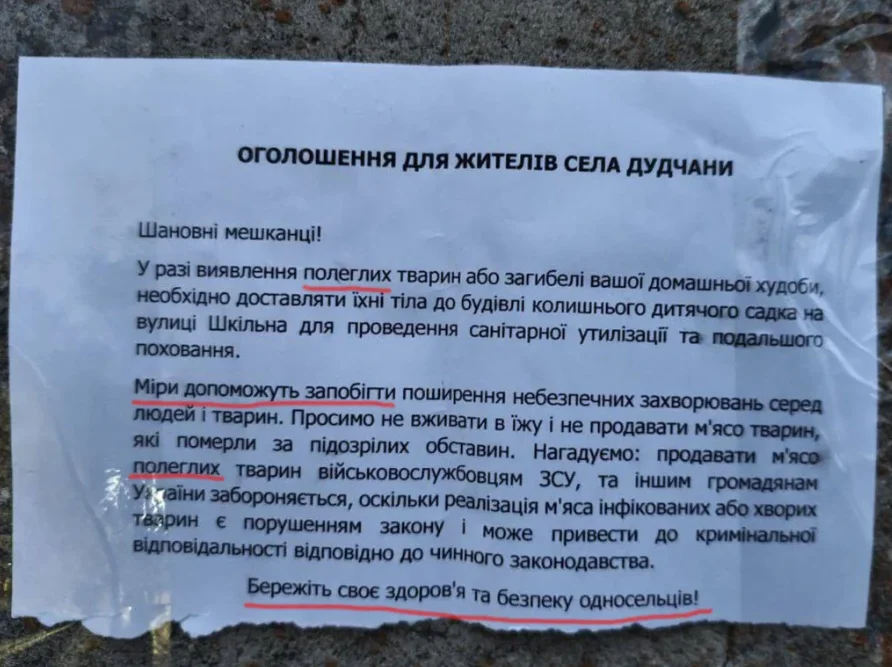
For example, the phrase “полеглі тварини” in Ukrainian is unethical, since the word “полеглі” is used with regard to those who died in battle, and in no way applies to animals.
A direct calque from Russian is also the phrase “Міри допоможуть запобігти…”.
The sentence “Take care of your health and the safety of your fellow villagers!” also sounds somewhat odd in Ukrainian.
This is not the first similar lie by the Russians about a rabies epidemic in Kherson region. Thus, in early October the Russians spread a fake claiming that Ukrainian troops in the Beryslav district were massively killing all animals and burning their carcasses along with villagers’ houses.
A few words about rabies: a case of this disease was indeed recorded in the village of Dudchany in the Beryslav district. It was probably brought by a wolf that bit a cow. Quarantine measures have been in effect there since 21 September, and this is a usual occurrence for steppe districts of Ukraine. There are no mass epidemics, no farms on fire, and no “terrible victims.”
“Boy in underwear” in Oleshky style
Russian occupiers are again trying to shift the blame for alleged violations of the laws and customs of war onto the Armed Forces of Ukraine. In attempts to create “evidence” of shelling of the civilian population by Ukrainian forces, they habitually resort to lies.
Thus, on 17 October pro-Kremlin resources spread another fake claiming that in the city of Oleshky, on occupied left-bank Kherson, a child died as a result of a strike by a Ukrainian drone. However, the photos that the Russians presented as “confirmation” turned out to have been taken several days earlier by the local collaborator Pavlo Filipchuk — and not in Oleshky at all, but in another settlement.
Enemy Telegram channels published the “tragic story”:
“Alyoshkinsky municipal formation suffered a UAV attack from the armed formations of Ukraine against the peaceful population. In the town of Alyoshky, a minor Vanya, born in 2015, was seriously wounded in a residential building. Shrapnel wounds to the lungs, liver and heart. Delivered to the hospital, but died. Doctors fought for the boy’s life, but the injuries were incompatible with life.”
As “evidence” they showed a photo of a destroyed building that was supposedly the home of the “dead child.”
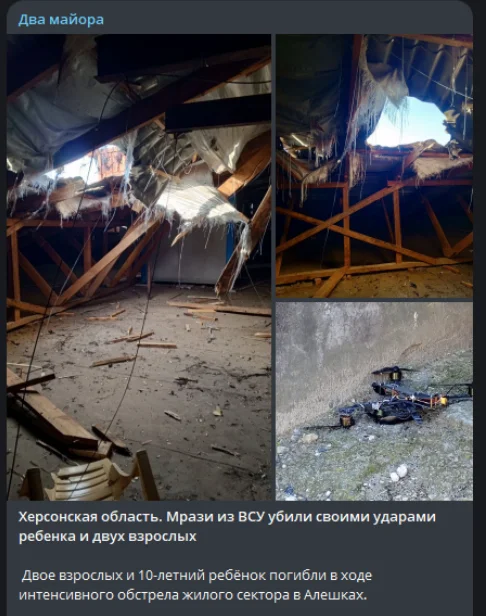
However, attentive users quickly noticed that the same photos had been posted a day earlier on the Telegram channel of the Gauleiter of Kakhovka, Pavlo Filipchuk. In his post he stated that the images show the Kakhovka cinema damaged by a drone strike, and that there were no casualties.
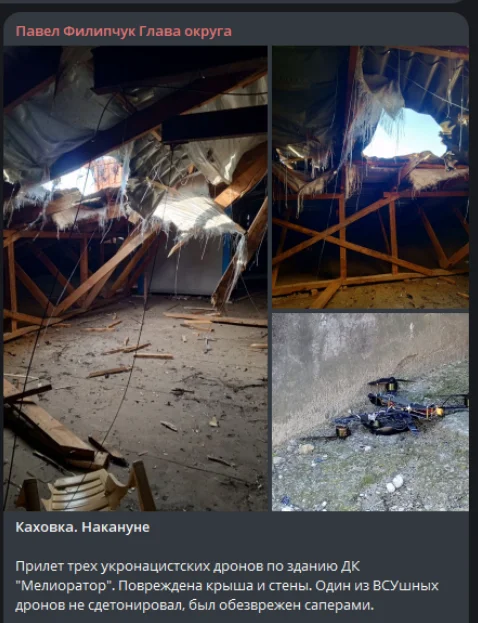
Thus, Filipchuk himself inadvertently debunked the Russian lie about the “next boy in his underwear.” Despite this, Russian propagandists have already managed to use the fabricated story to call for “leveling Kherson to the ground” in honor of the invented “Vanyusha.”