

“Don’t film us! Don’t photograph us!”, – shout the women and men we see near two stalls – the only ones working at the market of Kherson’s Korabel neighborhood, better known as the Island.
Here you can buy alcohol in an assortment that would make other Kherson shops jealous. It is obvious that this point of resilience is a fairly popular spot. The saleswoman deftly meets the needs of visitors who, despite the early hour, are already or still merry and talkative.
“You’ll film this, post it online, a drone will come and f**k everything up here”, – says one of the men.
We reply that the Russian military already have full information about what is happening on the Island thanks to reconnaissance drones.
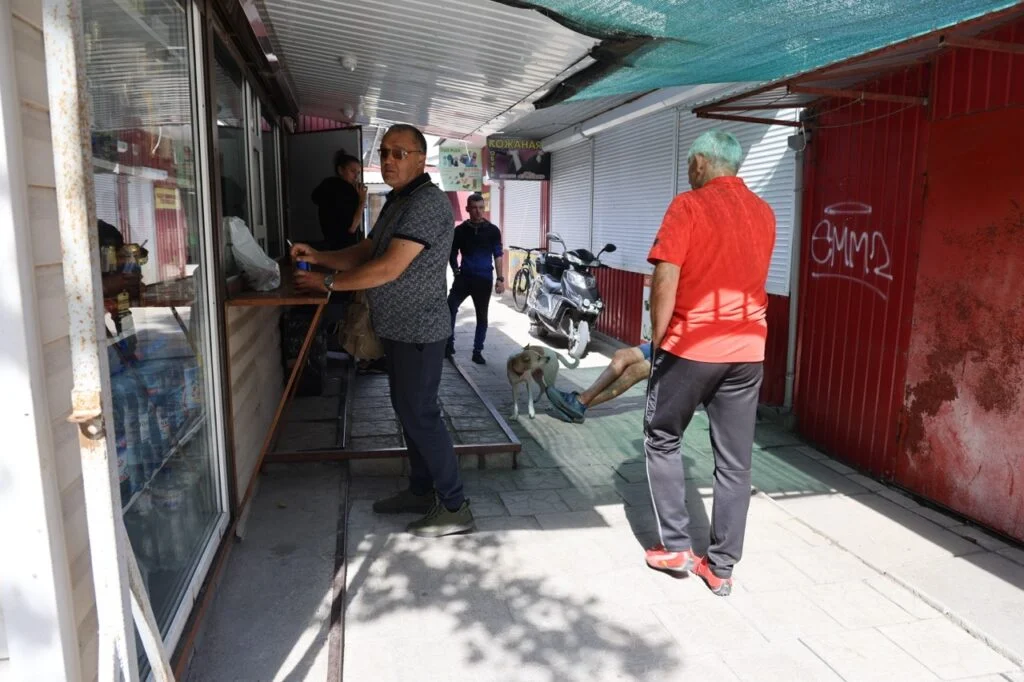
“We know. But why give extra information anyway? We’re scared. Don’t post this anywhere”, – says a woman who is standing by one of the open stalls and hears our conversation.
It felt as if another “interlocutor” was invisibly present – an irrational fear: the current “islanders” are so frightened that they see danger in any person they do not identify as one of their own, especially if that person has photo or video equipment.
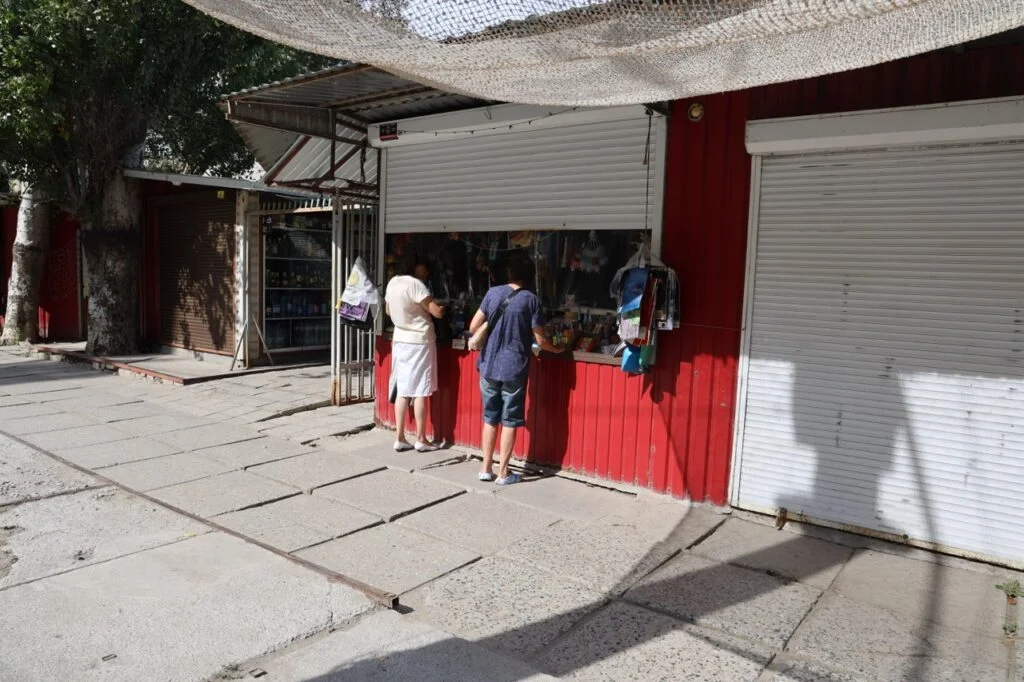
The market looks long abandoned.
Besides the alcohol stall, there is one more shop here – a grocery store with an assortment people call “a thousand little things.” All other trading points are closed, as are the supermarket and the building-and-household store located next to the market.
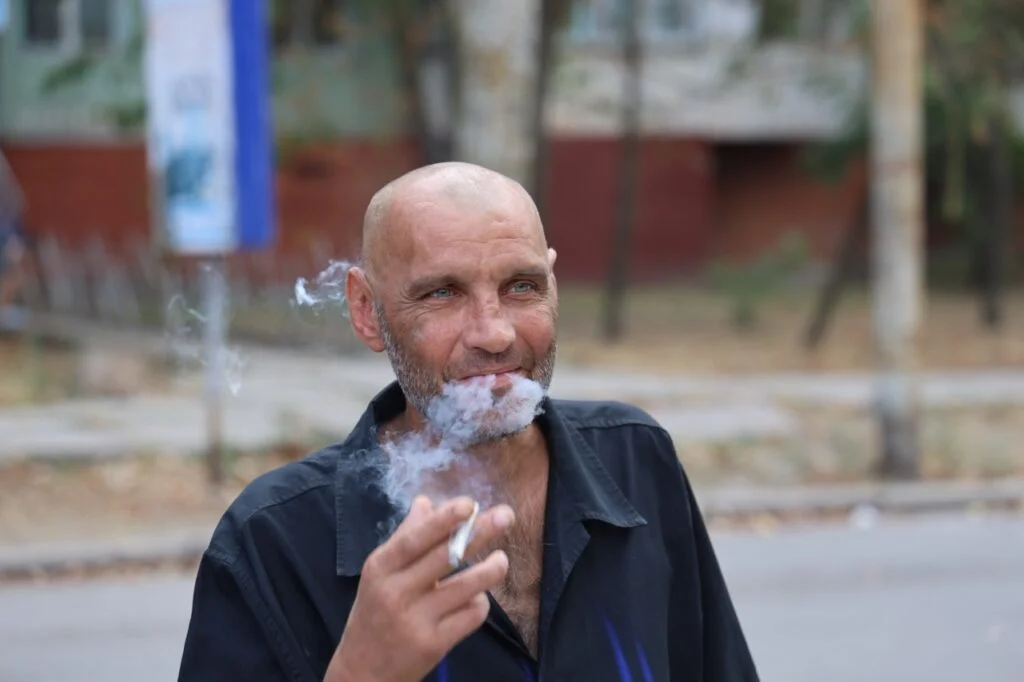
“We have everything – water, food, and cigarettes. They even bring dairy products, sausages…”, – says one of the residents standing by the stall with a can of Pepsi in one hand and a cigarette in the other.
When asked why garbage is not removed from the neighborhood, the man replies: “That’s not for us. It’s for ‘Parks of Kherson’ (municipal enterprise, – МОСТ). They also are not against it, but they are not allowed in. There is an order. They might not mind coming, although their truck is large. They are not being let in.”
Judging by his words, the man does not mind if a garbage truck for waste removal occasionally came to one of Kherson’s most dangerous neighborhoods over the damaged bridge across the Koshova River, risking becoming victims of Russian artillery shelling or drone attacks.
Moreover, he begins to theorize about the possibility of repairing the gas pipeline damaged by a Russian KAB bomb himself.
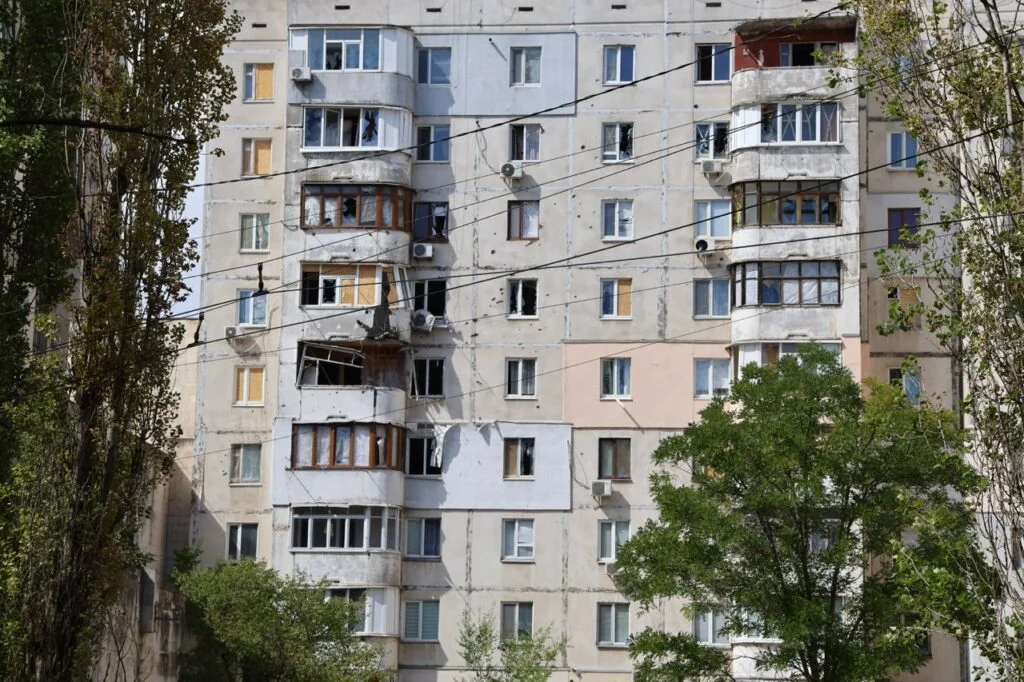
All of this seems surreal and the situation could be called somewhat amusing if not for the deadly danger that has hung over this place for more than three years.
Not everyone evacuated
According to the Kherson City Military Administration, about 240 people live in the Island neighborhood now. They either did not leave during the mass evacuation announced in early August 2025, or returned afterwards. The evacuation was announced because of the severe damage sustained by the vehicular-pedestrian bridge across the Koshova River after Russian bombing.
In the first days after the strike, during the most intensive phase of the evacuation, more than 600 people were taken from the Island out of roughly 1,800 who then lived in the neighborhood. As of early September, around 1,700 people were evacuated in total. According to Anton Yefanov, deputy head of the Kherson MVA, about 240 Kherson residents remain on the Island, four of whom have limited mobility.
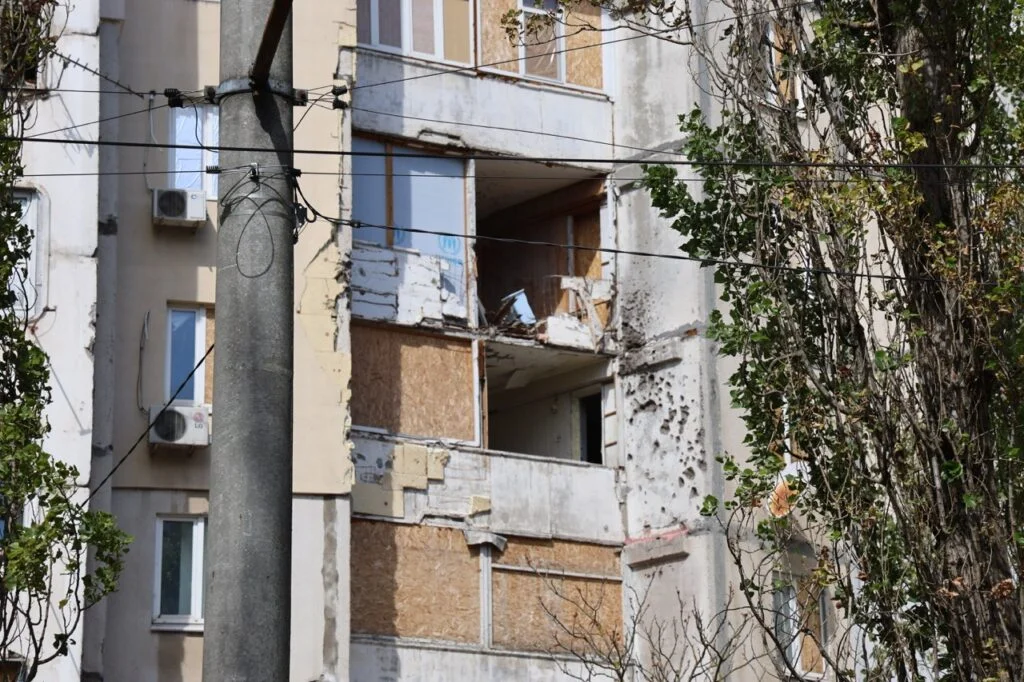
“If necessary, they can contact us and we will provide assistance with evacuation. It is exclusively their decision. Most citizens filed statements refusing evacuation,” Yefanov commented.
Currently the neighborhood has no gas supply, water is supplied on a schedule and only two hours a day (from 09:00 to 11:00). The heating season 2025-2026 will most likely not take place in the neighborhood. According to Yaroslav Shanko, head of the Kherson City Military Administration, due to the great danger there it is not possible to carry out preparatory work.
The MVA says that they will provide people with electric heaters. And what will residents do if serious electricity problems arise because of enemy shelling? Living without heating even in a relatively mild Kherson winter is a considerable ordeal.
By the way, power problems on the Island are frequent. Thus, on 25 September 2025 as a result of shelling carried out by Russian forces, the neighborhood was left without electricity.
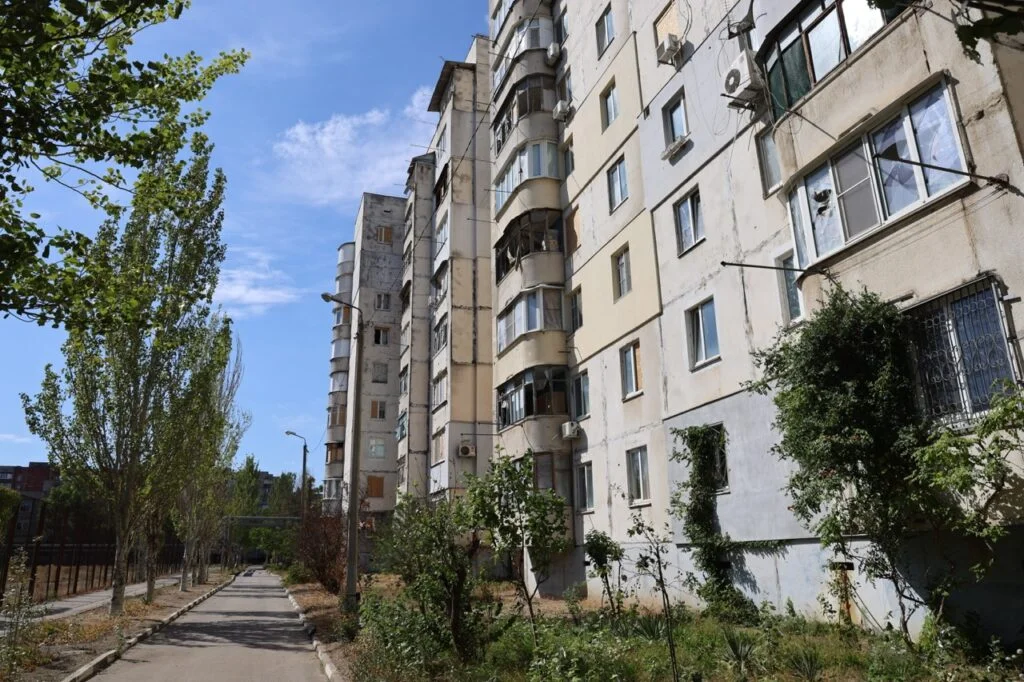
But several hundred people decided not to leave.
Of course, during a few hours on the Island we did not see all the current residents of the neighborhood. Of those we saw and spoke with, some looked like people leading marginal lifestyles, some could be called “strange.” However, there were also ordinary people.
“For now I decided to stay, but closer to winter I may leave. Because even though there is electricity and water, there is no gas,” says local resident Natalia. She was walking from the market, in a hurry and not inclined to a long conversation. The Island is a place where for safety reasons it is better to move quickly.
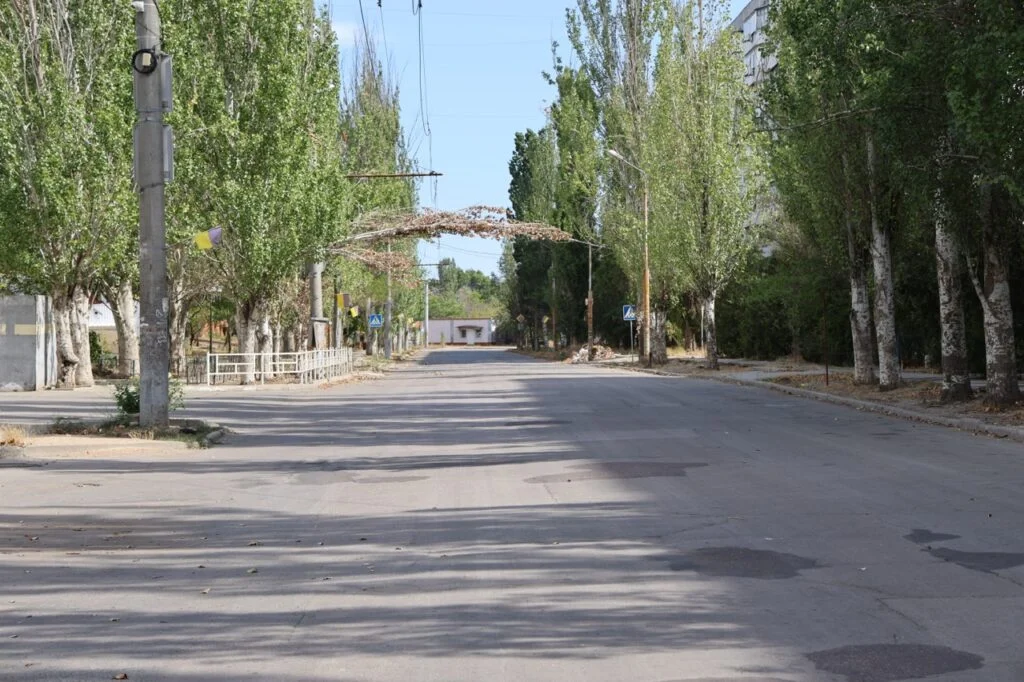
“Those who have stayed here now will continue to live here,” says another woman passing by, also coming from the market.
“And why don’t you leave?”, we ask her.
“My parents,” she answers, “are here. They are 80 years old. They don’t want to leave.”
A neighborhood ‘for the locals’
We return to the market. The locals have grown a bit more used to us, and the conversation goes more calmly. We talk about looting, which on the Island is a very serious problem.
“Clearly, an almost empty neighborhood is a temptation. Looting is a ‘side effect’ of what is happening now,” says the man with the Pepsi and cigarette.
He says he heard about a recent police raid on the Island during which four looters, likely local residents, were detained. Because now you can only get into the neighborhood through a checkpoint, where you are allowed in only if you have local registration.
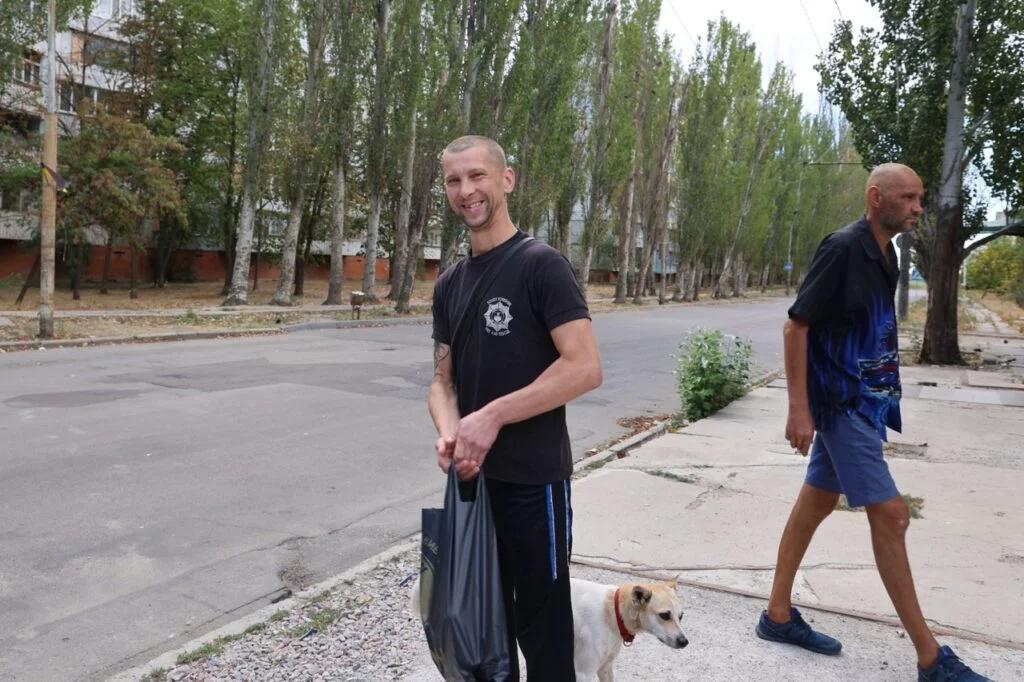
“The looters,” the man says, “clearly worked off some tips, because they robbed only those apartments where there was good equipment, some other valuables.”
He says the locals try to track the appearance of unwanted guests: “There are few people here now, so you immediately notice if someone unfamiliar appears.”
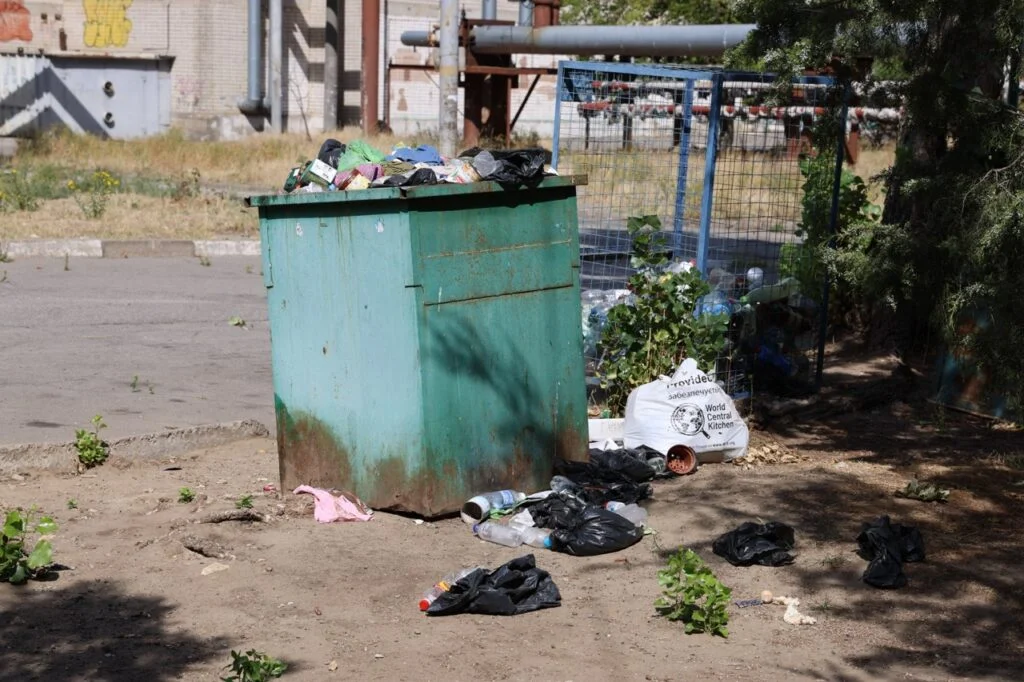
Since August public transport has not run to the Island. Residents of the neighborhood walk to the “mainland” mostly on foot, risking being caught in shelling or becoming victims of a Russian FPV drone.
Valeriy and Serhiy
In the courtyards, a little away from the market, it is empty. But you can find people to talk to.
We saw them on a bench near one of the buildings. Both are not young, but not old either. Each is about 50.
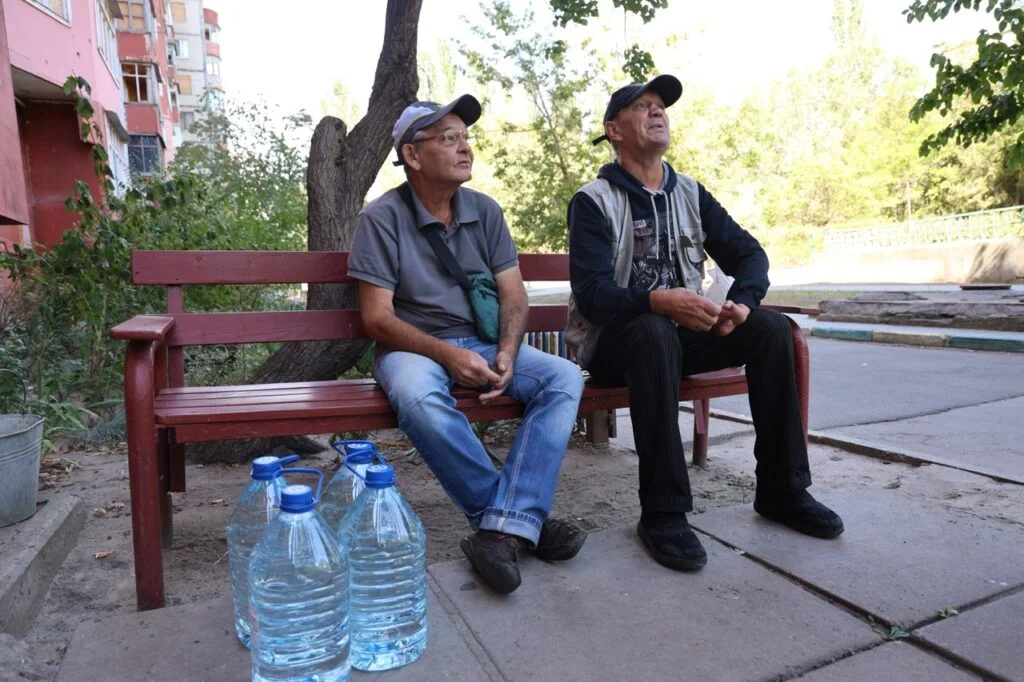
When asked how they live, they replied that there is the possibility to collect drinking water, and bread is delivered regularly. Therefore they do not want to leave.
“There is nowhere to go. There is no money for that. Go somewhere where we will be, as they say, on top of each other? I have seven cats and a dog,” says Valeriy.
“I have a cat who is 15 years old. He’s used to living at home since birth. Where will I go with him?”, says Serhiy, and he tells that his mother recently passed away.
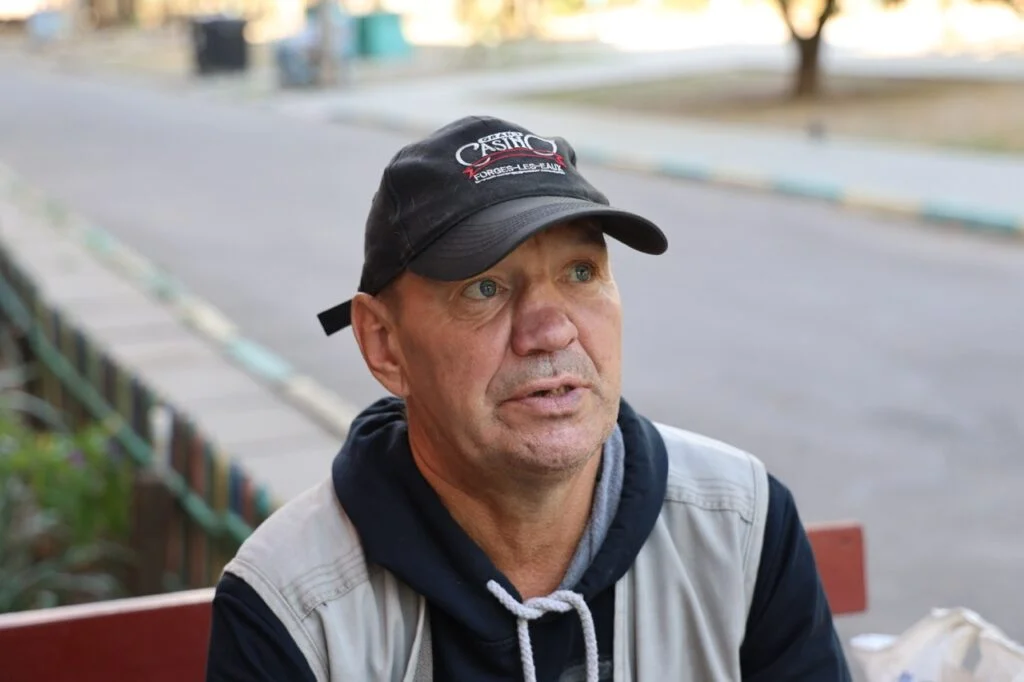
“I had to borrow money for the funeral,” the man says. “The funeral was the cheapest. It cost eight thousand.”
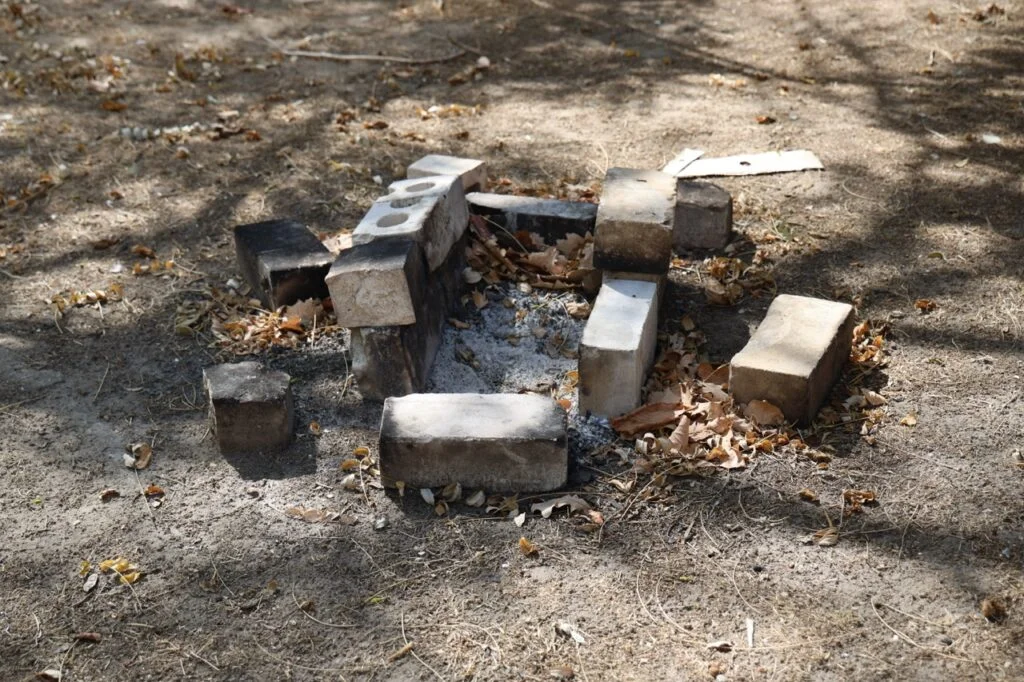
Talking about life, the men say that when there is electricity it is easier because you can cook at home. When there is no electricity, people go out to the courtyards and make fires. Serhiy says that he still cooks on a fire because he does not have an electric hotplate.
“There are hearths built of bricks near many entrances,” says Valeriy. “I have an electric hotplate.”
The man complains that during one of the shellings his apartment was left without windowpanes: “I want to close them with OSB boards, but I don’t know where to order them. And no one will tell me. The head of our condominium association is abroad, in Poland.”
In the buildings where the men live, they are not the only residents.
“About three people live in our building,” says Serhiy.
“In our entrance,” Valeriy says, “besides me with my wife, cats and dog, there are people in four other apartments. In the neighboring entrance there is one family. One entrance is completely empty. And in another one an elderly man lives – very old, and I don’t even know if he is still alive.”
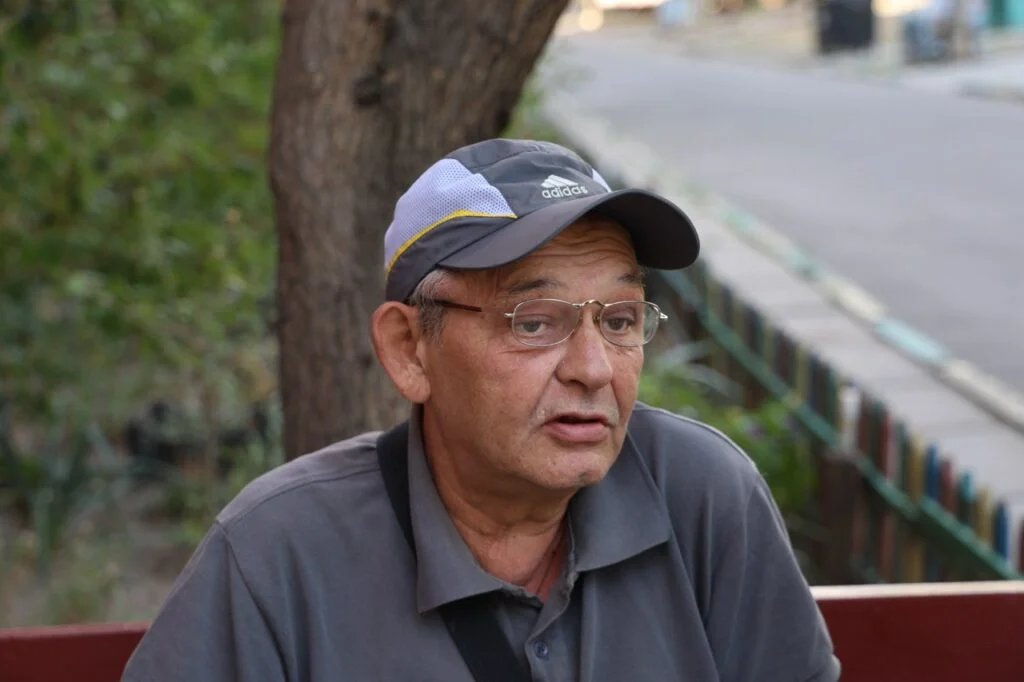
When asked about humanitarian aid, the men replied that they do not receive it. According to Valeriy, his wife contacted one of the distribution points and was offered to call the hotline. But whether she made that call we could not determine from the answer.
Both men understand that living on the Island means being in constant danger. They say they have had to run from enemy drones more than once. They said that in such a situation it’s bad if the only nearby places are entrances with coded locks on the doors.
“They fly like at home,” Serhiy says about the Russian drones.
Valeriy says that less than an hour before our conversation the men had to run from an enemy “bird.” They managed to hide in an entrance, from where they heard the drone drop an explosive somewhere nearby.
Janitor Anatoliy
He is so thin that one involuntarily recalls photos from Nazi concentration camps of the Second World War or the Hollywood film “The Machinist,” in which actor Christian Bale lost weight down to 55 kilograms at a height of 183 centimeters for the lead role.
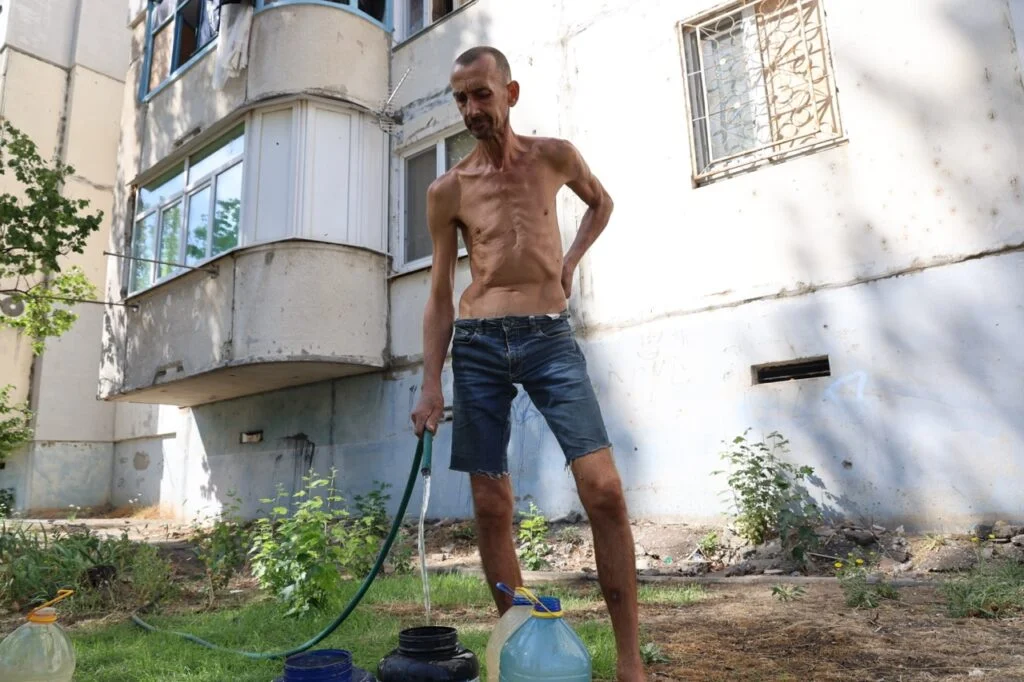
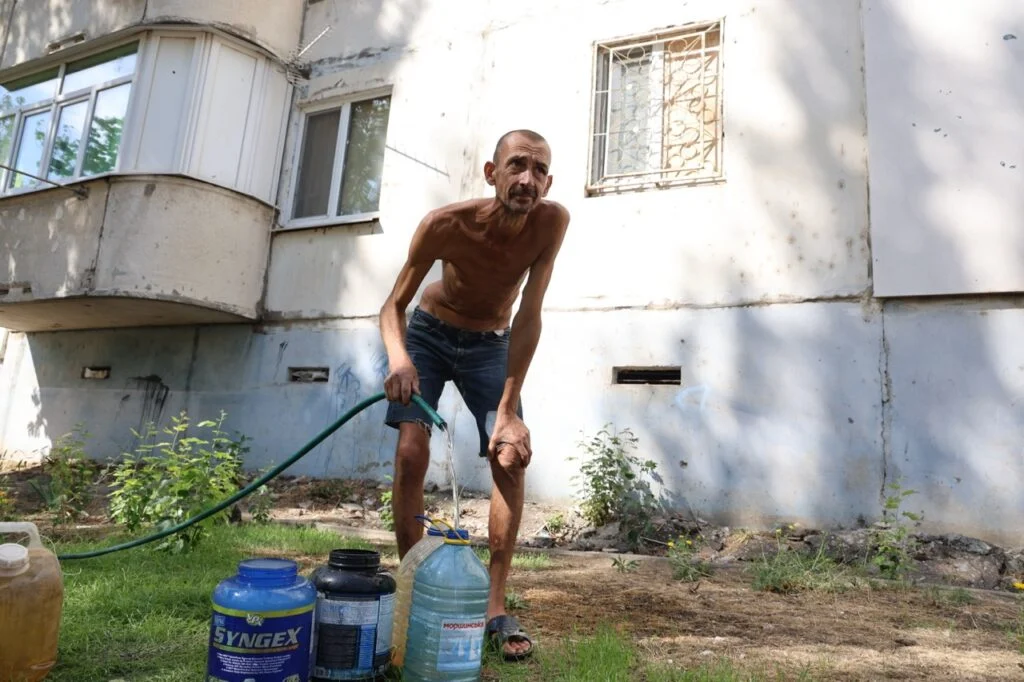
We saw this Island resident near one of the buildings. He was filling plastic containers with murky water from a hose coming out of the basement and wheeling it to the parking lot in a wheelbarrow. At the same time he was not at all concerned about conserving water: a lot of it spilled onto the ground.
“I work here as the janitor of this building,” says the man who introduced himself as Anatoliy, “so they allow me to collect water here. See what our water is like – it’s murky. True, if it settles, it’s not so bad. Although it used to be clear, now it’s not so much.”
When asked about life he says: “Life is good. We have not yet fallen into despair. As long as there is water and there is electricity.”
He says that about thirty people now live in the building where he lives. About the same number live in the neighboring building. These people are those who did not leave and those who returned after spending some time away and were unable to adapt to new conditions.
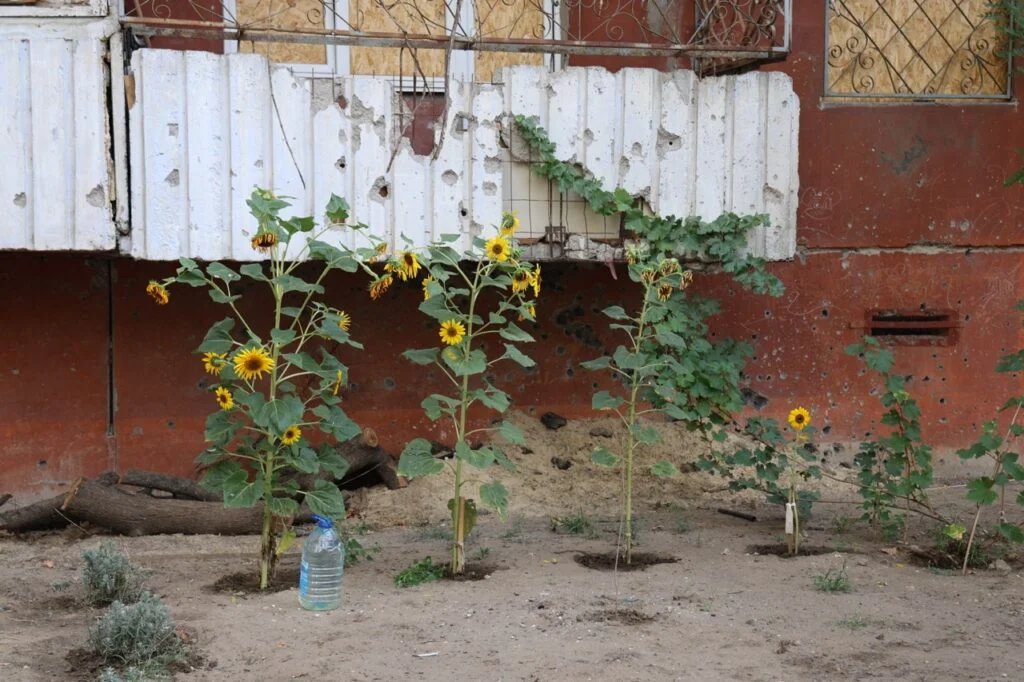
“Here we have, ” he shows with his hand to the buildings, “civilization. We even have flowers in front of the building, my mother takes care of them. And the head of the condominium association with his wife live in the building. And there are areas on the Island where very, very few people remain.”
Like other people who remain, Anatoliy complains about looting and apartment thefts: “We don’t have thefts. We watch over the building. People usually break into apartments at night. And they ‘bomb’ entire entrances where there are no good doors, no good locks.”
The man complains that garbage is not removed. He says he tries to prevent his courtyard from turning into a dump, and disposes of trash “in his own way”.
“Musician Raymond”
The man is bustling around a storage room arranged on the ground floor of an apartment building. Unlike many Island residents, he was very eager to talk, and at first we were happy, but quickly realized the reason for this sociability. The man lives in his own world. True, the war is present there. But…
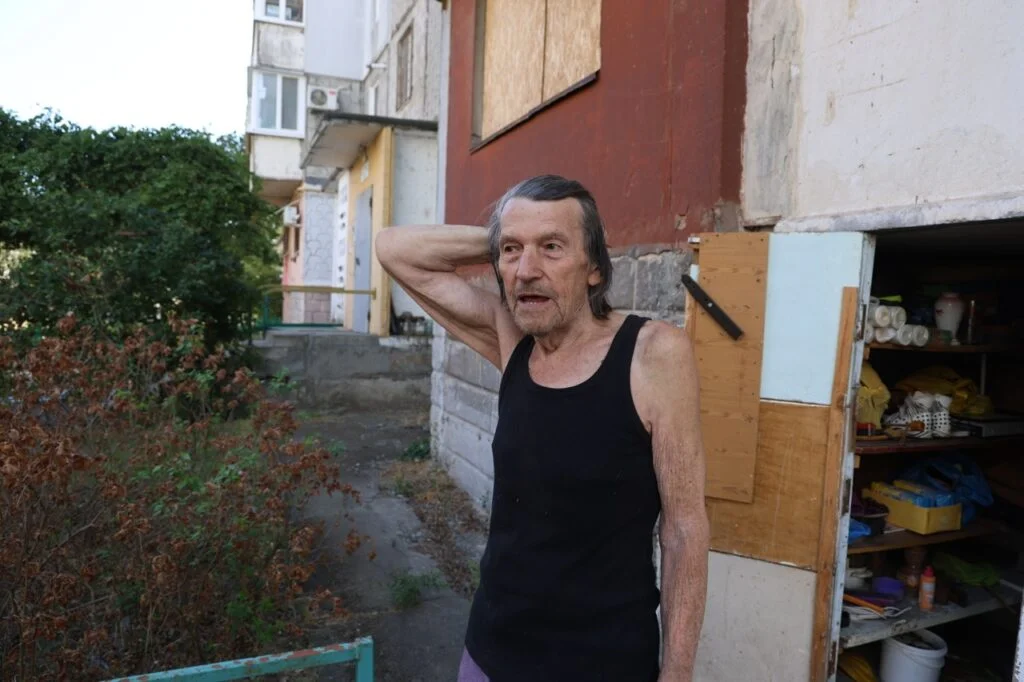 “I live fine,” the man says, “and I do not intend to leave. Because Saldo gave me this apartment. Saldo. You know who that is? When this house was handed over, he said: ‘Choose any apartment.’ I’m a musician. I’m not going to leave. I’m 78 years old… Oh! Eighty-eight! I’m Raymond the musician. I play like Raymond.”
Saying the last phrase, the man raises his hands and makes movements in the air as if playing a piano.
Perhaps the “islander” associates himself with the famous Latvian composer and pianist Raimonds Pauls.
During the conversation he said that he tunes pianos, and it is possible that this is one of the only truthful pieces of information we heard from him.
Because when the house where he lives was handed over, Volodymyr Saldo certainly was not the mayor of Kherson, but worked as an ordinary foreman in one of the city’s construction organizations and drank heavily. So he could not have given an apartment to a pianist.
The man did give his real name and patronymic – Valeriy Romanovych, adding that his name was supposedly given in honor of the Soviet pilot Valeriy Chkalov.
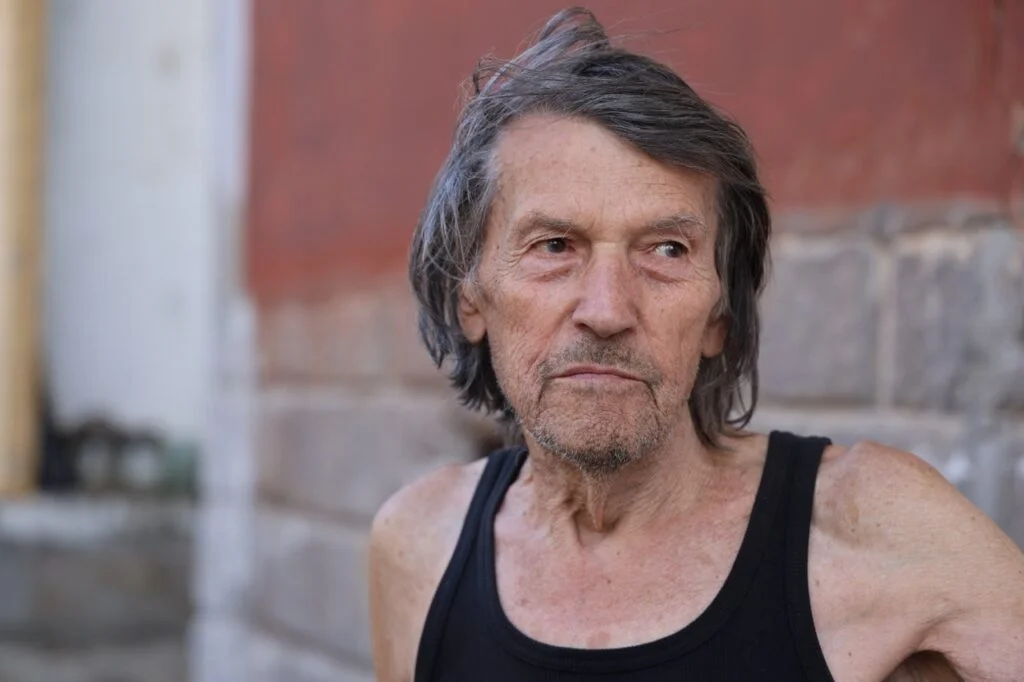
“You know Valeriy Chkalov, who flew under the bridge?”, the man asks, possibly thinking of a real episode from the 1941 Soviet film “Valeriy Chkalov,” and adds: “Then everyone went to study to become pilots. And I studied to be a pilot.”
Although the man clearly looks like he was born much later than 1941.
However Valeriy Romanovych, although he says he does not quite understand why so many people left the Island, has not yet completely lost touch with reality. He realizes there is a war in the country. He says he is scared during shelling. And he says “we need to end the war, then we will all live well.” We do not ask what he imagines as an end to the war. We simply say goodbye politely.
Fisherman Mykola
This meeting not only surprised but even stunned.
In peacetime a person with fishing gear is more than a common sight for Kherson and especially for the Island. But now, when the neighborhood is not even near the front but almost front-line, when the Dnipro River and its tributary Koshova are territories of immense danger, encountering a fisherman on the Island is an anomaly worthy of “Investigative Reports.”
“There, by the river, a big drone is lying,” the fisherman tells us after greeting us.
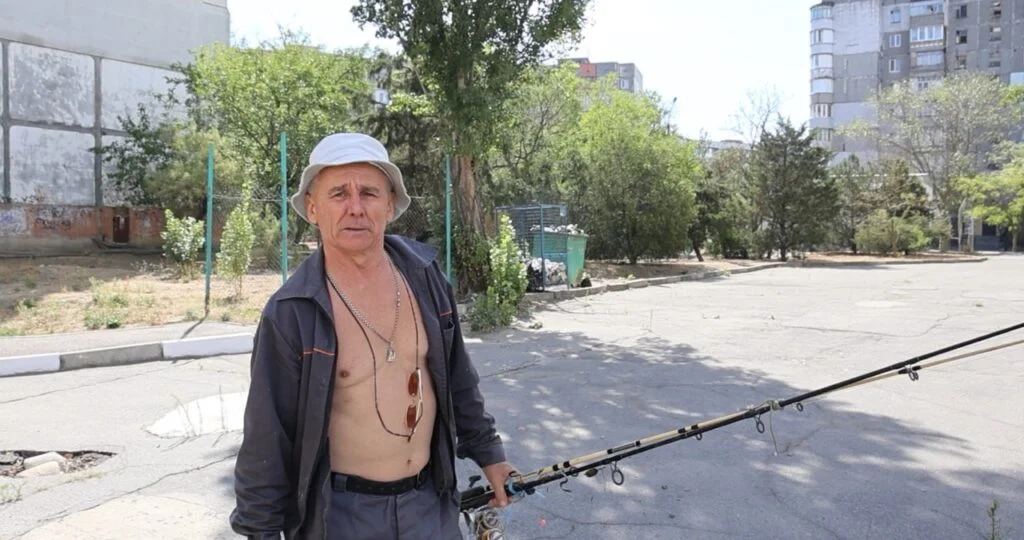
This man named Mykola says he is going home not empty-handed: “There are some gudgeon (freshwater fish, – MOST) in dozens. My wife will cook something from them.”
When asked where he fishes, the man replied: “That’s a military secret. If I tell you where, what if it flies there? Thanks. No need.”
Lidiya Mykolaivna and the flowers
Well-kept flowerbeds by a building are a sign that people live there. And now the flowers by the few buildings on the Island where someone still remains have acquired an almost sacred meaning. By one of the buildings where life still flickers, we see a tended flowerbed and an elderly woman. Lidiya Mykolaivna is watering the plants. She says she cannot help tending the flowerbed: “It’s alive. And it’s beautiful.”
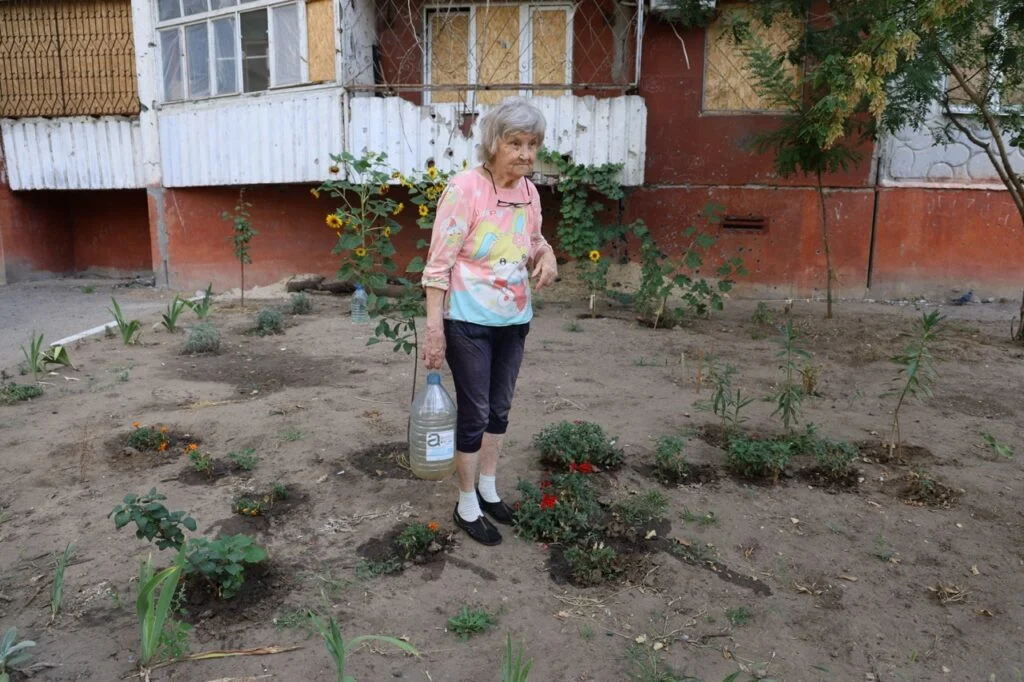
“Why don’t I leave?,” she says in response to our questions. “You need money for that, and I don’t have it. They offered to evacuate me. But where to?”
She says that last year she wintered relatively well because there was centralized heating. Unlike the year before last, when people insulated themselves by heating bricks on gas stoves.
“Because of that,” the woman says, “the ceilings ‘sweated’, the wallpaper peeled off the walls. Now there is no gas. I hope I will be able to use an electric heater. I cook on an electric hotplate.”
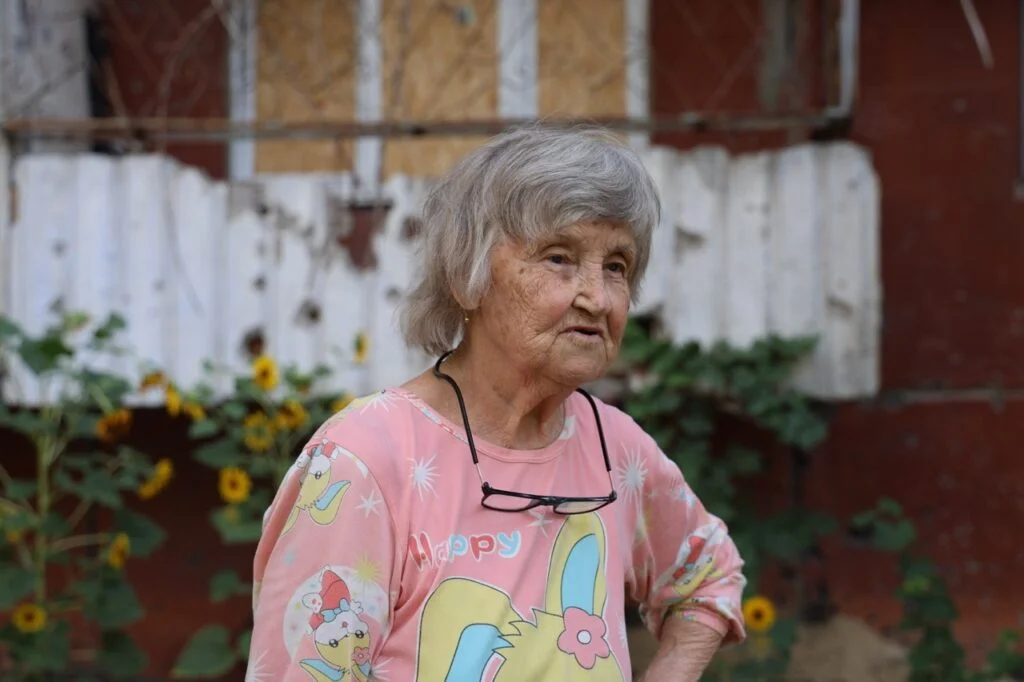
According to Lidiya Mykolaivna, water is given in the morning for 2-3 hours: “Earlier it was twice a day, now it is once. During that time you have to manage to wash and make a supply so that there’s enough for yourself and to water the flowers.”
Asked about medical assistance and access to medicine, the woman says that she asks acquaintances who sometimes go to the “mainland” to buy medicines, and medical assistance is poor. There is not a single doctor on the Island and due to the enormous danger an ambulance will not come to the neighborhood.
Dissatisfied Iryna Valentynivna
In the neighboring yard an elderly woman is sweeping near the entrance. She says her name is Iryna Valentynivna. She “erupts” in a passionate speech accusing the local authorities: “They made a dump out of the Island! They turned everything off! They drove people away, those two thousand (probably referring to state aid for IDPs, – MOST) were promised. It used to be a huge, wonderful neighborhood. They made a ghetto! And Kherson has been turned into a concentration camp!”
She notices she is being filmed. She asks: “Why didn’t you ask for permission?” But she continues the conversation.
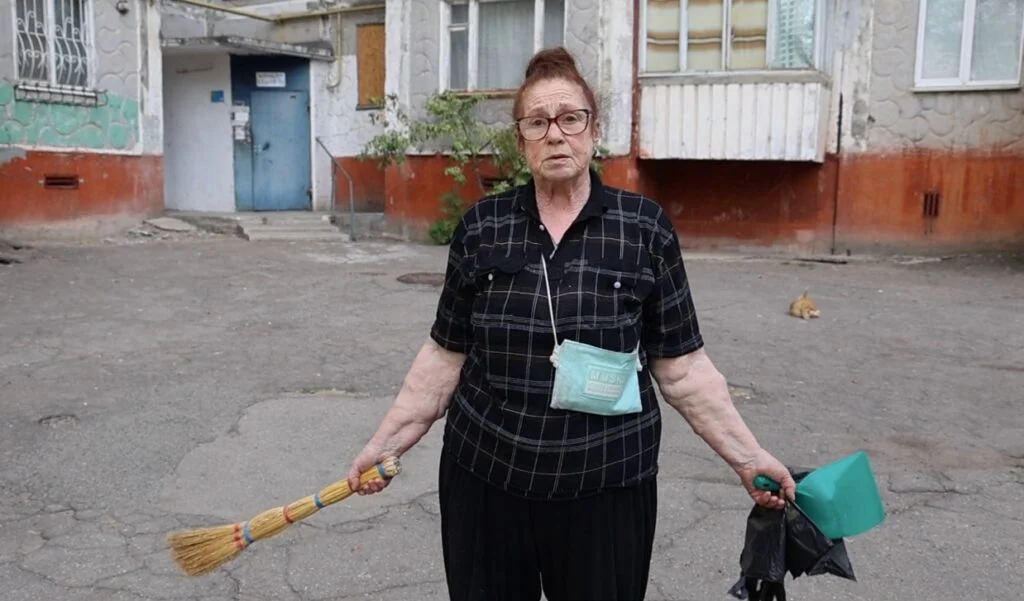
Asked why she remains on the Island and what she will do if the Russians completely destroy the vehicular bridge, she answers: “I won’t leave! This is my ‘nest’! Why don’t they repair the bridge?! My son worked on a vehicle, he drove through the Antonivskyi bridge on the pontoon while it was possible. Is there some hole in the bridge? Then let them repair it! I have no words! A dead neighborhood stands! A dump!”
She believes one should live with hope for the future.
“What is a person created for? To see, not to wait! When they blew up it (the bridge across the Koshova, – MOST), and you spitefully (there you have it, Russians!), you did this to us – like that, and we… We still have electricity, we still have water, we have everything, and we are alive, and you won’t take us by any means. This is how to live! Not like: oh, what if they – us, what if… Well, that’s why they beat us to a pulp.”
They chose the ghetto
It cannot be denied that the Island is indeed turning into a kind of ghetto. Without the possibility of providing people with medical assistance and other services needed for a more-or-less normal life.
Police officers are constantly present there, but they simply do not have the forces to conduct raids against looters.
But despite everything and however it may be, staying in this ghetto is the choice of the people themselves.
The publication was created as part of the Institute for War and Peace Reporting (IWPR) project “Strengthening Public Oversight” with financial support from Norway.