

Against the background of social networks losing their status as the main platforms for news and discussion and being replaced by Telegram, Ukrainian YouTube, on the contrary, has gradually turned into a platform for socio-political debates and independent journalism. Traditional media increasingly face distrust, while video content attracts viewers with the openness of the format and the opportunity to hear the “live voice” of local authors. Political decisions, military challenges, community problems and life in de-occupied territories are discussed here.
In Kherson region there are a small number of YouTube channels, but their content is fairly diverse: from amateur initiatives where authors conduct interviews, shoot non-professional reports and share opinions, to full editorial projects that prepare analysis and reports. Some channels focus on humor and a blogger style, others on deep expertise. In any case, the audience of these channels is gradually growing. And the most popular local YouTube channels belong to local media.
YouTube of Kherson media
The largest media YouTube channels belong to “Kherson Plus”, “Vhoru” and “Suspilne”.
“Kherson Plus” is the channel of the local TV company of the same name, which stopped broadcasting after the occupation of Kherson and did not resume after the city was liberated. Thus, the website, YouTube and social networks are the main platforms of the TV channel. Their eponymous YouTube channel has 60 thousand subscribers and almost six thousand videos. It was created at the end of 2010. The channel gained its main audience before the full-scale invasion, because its activity has significantly decreased now, and video views are rather modest – about 200-300 views. Of the last ten videos, three – are reports by the TV channel director Volodymyr Kosyuk on the implementation of charitable projects. It seems these materials are for media reporting in grant projects.
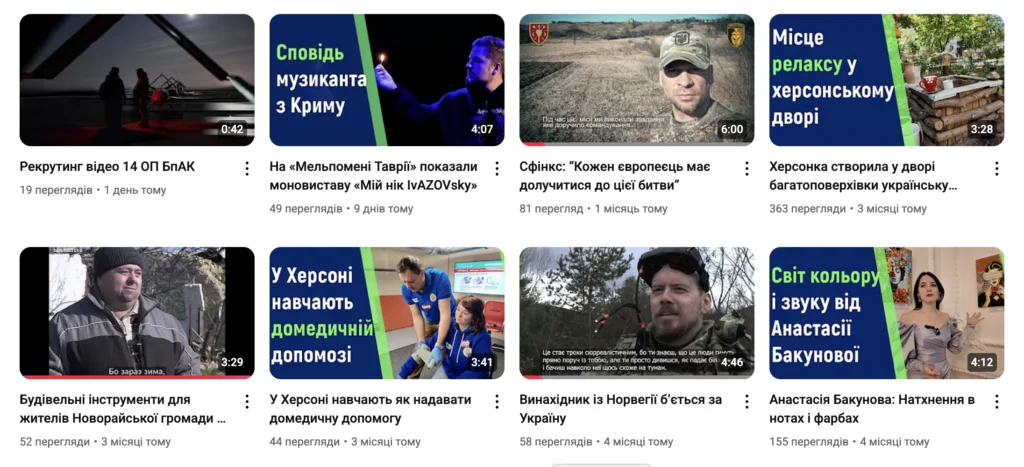
Three more clips were filmed and edited by military personnel about their units, as indicated by the brigade logos in the videos. The other clips are short video stories about life in Kherson and the stories of the city’s residents. The channel filmed these five reports over half a year.
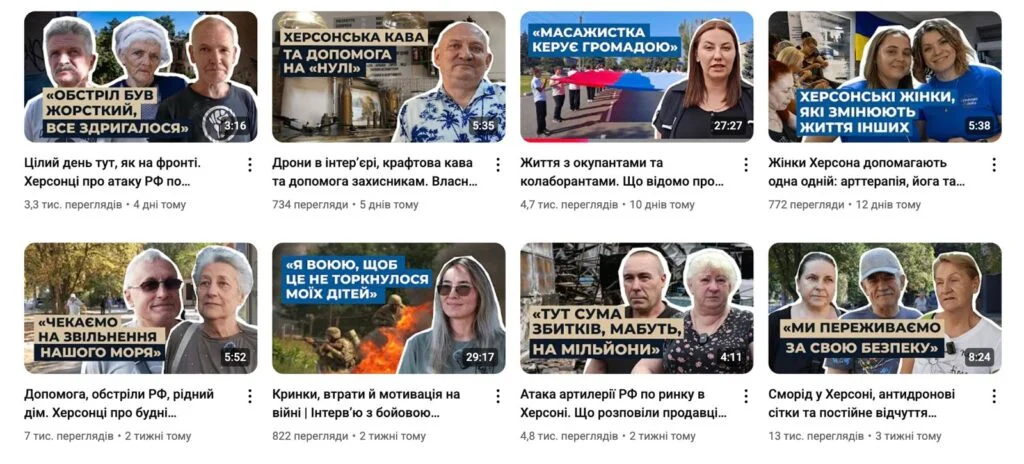
The media platform “Vhoru” runs a channel of the same name somewhat more actively. It was founded in January 2013. It has almost 57 thousand subscribers, and videos are released every 2-3 days. The channel’s content consists of street reports, interviews and features. These videos do not have very many views – from several hundred to a few thousand views, but reports from places of shelling and from the city streets gain quite a lot of views – from several to ten thousand. The authors repurpose all content into short shorts, which have significantly more views.
With a frequency of every 3-4 days the channel runs live streams in which journalists talk with various guests, including agency spokespeople and experts. For such specific content, it has many views – on average, from several hundred to five thousand. All content on Vhoru is original.
“Suspilne Kherson”, the oldest in our review, was created on October 29, 2009. It is apparently the renamed channel of the Kherson regional television and radio company “Skifia”. The channel has 14 thousand videos and 53.5 thousand subscribers. The content here is quite uniform – news or interviews. Obviously, the Suspilne team produces a lot of content, since it has the technical and human resources to do so. Reports appear on the channel almost daily and have from a few hundred to a few thousand views.
The most popular reports on the channel are about the consequences of the flooding of Kherson in 2023.
It should be noted that all the listed channels do not monetize content with direct advertising, earning on the display of service ad notices instead.
Bloggers and influencers of Kherson YouTube
In fact, bloggers and influencers are rather modestly represented in Kherson region. And compared to the Kherson fishing blogger Vladyslav Sysun, or Captain Hook, who has over 161 thousand subscribers on his channel, they are even more modest.
Thus, the most popular socio-political commentator is the former spokesperson, now deputy head of the Kherson Regional Military Administration, Oleksandr Tolokonnikov. He created the channel in 2012, but did not fill it with content for 10 years. In December 2022 he began uploading recordings of his TV appearances and short pieces from Kherson region.
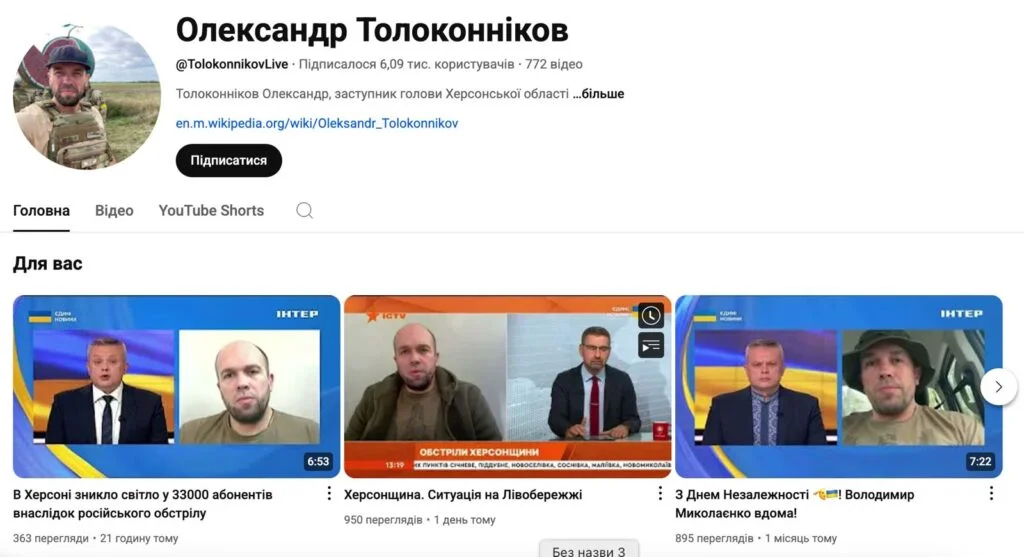
However, recordings of broadcasts predominate over original content here, and the channel is rather a collection of the author’s TV appearances. The deputy head of the RMA has over 6 thousand subscribers, and videos gain up to 2-3 thousand views.
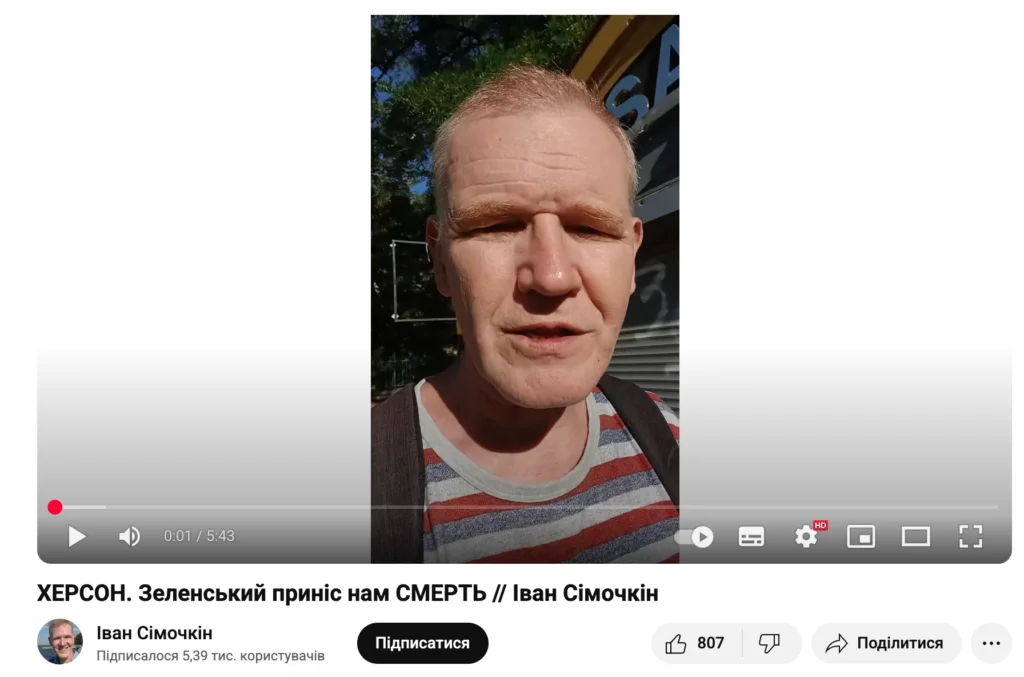
Equally popular are two bloggers from the same party – European Solidarity activist Ivan Simochkin and Kherson city council deputy from the same political force, Oksana Pogomiy.
Simochkin has 5.4 thousand subscribers on his YouTube channel, which he has maintained since 2007. He started it while still living in Moscow (Russia). In the late 2000s and early 2010s Simochkin blogged on LiveJournal and hardly used his YouTube channel.
In January 2022 he returned to Kherson and already in March began publishing videos from rallies against the Russian occupation. He began properly running his video blog from the beginning of 2024, publishing his thoughts about politics, the war and Kherson.
Currently the channel’s content consists of the author’s monologues recorded on the phone’s front camera, reports about the condition of the city’s streets and political vlogs. These videos gain from several hundred to a few thousand views. And whereas earlier these were almost entirely reposts of the author’s vertical videos from TikTok, the last two videos on the channel have been recorded more professionally and for YouTube. Obviously, as an activist of the European Solidarity party, he actively criticizes President Zelensky, praises ex-president Poroshenko and his supporters, and sometimes resorts to conspiracy theories mainly about Volodymyr Zelensky.
City council deputy Oksana Pogomiy has been active on social networks for many years, but she started developing her own YouTube channel relatively recently — in May 2024. It currently has 2,650 subscribers and 300 videos. As with Simochkin, the vast majority of the videos are TikTok clips with a strong political tint. This includes criticism of the authorities, praise of the European Solidarity party and volunteer initiatives affiliated with it. Pogomiy also collects recordings of all her TV appearances on the channel, mainly on Pryamyi and Espreso. Views on the deputy’s channel range from several hundred to a few thousand, but some videos get 30-40 thousand.
And recently Simochkin and Pogomiy began recording joint videos in which they summarize the week’s news.
Viewers: who shows the world what Kherson looks like now
Separate are channels whose authors rarely express themselves on socio-political topics but have popularity and a certain influence on the audience. These are so-called overview channels, whose authors make tours of Kherson, film streets, yards and landmarks. Their popularity began in 2022 after the occupation of Kherson. At first the audience of such YouTube channels consisted of people interested in events in the occupied city, but the more people left the city, the more often they watched these channels, which was clearly visible from the comments.
Some channels and bloggers even made videos on request when a person who had not lived in Kherson for some time asked to film their street or neighborhood.
Currently no more than ten such channels remain, as their authors gradually left the city, which is constantly under shelling.
One of the most popular is local blogger Oleksandr Khaitas, who works in a service center and repairs electronics. His channel has 19.5 thousand subscribers, and videos get tens, and sometimes hundreds of thousands of views.
He regularly films city overviews, the results of strikes and other events important to the Kherson audience. The author’s archive from the time of Kherson’s occupation can become an interesting and important source for studying that period.
The channel “Nash Kherson” with more than 72 thousand subscribers was founded back in 2019. Its author is unknown, but most likely has ties to the Kherson Regional Military Administration. Most content is duplicated or made from videos published on the Kherson RMA channels. The channel publishes repackaged interviews, clips about the consequences of shelling and similar content.
There is rarely original content here, but each clip still gains its 5-10 thousand views. 
The most views on the channel were gained by clips about the consequences of the Russians’ blowing up of the Kakhovka HPP. Photo: screenshot of the Nash Kherson channel
The most popular reports were shot for the channel back in the summer of 2023, during the city flooding after the Kakhovka HPP explosion. They had from two to three million views.
Pro-Russian YouTube channels about Kherson region
There are not that many pro-Russian channels about and for Kherson region. Even fewer remained after the de facto blocking of YouTube in Russia and in the temporarily occupied territories, although some channels are still active and publish content.
The once-popular channel of Kherson collaborator Kostiantyn Shulha “Konstantin S” has not been updated for over two years. Shulha himself is engaged in forming and leading groups of spotters that operate in Kherson, so he abandoned the blog. Although the channel was popular and currently has over 28 thousand subscribers.
The channel “Victoria S”. Do shows signs of life. Before the full-scale invasion it was a typical channel of a local blogger, an older woman who filmed dozens of clips about the city, her dog, market prices and other important things on her phone. The channel now has 32 thousand subscribers, and videos averaged 1-2 thousand views. At the beginning of the full-scale invasion Victoria was already saying goodbye to life, expecting that the Russians would wipe Kherson and her from the face of the earth.
But then she gradually returned to her usual topics, involving her husband Mykola Zhuro in filming. By the end of spring 2022 Kherson bloggers had changed their rhetoric to pro-Russian and began propaganda work. For pro-Russian calls and praising the illegal referendum the SBU opened a case against Zhuro and in 2024 he received a guilty verdict and a sentence of 10 years in absentia.
By then, the family of collaborating bloggers had already been living in occupied Kerch, where they fled with the Russians in November 2022. In Crimea the bloggers received some housing and continued filming their blogs. Zhuro began wearing Z-symbolism, and his wife off-screen continues to engage in propaganda.
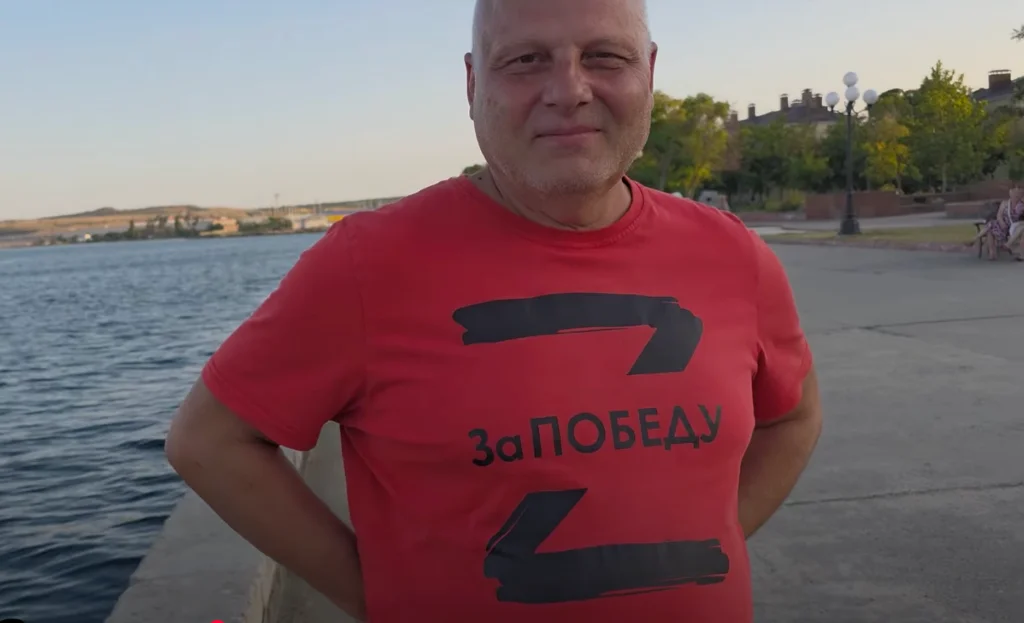
In addition to ordinary walks and her assessments of the situation, apparently inspired by Russian television, the woman added other types of content. Not so long ago the collaborator began reading out news from Russian media over video sequences. The blogger couple actively asks the audience for money and, according to them, often receive it.
The most popular videos on the channel were shot during the occupation, but last year’s report about prices in temporarily occupied Crimea gained a million views.
In 2022 attention was focused on occupied Kherson and all bloggers producing content from the city received good views. Currently, content on the YouTube of former Kherson residents, which is effectively blocked in Russia and in the TOT, appears less often and is watched by fewer people.
Overall, we must state that YouTube in Kherson is a new platform for socio-political journalism that is gradually shaping the local information agenda. Despite limited resources and the danger of working in wartime conditions, editorial projects, author blogs and amateur initiatives are emerging here.
Importantly, the audience is growing: people are looking for an alternative to official channels, timely information and the living voice of their fellow citizens. This is what makes local YouTube a unique phenomenon in the region’s media landscape.
The future of this niche depends on how well authors manage to balance professional journalism, blogging and the needs of the community, which now especially craves reliable and life-close sources of information.
Sergii Nikitenko, regional representative Institute of Mass Information in Kherson region