

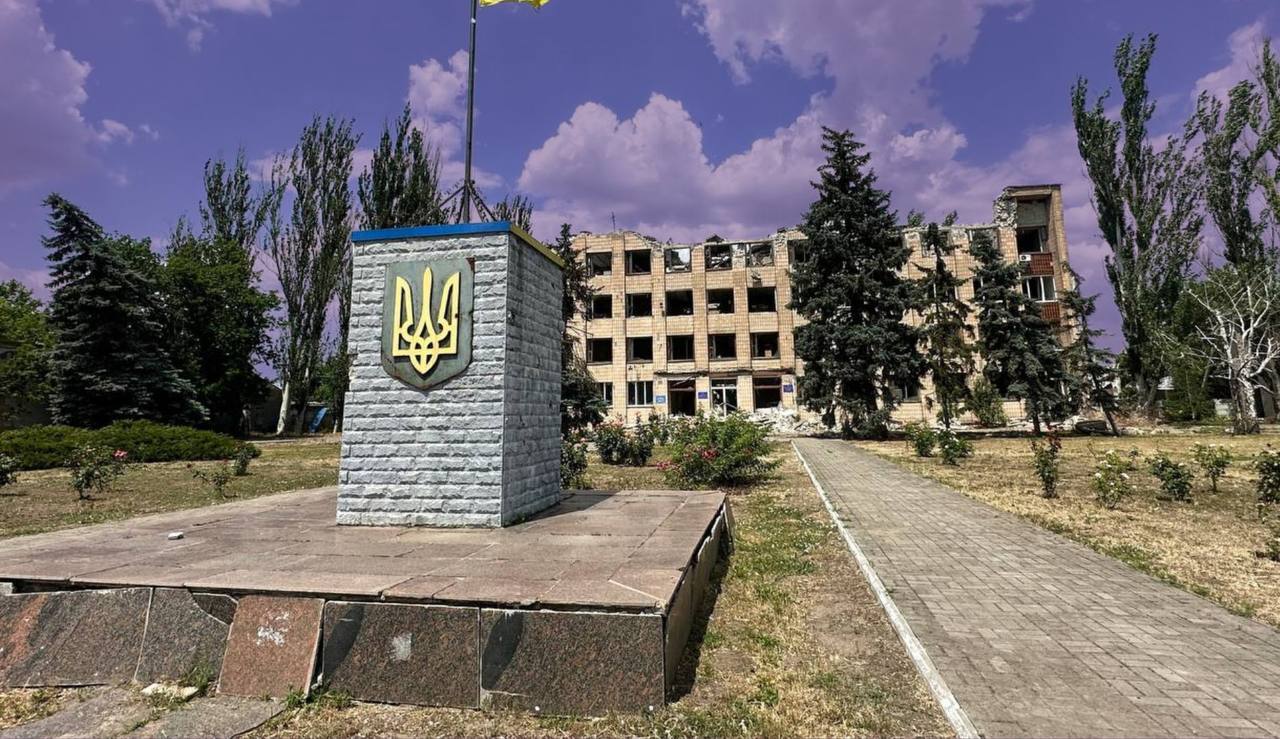
Russia’s full-scale invasion has caused catastrophic damage to the eastern and southern territories of Ukraine. Thousands of homes of residents of Kherson and Donetsk regions have been damaged or destroyed. Communities where infrastructure and the housing stock have been destroyed are exhausted and unable to cover losses at their own expense.
In a joint article by “Skhidnyi Variant” and “MOST” we describe reconstruction decisions for frontline communities that are already working today
The war unleashed by Russia has destroyed thousands of Ukrainians’ residential buildings
Since the beginning of the Russian military invasion in 2014, thousands of Ukrainians’ houses were destroyed during hostilities. When Russia carried out an open escalation, it began to openly terrorize the civilian population, deliberately directing missiles and strike drones at civilian residences.
From February 24, 2022 to July 24, 2025, more than 138 thousand residential buildings were damaged or destroyed in Donetsk region. Of these, on the territory controlled by the region nearly 42 thousand houses were damaged or destroyed, of which almost 4 thousand are apartment buildings and nearly 38 thousand are private houses. This was reported to Skhidnyi Variant in a comment by the Director of the Department of Housing and Communal Services of the Donetsk Regional Military Administration, Serhii Boievskyi.

“On the temporarily occupied territories of the Bakhmut, Svitlodarsk, Soledar, Toretsk, Velykonovosilkivska, Vuhledar, Volnovakha, Komar, Myrne, Olhynka, Staromlynivska, Khlibodarivka, Illinivska, Mangush, Mariupol, Sartan, Avdiivka, Hrodivka, Kurakhove, Maryinka, Novohrodivka, Selydove, Ocheretyne communities more than 96 thousand residential buildings were damaged or destroyed, of which 5 thousand are apartment buildings and 91 thousand are private residential buildings,” Boievskyi said.
On the right-bank part of Kherson region Russian shelling damaged or destroyed nearly 33 thousand private and one and a half thousand apartment buildings. This was reported by the head of the Kherson OVA, Oleksandr Prokudin.
“Some buildings have already been damaged ten times, the Russians continue to strike there,” — says Prokudin.
The number of affected houses is constantly growing in all frontline regions, because the Russian army does not stop its strikes for a day.
During the first seven months of the full-scale invasion the line of combat passed through the Vysokopilska community in Kherson region. Part of the community was under occupation. The Ukrainian army advanced, but, according to the head of the Vysokopil village military administration, Kostyantyn Starodumov, even those settlements that were liberated quite quickly found themselves back on the front line and kept getting hit.
“Therefore we cannot say that we have settlements that survived,” — says Starodumov.

Before the Russian full-scale invasion this community had over 12 thousand residents — 22 settlements. After de-occupation, a little more than a thousand remained.
Administrative buildings, CNAPs, hospitals, FAPs were damaged or completely destroyed. That’s 99.9%. Damage to the housing stock — about 75%. The official date of liberation of the community is October 4, 2022.
“During the seven months of occupation and hostilities people lived entirely without electricity, water and gas. Mostly these were damaged networks. The first broken transformers mean the impossibility of servicing them. Hence the lack of electricity, which paralyzes the whole system,” the official explains.

After de-occupation, Starodumov recalls, the first thing they tried to do was to save what remained. Some residents wanted to return home as quickly as possible. Even if the main building was destroyed, they settled in the summer kitchen, which in places also had to be patched up.
“We were then entering winter. It was necessary to quickly cover the roofs for these people. So the first humanitarian convoys that went here carried building materials. We could not meet these needs on our own. To provide plastic sheeting, tarpaulin — a dense material, roofing slate,” — explains Starodumov, adding that, in his view, no single community or even region could have covered such large expenses alone. Moreover, there was a need for human resources. At first it was retirees who returned to the community, not young people.


Key reconstruction decisions: Kherson region experience
For the Vysokopil community it all began with a major offensive by the Ukrainian Defense Forces on the right bank of the region. This community was liberated among the first. All government bodies immediately went to the sites.
“These were representatives of the central government. And then, as I understand it, the President of Ukraine’s idea appeared to support deoccupied Kherson communities by rear regions — the ‘Plich-o-Plich’ (Shoulder-to-Shoulder) project. This is a national project to unite partner communities (rear and central communities of Ukraine) to support and restore frontline communities (communities located along the border and on the line of combat) where a significant part of infrastructure objects is damaged and destroyed. Since the spring of 2023 we were supported by Cherkasy, Dnipropetrovsk, Chernivtsi, Ternopil, Khmelnytskyi, and Kirovohrad regions. These regions provided assistance. At that time the task was to help with all available forces and means, but there was no understanding of how exactly we would do this,” recalls the head of Vysokopil SVA Kostyantyn Starodumov.
Loads of humanitarian aid and building materials went to the community. Volunteers arrived who repaired roofs and installed windows. Representatives of the State Emergency Service from all regions of Ukraine carried out demining.

“At that time the main idea was that the partner community provides money and contracting organizations that would perform the work. That is, we pay these contractors from those funds and taxes return back to the community that sent the funds, so it is like a circulation of those budget monies,” — explains Starodumov.
Thus, in 2023–2024 the Vysokopil community managed to restore or fix more than a thousand households.
“It should be understood that we still could not bring everything to perfection, so we tried to combine other state aid and charitable organizations: for example, the roof was done by donors from one region, the windows were provided by another, and the state program ‘eVidnovlennya’ was directed straight to interior repairs,” — explains Starodumov.
Thanks to the first phase of the ‘Plich-o-Plich’ project the Vysokopil community repaired most of the school and restarted offline classes. At the initiative of the head of the Cherkasy OVA Ihor Taburets Cherkasy region equipped a shelter in the school.


When partner communities arrived in Kherson there were no official instructions or prescribed algorithms yet. There was only one request: help us restore what was destroyed. And each community responded in its own way — based on its own capabilities, resources and the human desire to help.
Concrete help was provided for concrete needs. Partner communities provided what they had: some brought drinking water and food packages, some — building materials (roofing slate, metal roofing, lumber), others — sent funds to restore one specific settlement.
This allowed problems to be solved point by point.
“Representatives of partner communities personally came to our settlements. They communicated with people, spoke with us, collected needs. They tried to organize everything so that the partner would restore at least one social facility (FAP, starosta office, resilience hub) in a particular settlement,” — says Starodumov.
With experience came understanding: repairing apartment buildings is more effective than scattered restoration of private housing.
“The partner community from Khmelnytskyi region began by helping to rebuild private households. Then we and they realized that it is more appropriate to bring a block of apartment buildings in order. Essentially, these are two-storey apartment houses — and there are 17 of them. Roughly speaking, by repairing one building we cover more people than by repairing one private house at a time,” — says Starodumov.
This allowed not only to do more with the same resources, but also to create a concentration point of life to which later neighbors and services gravitated.


They also introduced a flexible model: everyone gives what they can. Some communities could provide contractors, others — building materials or funding. Often it was a mix: builders from the partner community or hired local residents; part of the materials from the local budget, the rest from donors; design work funded by a state subsidy.
Such a co-financing system allowed assembling a “puzzle” even when none of the actors could cover all needs alone.
In 2023–2024 partner communities went further. They did not limit themselves to restoring homes and infrastructure objects. Ideas for restoring the social sphere were also implemented.
“They told us: ‘Let’s bring your children to us for a rest! We have the capacity to host children.’ And it started. I understand that each of our communities sent children to rest and recuperate with their partner communities,” — says Starodumov.
On January 31, 2025, Cabinet of Ministers resolution No. 97 was issued, which launched a two-year experimental project ‘Plich‑o‑Plich: Cohesive Communities’ and this, according to Kostyantyn Starodumov, is a sort of second stage of the project that took as its basis the developed models of interaction between Kherson communities and other rear regions.
What worked best for the Vysokopil community?
- Localization of responsibility: one community — one object.
- Flexible resource model: “give what you have.”
- Involvement of locals: both in construction and in life.
- Emphasis not only on “restore the roof” but on “restore life.”
Regarding the main obstacles in implementing the reconstruction process in the Vysokopil community, Kostyantyn Starodumov notes a personnel shortage. Many local residents left the community. Bureaucratic moments — — are things that can be dealt with.
“We must understand that we have bureaucracy which we must follow. And it is extremely difficult to combine several funding sources into one object. But these are our working days, so we cannot say that it is impossible. We must approach this thoughtfully. Only thanks to the ‘Plich-o-Plich’ project were we able to restore, repair more than a thousand households. That is, somewhere only the roof, somewhere only the windows, but they were combined like that. Then state support connects — ‘eVidnovlennya’, then donors come who constantly help people. It should be understood that we have quite a lot of completely destroyed households and people receive certificates for them. There are over 300 such households, so people can buy housing in a safer place,” — explains Kostyantyn Starodumov, head of Vysokopil SVA.
As for the social impact, if at the time of deoccupation there were about a thousand people in the community, in 2023 the population increased to 2 thousand, and today it is over 6 thousand people, of whom over a thousand are children. People are returning, and this is the main indicator that the community is recovering, the territory is being restored and there is hope for future life.
Key reconstruction decisions: Donetsk region experience
In Donetsk region recovery of communities is much more difficult. Because towns and villages that two years ago were considered the conditional “rear” are now on the line of combat.
Kostiantynivka before the war was one of the largest industrial centers of eastern Ukraine. Enterprises of black and non-ferrous metallurgy, glass, chemical and construction industries operated here. The city was an important transit railway hub of the region.
After the start of the full-scale Russian invasion the Kostiantynivka community for several years was a relatively safe territory. Internally displaced people came here, shops and markets worked, utilities operated — the city lived its life despite the proximity of the front and the threat of shelling. This year, due to the enemy’s advance from the Toretsk and Chasiv Yar directions, Kostiantynivka has become closer to the line of combat. The enemy shells the city daily, destroying hundreds of residential buildings.

As of the end of July on the territory of the Kostiantynivka community more than 4 thousand private and 457 multi-storey buildings were damaged. Some of them are unsuitable for restoration at all.
“Given the fact that the Kostiantynivka community is in the zone of active hostilities and suffers daily from dense missile, aviation, artillery shelling and drone attacks, capital repairs in multi-storey residential buildings are not being carried out. Where possible we perform current repair works,” — reported the head of the Kostiantynivka city military administration Serhii Horbunov.

When the security situation allowed, mechanisms for housing recovery worked in the community from the city council and charitable organizations. After shelling, communal services worked on site: boarded up broken windows, sealed holes with tarpaulin and mounting foam, provided assistance to those affected. Charitable organizations “Angels of Salvation”, “Avalist”, “Chemoniks”, “Solidarites International” helped the population with building materials.
To date charitable organizations have provided aid for emergency recovery to almost 7 thousand households. Now, due to the escalation of the frontline situation, assistance from donors is suspended.
“At the expense of the local budget we created and use a material reserve of the community, from which assistance for emergency restoration of damaged housing stock is also provided. Owners of damaged houses are given building materials in the form of sheeting, OSB boards, mounting foam, boards, battens, tarpaulin. This year from the community material reserve we have already helped 5 thousand households,” — said Serhii Horbunov.
In other frontline communities where possible, international and Ukrainian organizations help the population to restore their homes. In particular, the charity fund “Angels of Salvation” works on both emergency and long-term recovery in Donetsk region. Its teams operate at shelling sites and distribute construction kits. A basic set of materials is formed: sheeting, OSB boards, roof overlays. They are distributed in designated places which local authorities inform residents about.
“Our teams adhere to safety norms, do not carry out distributions during shelling, and if a large number of materials needs to be issued — distribute them over several meetings to avoid crowding. During distribution our distributors check whether installation assistance is needed for vulnerable categories of the population (or upon request to the hotline). If so, our repair crew ‘Workshop on Wheels’ arrives the same or next day and helps install the temporary covering. We also repair civilian premises of schools, libraries, hospitals,” — says Anastasiia Honcharuk, spokesperson for the charity fund “Angels of Salvation”.

Long-term recovery is the process from the moment damage is recorded to the full repair of housing. First the engineers of “Angels of Salvation” inspect the homes damaged by shelling and record the degree of damage. This primarily concerns elements of the thermal envelope: roof, windows, external and internal doors.
After inspection recipients are issued funds to purchase materials. If people cannot buy them independently — “Angels of Salvation” provide materials directly. Then a mobile crew “Workshop on Wheels” comes to the object and performs all repair works. Such assistance is provided only in cases where people cannot use the state program “eVidnovlennya”.

In the first half of 2025 “Angels of Salvation” provided building assistance to more than 14 thousand households — that is more than 22 thousand people in 92 settlements of Donetsk region.
“Unfortunately, these are tragically large figures, so we will continue to provide assistance to people as long as it is necessary,” — said Anastasiia Honcharuk.

***
The Russian army systematically strikes civilian objects, kills civilians, destroys their homes. In conditions of constant threat, thanks to state and charitable initiatives Ukrainians can repair housing “here and now”. Full-scale recovery, as is reasonable to assume, will await the frontline communities only after the end of hostilities.
Material created jointly with the online publication “Skhidnyi Variant”. Authors: Inha Pavlii, Natalia Maistrenko, Serhii Nikitenko, Olena Hnitsetska